Welcome to our next lesson. In our previous session, we focused on using participle and reduced relative clauses to make your writing more concise and stylistically varied. This is a key part of demonstrating the grammatical range needed for a top IELTS score.
Today, we will address another critical area of grammatical accuracy that distinguishes a Band 7 from a Band 8 or 9. This lesson is designed to help you achieve the learning outcome: Apply correct article and determiner usage in complex academic contexts. While articles (a, an, the) may seem like small words, examiners view repeated errors in their usage as a systemic weakness. Mastering them is not about memorizing endless rules, but about understanding the logic of specificity and generality in English, a skill essential for the precision required in academic writing.
Why Articles Matter for a High Band Score
For a writer already at Band 7, the path to 8.5 involves eliminating frequent, "small" errors that create an impression of carelessness or a lack of full grammatical control. Article mistakes are a classic example.
The article from Learn English Weekly explains this well. It's not that a single error is disastrous, but a pattern of mistakes with a, an, and the signals to the examiner that you haven't fully mastered this fundamental aspect of English.
Articles IELTS Writing: A, An, The Explained Clearly
To begin, let's frame the importance of this topic in the context of the IELTS exam. Please read the introduction and the section on why articles are so significant.
Read the sections Why Articles Matter and How Examiners Notice Errors. As you read, consider how an examiner's impression is formed by the consistency of your grammar, not just its complexity.
The Core Principle: General, Specific, and Unique
At its heart, article usage is about signaling to your reader whether you are talking about a general idea, a specific example, or something unique. Getting this right makes your writing clear and logical.
This simple image illustrates the core distinction perfectly.
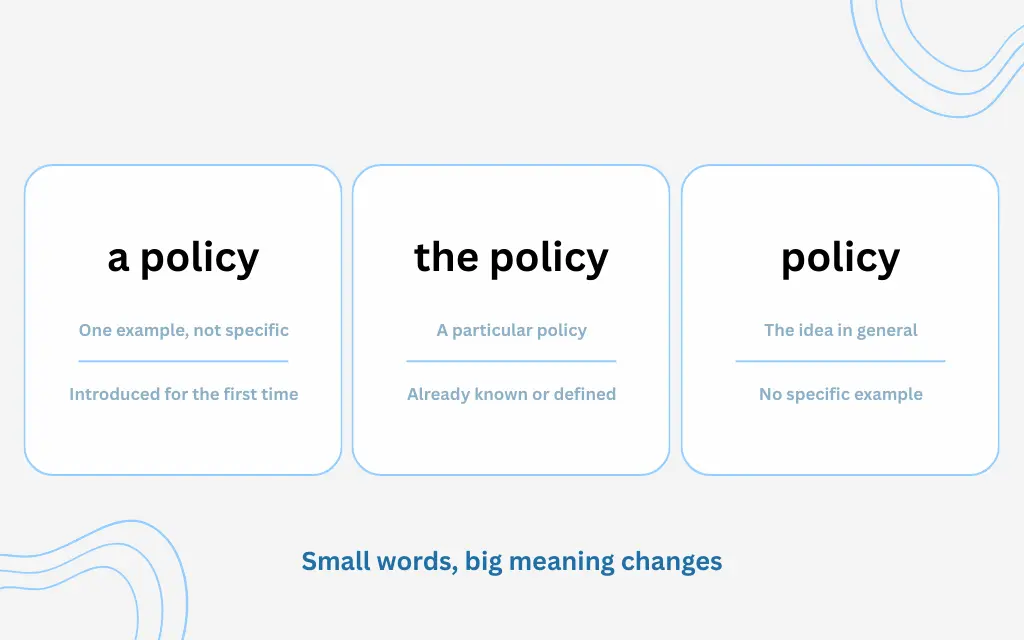
Let's break this down:
a/an(Indefinite Article): Used to introduce a singular, countable noun for the first time, or to refer to any one member of a group. Example: The government proposed a new solution.the(Definite Article): Used when the noun is specific, unique, or has been mentioned before. The reader knows exactly which one you mean. Example: ... The solution involved increasing taxes.- Zero Article (Ø): Used to talk about things in general using plural or uncountable nouns. Example: Effective solutions are needed to address poverty.
This is the fundamental logic that underpins almost all article rules.
The Most Common Pitfall: Countable vs. Uncountable Nouns
One of the most frequent sources of article errors for advanced learners involves uncountable nouns. Many words that are countable in other languages are uncountable in English, especially abstract concepts vital for IELTS Task 2.
Common uncountable nouns in academic writing include: information, research, evidence, advice, knowledge, progress, traffic, equipment, furniture.
You cannot use a/an with these words, nor can you make them plural.
- Incorrect: The study provides an important evidence...
- Correct: The study provides important evidence...
- Correct (if you need to count it): The study provides a piece of important evidence...
The following video from Wordvice Editing Service offers a very clear explanation of how the distinction between countable and uncountable nouns affects article choice.
Using Articles (a, an, the) in Academic Writing
This video clearly explains the rules for using articles with countable and uncountable nouns, which is a critical concept.
Please watch the segment from uncountable vs countable nouns. Pay close attention to how uncountable nouns can take either the (for specific instances) or the zero article (for general meaning), but never a/an.
Mastering the Zero Article in Academic Writing
Using "no article" correctly is a sign of a sophisticated writer. It's how you make broad, general statements, which are essential for introductions and topic sentences in IELTS essays.
The zero article is primarily used in two situations in academic contexts:
- With plural countable nouns to make a generalisation:
- Universities should focus on developing critical thinking skills. (Not "The universities..." if you mean all universities in general).
- With uncountable nouns to refer to a general concept:
- Education is often seen as the key to economic development. (Not "An education..." or "The education..." when speaking generally).
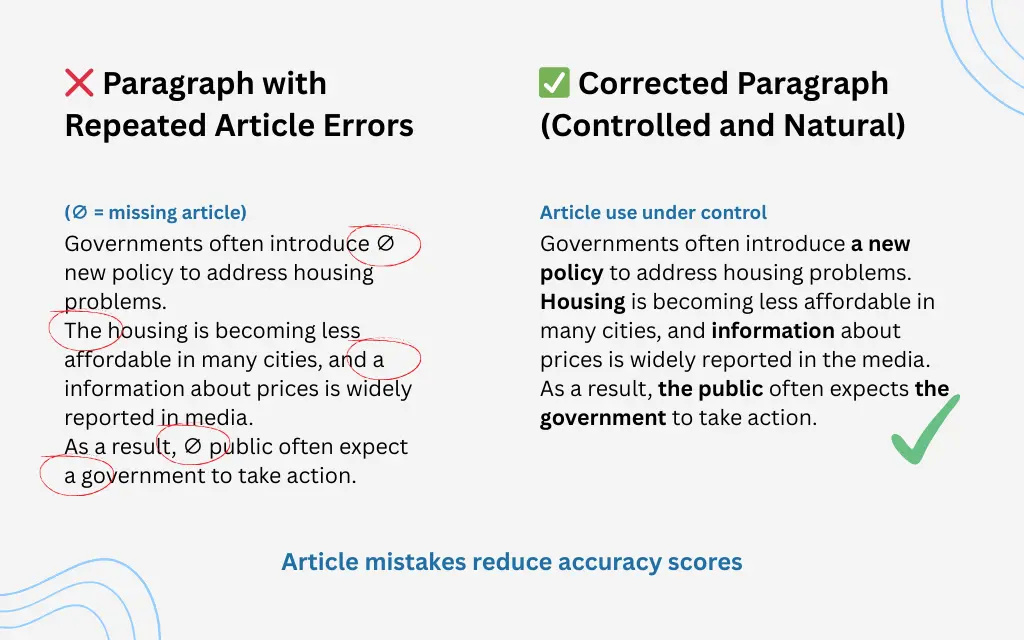
The image below shows a paragraph where incorrect article use (including overuse of the and misuse of a) makes the writing sound unnatural. The corrected version uses the zero article for general concepts like "housing" and "information".
Advanced Rules and Academic Patterns
To elevate your writing to a Band 8.5 level, you need to control articles in more complex situations. The guide from Proof-Reading-Service.com provides an excellent overview of patterns specific to academic writing.
Basic Parts of Speech in English: Nouns, Pronouns and Articles – Proof-Reading-Service.com
This resource goes into the specific conventions of academic writing, which will help you apply these rules with greater precision.
First, review the basic definitions under section 4, from the start of the section. Then, focus carefully on the table in section 4.4, titled Academic patterns. This table is particularly useful as it covers common IELTS contexts like fields of study ("She studies neuroscience") and first vs. subsequent mentions ("We propose a model... The model...").
Here are a few more advanced rules that often appear in IELTS topics, covered brilliantly in the LetThemTalkTV video:
- Geographical Names: Use
thefor countries with plural names or names including a noun like 'kingdom' or 'states' (the Netherlands,the UK,the Philippines), but use the zero article for most others (Germany,Vietnam,Brazil). - Social Groups: Use
the+ adjective to refer to a group of people (the rich,the poor,the unemployed). - General Places vs. Specific Buildings: The meaning of words like
school,prison, andhospitalchanges with the article.He is in **hospital**.(as a patient)I went to **the hospital** to visit him.(the specific building)
Practice and Self-Correction
Applying these rules under pressure is the final step. A systematic approach to editing your own work can help you spot and correct article errors.
- Practice Exercises: First, test your understanding with a few practice questions.
Basic Parts of Speech in English: Nouns, Pronouns and Articles – Proof-Reading-Service.com
Now, let's apply what you've learned.
In the section "Practice: Try These", please complete questions 1, 4, and 6, which focus specifically on article usage. Check your answers below the questions.
- Develop an Editing Habit: Incorporate an "article check" into your writing process.
Basic Parts of Speech in English: Nouns, Pronouns and Articles – Proof-Reading-Service.com
This resource provides a practical, step-by-step method for proofreading your own work for common errors, including articles.
Read the section titled A Short Editing Workflow. I strongly recommend adopting step 1: "Underline every article" when you review your practice essays. For each one, ask yourself: Is this noun specific or general? Is this the first time I'm mentioning it? Is it countable or uncountable? This habit will build your intuitive sense for correct article use.
Conclusion
In this lesson, we have deconstructed the logic behind English articles and determiners, moving from core principles to the nuanced rules expected in high-level academic writing. Correct article usage is a powerful indicator of your grammatical control and precision.
Key Takeaways:
- Articles signal the specificity of a noun to the reader.
- The distinction between countable and uncountable nouns is a primary source of errors. Nouns like
research,information, andevidenceare uncountable. - The zero article is essential for making general statements with plural and uncountable nouns.
- Mastering articles is about developing awareness and a systematic checking process, not just memorizing rules.
In our next lesson, we will continue to refine your grammatical accuracy by focusing on another structure that adds elegance and clarity to your writing: "Use parallel structure accurately in lists, comparisons, and paired constructions." This will help ensure your complex sentences are not only sophisticated but also grammatically sound and easy to read.