Welcome to the final lesson in our module on Advanced Grammar and Syntax. Over the past several lessons, we've dissected complex grammatical structures, from conditional clauses to the parallel structures we discussed last time. Now, we will transition from mastering individual components to ensuring the integrity of the entire structure.
Today's lesson focuses on a skill that is paramount for shifting your score from a 7.0 to the 8.5 range: how to self-edit a piece of writing systematically to eliminate grammatical errors. While a Band 7 writer often produces error-free sentences, a Band 8 writer does so with much greater consistency, leaving only occasional, minor slips. This difference doesn't come from simply knowing more grammar; it comes from having a rigorous, disciplined process for finding and fixing mistakes under pressure.
By the end of this lesson, you will have a clear, step-by-step method for proofreading your IELTS essays, turning the final, crucial minutes of the writing test into your most powerful tool for score improvement.
The Non-Negotiable Final Five Minutes
In the high-pressure environment of the IELTS exam, it's tempting to use every second to write more. However, the highest-scoring candidates know that the final few minutes dedicated to editing are not a luxury but a necessity. Writing without checking is like building a complex machine and never testing it—you are simply hoping it works.
A well-managed writing task allocates specific time for planning, writing, and, crucially, editing.
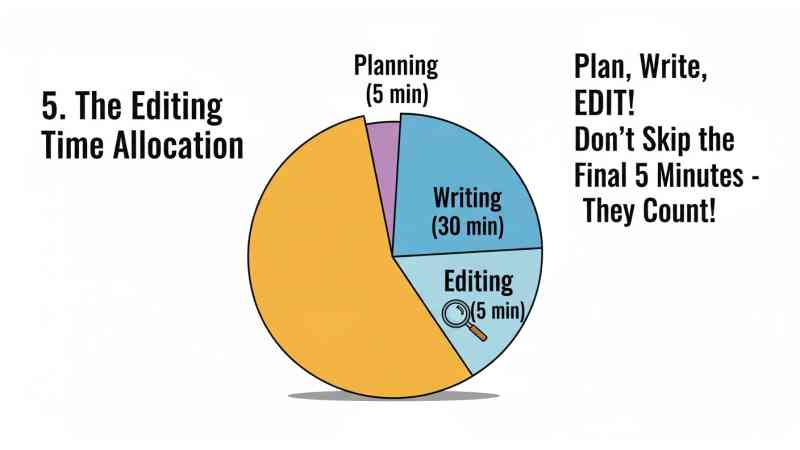
As the chart emphasizes, those final five minutes are critical. This is your opportunity to catch the small but costly errors that can prevent an otherwise strong essay from achieving a top band score. Let's build a system to make the most of that time.
From Random Scan to Systematic Hunt
The key to effective editing is to be systematic. Simply "reading over" your essay is inefficient because your brain, which just wrote the text, will often see what it meant to write, not what is actually on the page. A much better approach is to scan your essay multiple times, each time looking for a different type of error.
The following resource from IELTS Advantage outlines a simple but powerful structure for the entire writing process, culminating in the "Checking Stage."
The Only IELTS Writing Task 2 Strategy You Need in 2025
This article breaks down the writing process into three stages. We'll focus on the third.
First, familiarize yourself with the three stages presented in the table. Then, read the section "Stage 3: The Checking Stage," which proposes a 3-step process for reviewing your work. Pay close attention to how checking is layered: after each sentence, each paragraph, and a final full review.
This multi-layered approach ensures you're looking at your work from different perspectives—the micro-level of the sentence and the macro-level of the paragraph and full essay.
To get a more detailed breakdown of what to look for in each pass, the next video offers an excellent, actionable strategy.
How to Proofread your Own IELTS Writing Essays
This video from IELTS Energy TV breaks down proofreading into three distinct passes, each with a specific goal. This method prevents you from becoming overwhelmed and helps you focus your attention effectively.
Watch the entire video, taking note of the three-step strategy. Step 1: Structure. Note what to check for in Task 1 vs. Task 2. Step 2: Vocabulary. Focus on spelling and, more importantly, repetition. Step 3: Grammar. The presenter suggests focusing on two high-frequency error types: verb tense and subject-noun agreement (singular/plural). The key insight here is to hunt for one type of error at a time.
Your Grammar Error "Hit List"
The third pass—the grammar check—is where you will apply everything we have covered in this module. To be effective, you need to know what you're looking for. While you should check for any errors, it's efficient to have a "hit list" of the most common mistakes that candidates make.
The official IELTS partner, IDP, provides an excellent list of these common pitfalls. This is your checklist for the grammar-focused editing pass.
IELTS Writing Task 2: 8 steps towards a band 8
This article provides tips for achieving a Band 8. We will focus on the sections that detail common errors and provide a final checklist.
First, scroll down to "Step 7" and study the table of common grammatical errors. This is your hit list. Many of these, like articles, conditionals, and passive voice, should be familiar from our previous lessons. Next, review the comprehensive checklist under "Step 8: Checklist." While this list covers all four marking criteria, pay special attention to the final section, "Grammatical range and accuracy." This section turns the "hit list" into a series of direct questions you can ask yourself while editing.
Let's consolidate this into a single, powerful proofreading system you can practice and deploy on test day:
-
First Pass (1 minute): The Big Picture (Coherence & Task Response)
- Does my introduction have a clear thesis?
- Does each body paragraph have a single, clear main idea?
- Does my conclusion summarize my points without adding new information?
- Have I answered all parts of the question?
-
Second Pass (2 minutes): The Vocabulary Check (Lexical Resource)
- Scan for spelling mistakes and typos.
- Hunt for repeated words. Can I replace a repeated "important" with "crucial," "vital," or "significant"? Can I paraphrase a key concept instead of repeating the same noun?
- Is my language appropriately formal? (e.g.,
cannotinstead ofcan't).
-
Third Pass (2 minutes): The Grammar Hunt (Grammatical Range & Accuracy)
- Subject-Verb Agreement: Scan each sentence. Does my verb match my subject? (e.g., "The increase in prices causes hardship," not "cause").
- Tense Consistency: Am I using the correct tense? If discussing a past event, are all my verbs in the past tense?
- Articles (a/an/the): Check your nouns. Have I used articles correctly, especially with singular countable nouns?
- Plurals (-s): Have I added
-sto plural nouns? Have I incorrectly added it to uncountable nouns? - Punctuation: Does every sentence end with a full stop? Are commas used correctly in complex sentences and lists?
By using a focused, multi-pass system, you are far more likely to produce the clean, error-free writing characteristic of a Band 8 or 9.
Conclusion
In this lesson, we've constructed a systematic framework for self-editing, transforming it from a hopeful final glance into a methodical error hunt. You now have a process to ensure your grammatical knowledge is fully reflected in your final written product.
Key Takeaways:
- Allocate Time: Reserve the final 3-5 minutes of the writing test exclusively for editing.
- Use a System: Don't just "read over" your work. Use a multi-pass approach, checking for structure, vocabulary, and grammar in separate, focused scans.
- Know Your Targets: Use a "hit list" of common grammatical errors (subject-verb agreement, tense, articles, plurals) to guide your grammar check.
- Practice the Process: The more you practice this three-pass system in your preparation, the faster and more effective you will become.
This lesson concludes our module on Advanced Grammar and Syntax. You now have the tools to both construct sophisticated sentences and ensure they are grammatically flawless. In our next module, we will shift our focus to the second pillar of high-level writing: Advanced Vocabulary and Paraphrasing. Our first lesson will explore how to employ precise, topic-specific collocations to make your arguments more impactful and your language more sophisticated.