Welcome back. In our last lesson, we focused on crafting compelling voicemails to re-engage warm leads, ensuring your follow-up cadence has the best possible chance of success. We built the scripts and laid the groundwork for effective communication. But a script is only half the battle. How you deliver it—and how you manage the entire conversation that follows—is where mastery is forged.
Top performers in any field, from athletes to surgeons, share one common trait: they relentlessly review their own performance. An athlete watches game tape, a surgeon debriefs a procedure. For you, the equivalent is the call recording. Listening to your own calls is the single fastest way to improve your skills, identify blind spots, and accelerate your journey to mastering phone setting.
Today, we will focus on exactly that. Our goal is to conduct a self-review of a recorded practice call using a structured feedback framework. We'll move beyond simply listening back and cringing. Instead, you'll learn how to dissect your calls like a professional, using a systematic approach to turn every conversation into a learning opportunity.
The Professional's Mindset: Your Calls as "Game Tape"
Before we dive into frameworks and checklists, it's essential to adopt the right mindset. Reviewing your own calls can be uncomfortable, but it's a sign of professionalism, not weakness. The goal isn't to judge yourself, but to coach yourself.
To see what this looks like in practice, watch this short clip from sales coach Charles Rhodes. He reviews his own calls to find areas for improvement, treating them as "game tape."
Real Sales Call Review of a $50K/mo Closer (with Explanations)
This video introduces the concept of reviewing real sales calls for improvement. The presenter demonstrates a commitment to self-analysis, which is the mindset we want to cultivate.
Watch the first section of the video from the introduction, where he explains why reviewing real, unedited calls is so valuable. Then, skip to the end and watch his concluding thoughts from "always improving", where he reinforces the idea that even experts can get better.
As he says, "You can always be improving." This process is your path to doing just that.
Why a Structured Framework is Crucial
Simply listening to a call isn't enough. Without a plan, you'll likely focus only on what you remember feeling, miss key details, and struggle to define actionable next steps. A structured framework forces you to be objective and systematic.

This is where self-review becomes a powerful tool.
The Call Recording Method that Actually Works
This article from Hyperbound outlines a professional process for call reviews and explains the importance of the self-review step.
First, read the section titled "The Self-Review - Listen Alone First" to understand its core purpose. Then, find the FAQ at the bottom and read the answer to the question "Why is self-review important?". This reinforces the value of analyzing your own performance first.
By reviewing your calls privately with a structured approach, you take ownership of your development and make the learning process far more effective.
Building Your Scorecard: The 7 Categories of a Great Call
The foundation of our framework is a behavioral scorecard. Instead of vague categories like "good communication," we will focus on specific, observable actions that lead to successful calls.
This approach is powerful because it gives you concrete areas to work on. "Improve your discovery" is not helpful advice. "Ask at least three layers deep on a pain point" is an actionable instruction you can practice.
Sales Call Scorecard Template: 7 Categories That Actually Matter
This article from GradeMyClose provides an excellent, behavior-based scorecard. It's built from analyzing thousands of calls and is the perfect model for our Notion template.
First, read the introduction, "The Problem With Most Sales Scorecards," to understand why behavioral scoring is so effective. Then, study the main section, "The 7-Category Scorecard Template." Read the description and scoring benchmarks for all seven categories, from Call Opening to Active Listening. As you read, think about how these apply to your warm calls with prospects from your DM conversations.
These seven categories give you a comprehensive, 360-degree view of your call performance.
- Call Opening: How you set the stage.
- Discovery Quality: How well you uncover needs.
- Qualification: If you confirm they're a real opportunity (BANT).
- Value Presentation: How you connect their problem to your solution.
- Objection Handling: Your response to pushback.
- Closing & Commitment: How you secure the next step.
- Talk Ratio & Active Listening: The rhythm of the conversation.
What to Listen For: The Qualitative Details
Beyond the scorecard, you need to analyze the qualitative aspects of your delivery. Your tonality, pacing, and word choice can make or break a call.
The Call Recording Method that Actually Works
Let's return to the Hyperbound article. This section gives you a checklist of specific things to listen for.
Read the section "What to Analyze: Deconstructing Your Call for Breakthrough Moments." Focus on the five subsections from Pacing to Objection Handling. Pay attention to the "Actionable Tip" for each one.
Listening for these details is critical. For example, you might discover you speak too quickly when you're nervous or use filler words like "um" and "like" that undermine your authority. Catching these habits is the first step to fixing them.
In this next video, you'll see a reviewer give feedback on these exact points—tonality, note-taking, and specific word choice.
LIVE Appointment Setting Call Review | Sales Call Breakdown
This video from Remote Closing Academy is a live breakdown of an appointment setting call. It's a great example of how to provide specific, actionable feedback.
Watch two short clips. First, the importance of taking notes to capture pain points, which is something you'll be doing in Notion. Second, notice the feedback on tonality and word choice, where the reviewer suggests replacing "sorry" with a more neutral phrase.
Your Turn: Build Your Call Review Template in Notion
Now it's time to integrate this framework into your workflow. Given your experience with Notion for lead tracking, we will build a dedicated template for call reviews. This will become your personal "game tape" library.
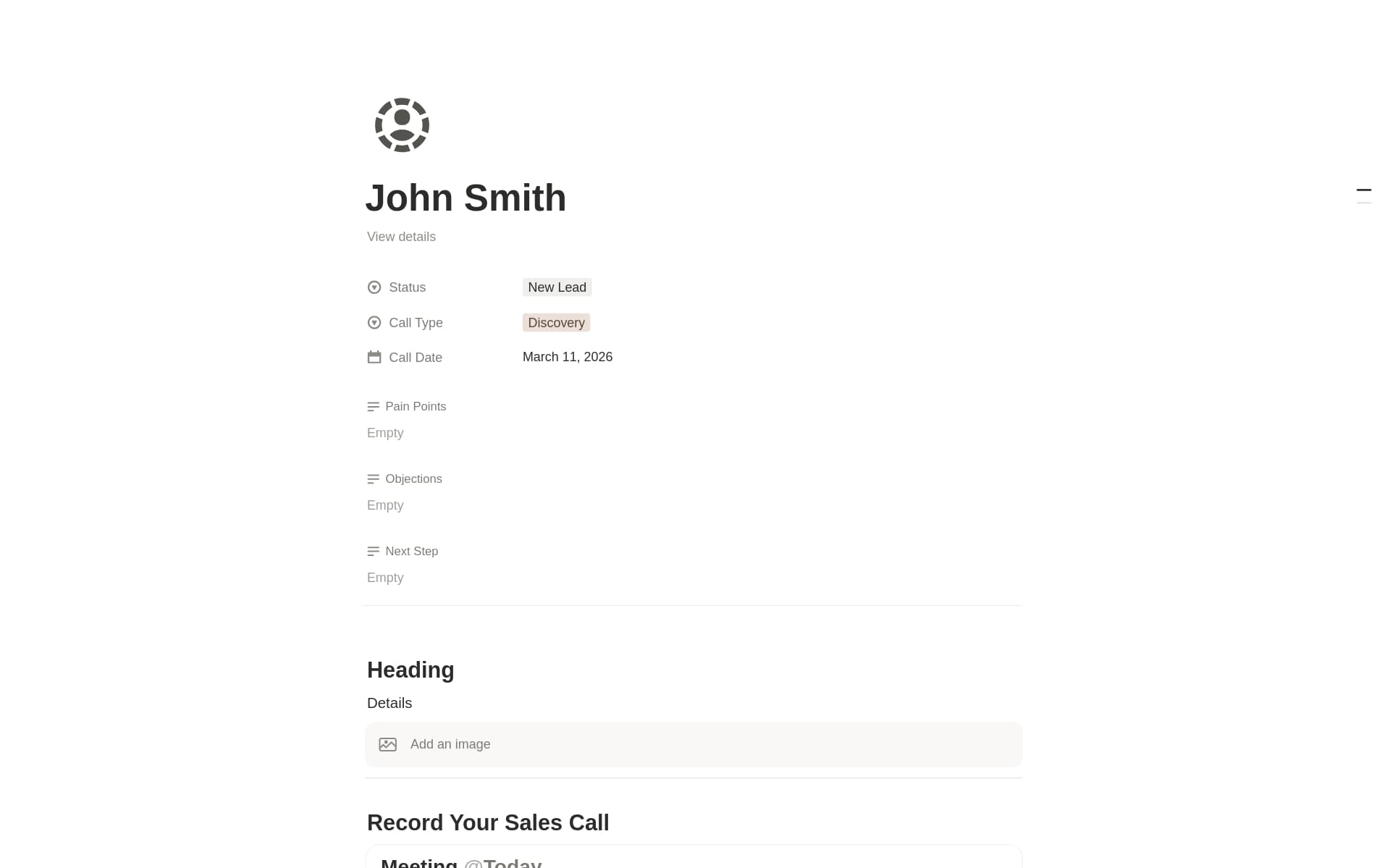
Instructions:
-
Go to your Notion workspace and create a new database page. Call it "Call Review Hub."
-
Create a new template within this database called "Call Review Template."
-
Add Properties: Configure the following properties for your template.
- Prospect Name: (Title property)
- Call Date: (Date property)
- Recording Link: (URL property)
- Call Type: (Select property with options like "Warm Follow-up," "Cold Call Practice," "Voicemail Practice")
- Call Opening (1-10): (Number property)
- Discovery (1-10): (Number property)
- Qualification (1-10): (Number property)
- Value Presentation (1-10): (Number property)
- Objection Handling (1-10): (Number property)
- Closing (1-10): (Number property)
- Active Listening (1-10): (Number property)
- Overall Score: (Formula property. Use the
prop()function to average the 7 scores above.)
-
Structure the Template Body: Inside the body of the template, create the following headings using H2 or H3 formatting. This is where you'll write your analysis.
✅ Key Strengths (What Went Well?)
- (Timestamp) - e.g., @01:15 - I built good rapport here by referencing our DM conversation.
- (Timestamp) -
🧠 Areas for Improvement (What could be different?)
- (Timestamp) - e.g., @04:32 - The prospect mentioned a concern, and I moved on without addressing it.
- (Timestamp) -
🎙️ Qualitative Analysis
- Pacing & Pauses:
- Tonality & Inflection:
- Filler Words & Qualifiers:
- Talk-to-Listen Ratio (Estimate):
🎯 One Actionable Goal
- Based on this review, my goal for the next call is to... (e.g., ...ask one more "why" question during discovery.)
Once you've created this template, you're ready to start recording and reviewing your practice calls. Start by practicing the voicemail scripts you wrote in the last lesson. Then, try a mock warm call with a friend or even by yourself, playing both roles.
Conclusion
You now have a professional, structured framework for self-improvement. By treating your call recordings as "game tape" and analyzing them with your new Notion template, you've created a powerful feedback loop that will accelerate your learning far beyond just making more calls.
Key Takeaways:
- Mindset is everything: View call review as a professional practice for improvement, not self-criticism.
- Structure is key: Use a behavioral scorecard to analyze calls objectively and identify specific actions to improve.
- The 7 Categories: A great call has a strong opening, deep discovery, solid qualification, tailored value, confident objection handling, a clear close, and balanced listening.
- Qualitative matters: Pay attention to your tonality, pacing, and word choice, as they significantly impact how you are perceived.
- Set one goal: After each review, define one single, actionable goal for your next call to ensure continuous, focused improvement.
In our next lesson, we will zoom out from individual call analysis. You'll learn how to analyze your logged call outcomes in Notion to identify patterns in your successful and unsuccessful interactions, turning your call data into strategic insights.