Hello! In our last session, we broke down the Acknowledge, Isolate, and Reframe (AIR) method, giving you a universal framework for handling genuine objections from warm leads. We established that an objection isn't a rejection, but an invitation to understand the prospect's world better.
Today, we're going to apply that framework to one of the most common hurdles in phone setting: the dreaded "Send me an email" request. Your goal for this lesson is to formulate a response to the 'Send me an email' objection that pivots back to a live conversation. Instead of seeing this as the end of the call, you will learn to see it as a critical mid-point, a moment where you can either lose control or guide the conversation to the next logical step.
Why "Just Send an Email" is a Trap
Whether you're calling a warm lead or a cold prospect, "Send me an email" is an objection you will hear constantly. But what does it really mean? It's rarely a simple request for information. It's usually one of two things:
- A Polite Brush-Off: The prospect is busy, uninterested, or uncomfortable saying "no" directly. The email is a conflict-free way to end the call.
- A Vague Interest / Delay Tactic: They might have a sliver of curiosity but aren't convinced it's worth their time to discuss now. They want to review the information on their own terms.
In either case, simply saying "Okay, I'll send one over!" and hanging up is one of the biggest mistakes a setter can make. The chance of that email ever being opened, let alone replied to, is incredibly low.
This video with sales expert Trent Dressel explains exactly why this objection is so critical to handle correctly and the cost of getting it wrong.
"Send me an Email” - Cold Call Objections and How To Overcome Them
In this clip, Trent breaks down the high cost of conceding to the "send me an email" request without a strategy.
Watch the section from the beginning of the video. Pay attention to his breakdown of the wasted time and effort that follows a poorly handled request, from crafting the "perfect" email to the fruitless follow-ups.
As you can see, your job isn't to just send an email. Your job is to understand the intent behind the request and keep the conversation alive.
Applying AIR: From Request to Conversation
Let's use the Acknowledge-Isolate-Reframe framework from our last lesson to build a powerful response.
1. Acknowledge: Agree and Take Control
Your first move is counter-intuitive: agree with them. Fighting the request will only create friction. By agreeing, you lower their defenses and keep control of the conversation.
- Prospect: "This sounds interesting. Can you send me an email?"
- You: "Absolutely. I'm happy to send that over. To make sure I have it right, is [email address] still the best one for you?"
You've agreed, maintained rapport, and confirmed a key piece of contact information. Now, you're in a position to pivot.
2. Isolate: Uncover the Real Interest
This is the most important step. Before you send a generic email into the void, you must qualify the request. Your goal is to understand what they are interested in, which forces them to engage mentally.
This infographic provides a simple but effective script for this exact moment.
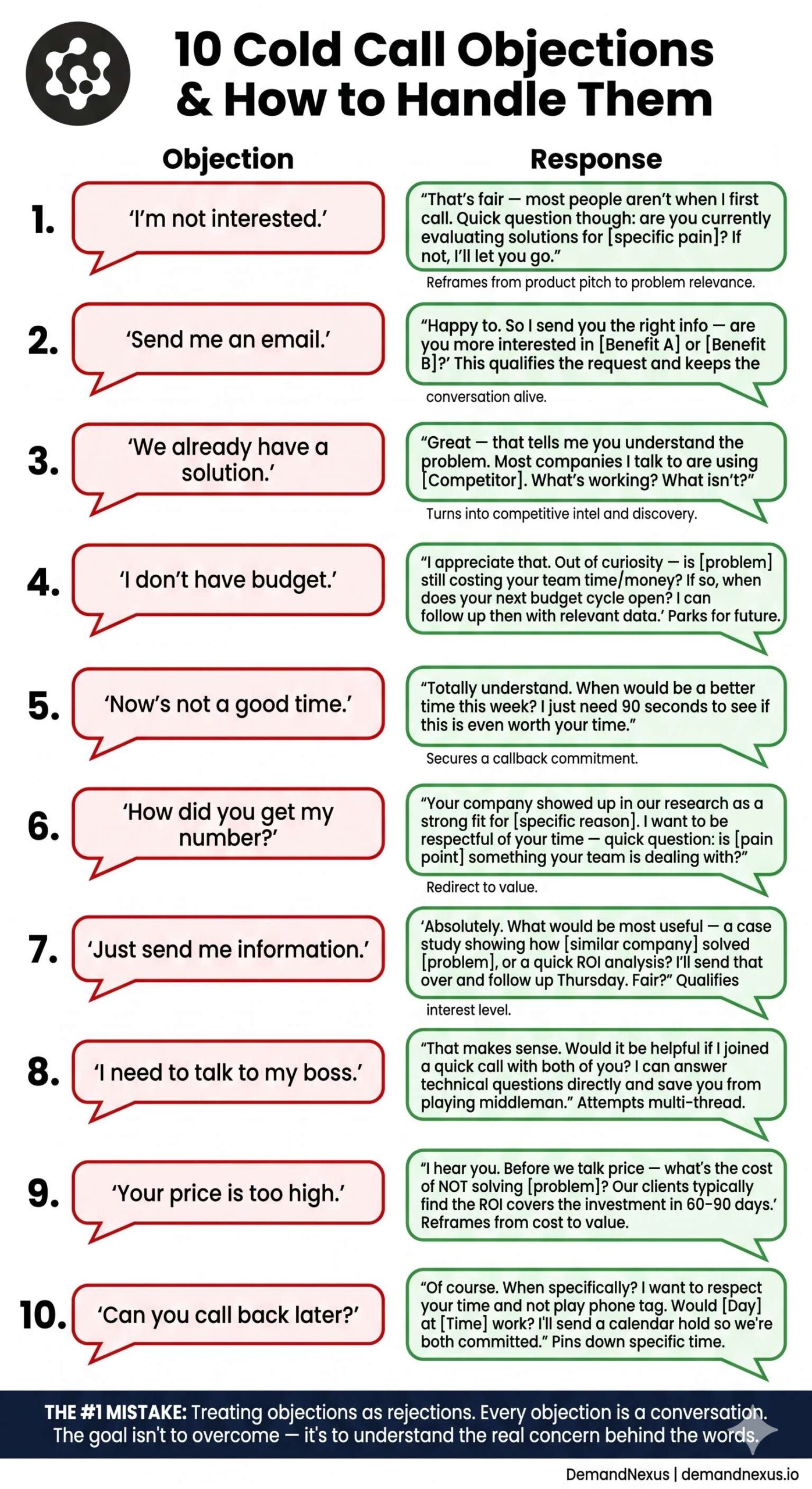
As you can see, the response is: "Happy to. So I send you the right info — are you more interested in [Benefit A] or [Benefit B]?"
This is brilliant because:
- It shows you're listening and want to be helpful.
- It forces the prospect to think about what you've said.
- Their answer (or lack thereof) tells you everything about their true interest level.
Here's a video that demonstrates this "question pivot" perfectly.
Common Sales Objections: "Send me an email" | Cold Calling Tips
Morgan Ingram from Sell Better explains that before you give them what they want (an email), you must ask questions to uncover what's really going on.
Watch this clip where he introduces the idea of asking clarifying questions. Focus on his key question from the first question: "Out of curiosity, what type of content would you like to see in this email?"
For your context with warm leads from DM, you can make this even more specific:
- "So I can send the right info, you mentioned in your DM you were struggling with [problem]. Are you more interested in learning how we solve [angle 1] or how we improve [angle 2]?"
If they can't answer or say "Just send me something general," you've likely uncovered a polite brush-off. This is valuable information. You can use a more direct approach to call it out professionally.
How to respond when a prospect asks for an email - LinkedIn
This LinkedIn post by Belal Batrawy offers a very direct script for when you suspect the request is a brush-off.
Read the part of the post that begins with this script. This is an advanced technique, but it's powerful because it protects your time and forces an honest answer.
3. Reframe: The "Give and Get" Contract
Once you've Acknowledged the request and Isolated what they're interested in, you can Reframe the next step. You're not just sending an email; you're setting up a future conversation. The best way to do this is with a "Give/Get" contract.
- You Give: The information they asked for.
- You Get: A scheduled time to discuss that information.
Here’s Morgan Ingram again, explaining this exact strategy.
Common Sales Objections: "Send me an email" | Cold Calling Tips
This clip introduces the "Give/Get" framework, turning the email send into a reason for the next meeting.
Watch from this segment. Notice how he positions the follow-up call not as a separate demand, but as a necessary part of understanding the information he's about to send. The key phrase is, "...what we found to be best...is to set up a conversation...does that sound fair?"
Putting it all together, a full response might look like this:
- Prospect: "Just send me an email."
- You (Acknowledge): "Happy to. Is your email still [email]?"
- Prospect: "Yes, that's right."
- You (Isolate): "Great. So I can make it relevant and not waste your time, what caught your interest most from our chat just now? Was it the part about [Benefit A] or [Benefit B]?"
- Prospect: "Umm, probably [Benefit B]."
- You (Reframe): "Perfect. I'll send you a short email with a case study on exactly that. What I've found is that the information makes more sense with a bit of context. I have a spot open on Thursday at 3 PM for a quick 10-minute chat to walk you through it. How does that sound?"
Alternative Scripts for Different Situations
Depending on the flow of the conversation, you might use slightly different tactics.
The "Tentative Invite" (Assertive)
This is for when you feel you have some momentum. You send the email and a calendar invite at the same time, giving them an easy way to opt out, which paradoxically makes them more likely to consider it.
"Send me an Email” - Cold Call Objections and How To Overcome Them
Trent Dressel outlines a more assertive strategy that leverages a "tentative placeholder" on their calendar.
Watch his final word-for-word talk track, starting from this point. The key is giving them the power to decline the invite after they've seen the value in your email.
Conclusion
"Send me an email" is a test. If you pass, you keep the conversation moving forward. If you fail, you enter the black hole of the prospect's inbox. By mastering the pivot from this common objection back to a live conversation, you will dramatically increase your effectiveness as a phone setter.
Key Takeaways:
- Never just send the email. See the request as an opportunity to dig deeper.
- Use the AIR framework: First Acknowledge the request ("Happy to"). Then Isolate their true interest with a qualifying question ("To make it relevant, what..."). Finally, Reframe the next step by proposing a follow-up call to add context (The "Give/Get").
- Adapt to the lead's temperature. For your warm leads from DMs, you can be more direct and reference your prior conversations to make your "Isolate" questions more pointed and effective.
In our next lesson, we will tackle another common objection that can stop a call in its tracks: "I need to think about it." You'll learn how to use clarifying questions to get to the root of their hesitation and keep the process moving.