Welcome back! In our last lesson, we focused on a crucial diagnostic skill: telling the difference between a reflexive brush-off and a genuine objection. You now know that when a warm lead expresses a genuine objection, it's not a dead end but an invitation to a deeper conversation.
Today, we'll equip you with a powerful, systematic method to navigate that conversation. The learning outcome is to apply the Acknowledge, Isolate, and Reframe (AIR) method to handle common objections from warm leads. This three-step framework will give you the structure and confidence to turn potential roadblocks into pathways toward booking a call. Think of it as a repeatable algorithm for resolving concerns, moving you away from reactive rebuttals and toward strategic problem-solving.
The Acknowledge - Isolate - Reframe (AIR) Framework
When faced with an objection, our instinct can be to jump in and immediately defend our offer. The AIR method provides a more effective, professional alternative. It's a simple, three-word micro-framework that ensures you understand the real problem before you try to solve it.
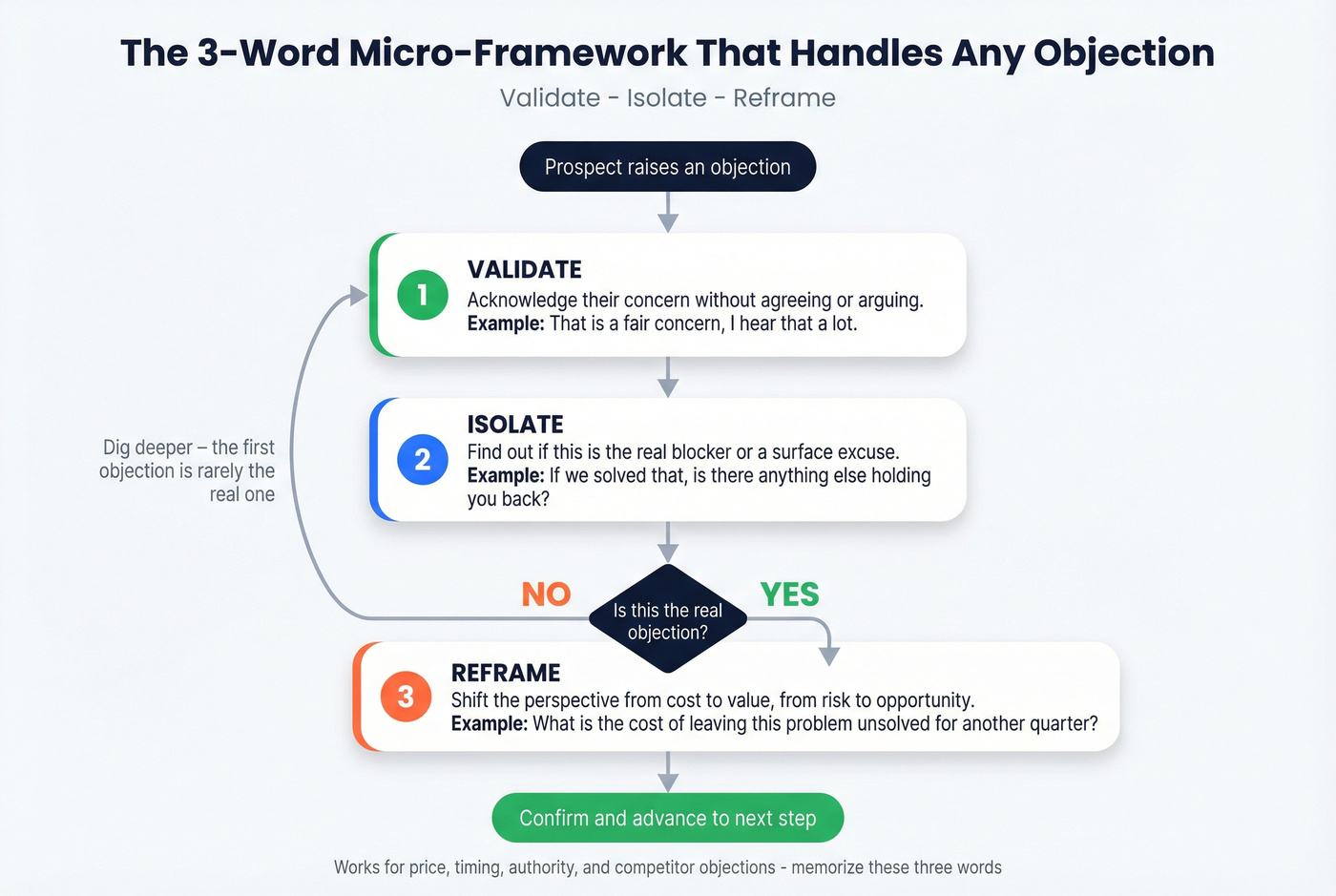
Let's break down each component of this powerful technique.
Step 1: Acknowledge
The first step is arguably the most important for maintaining rapport. Instead of treating an objection as an attack, you must first show the prospect that you've heard them and respect their concern. This immediately lowers their defenses and positions you as an ally.
The process starts with a simple, yet powerful action: pausing.

Resist the urge to speak immediately. A deliberate pause conveys confidence and gives you a moment to think. After pausing, you validate their feeling or statement. This is not about agreeing that your price is too high or your product is flawed; it's about agreeing that their concern is valid to them.
This article from Gong Labs provides excellent insight into the psychology and phrasing for this step.
Mastering Objection Handling: 12 Techniques That Work | Gong Labs
This article analyzes data from thousands of sales calls to show what top performers do differently. We'll use it to break down each step of the AIR method.
First, read the section Step one: pause, speak with calm authority. Notice the data on talking speed—slowing down signals confidence. Next, read Step three: validate before objection handling. The key here is to make the buyer feel understood. Phrases like "That's a valid concern" or "I hear what you're saying" are simple but effective.
Simple acknowledgement phrases include:
- "I appreciate you sharing that with me."
- "That makes sense."
- "I hear you. It sounds like budget is a key consideration for you."
Step 2: Isolate
The first objection you hear is often just the tip of the iceberg. "It's too expensive" could mean "I don't see the value," "I don't have the cash right now," or it could be a smokescreen for "I'm not the real decision-maker." The 'Isolate' step is about digging deeper to find the true, and often singular, root of the hesitation.
Your goal here is to determine two things:
- Is this the only objection?
- Is this the real objection?
To do this, you'll use clarifying questions. The following resource from Patrick Dang provides a concise role-play demonstrating this process.
How To Overcome Any Sales Objections - Best Sales Objection Handling Techniques
Sales coach Patrick Dang introduces a framework very similar to AIR (Empathize, Get to the Truth, Reframe) and demonstrates it with a common objection.
Watch from this segment. Pay close attention to how he handles the "let me think about it" objection. He first acknowledges ("I hear what you're saying") and then asks a question to isolate the real issue ("what exactly you need to think about?"). This uncovers the true obstacle: he needs to talk to his boss.
The most powerful isolation question is a hypothetical. You temporarily remove the stated objection to see what's underneath. Gong Labs provides the perfect script for this.
Mastering Objection Handling: 12 Techniques That Work | Gong Labs
Let's return to the Gong article to find the precise language for isolating an objection.
Read Step four: isolate the sales objection. The key phrase is: "If [the objection] wasn't an issue, would you be ready to move forward?" (Or a softer version). If they say yes, you know you've found the real problem to solve. If they say, "Well, actually...", they will reveal the true objection.
Step 3: Reframe
Once you have Acknowledged the concern and Isolated the real objection, you can finally address it. Reframing isn't about arguing or proving the prospect wrong. It's about helping them see their problem or your solution from a new perspective. You shift the focus from cost to value, from risk to opportunity, or from a problem to a solution.
For example:
- Objection: "This is too expensive."
- Reframe: Shift from cost to the cost of inaction. "I understand the investment is a key consideration. Let's look at it this way: what is the cost of leaving this problem unsolved for another three months?"
Before you present your reframe, it's crucial to get permission. This makes the prospect receptive to your perspective instead of feeling lectured.
3 Ways To Overcome Common Sales Objections Quickly | BMS
This article, which refers to the model as AIR (Acknowledge, Isolate, Respond), gives a great overview of the final step, which we are calling 'Reframe'.
Focus on the sections Isolate and Respond. While the article labels the second step "Isolate," its examples of probing questions are very useful. Then, notice how the "Respond" step is about providing a solution that resolves the now-isolated concern by focusing on benefits and ROI. This is the essence of a reframe.
The Gong Labs article gives a perfect, non-confrontational phrase to gain permission before offering your reframe.
Mastering Objection Handling: 12 Techniques That Work | Gong Labs
Now for the final piece of the puzzle: delivering the reframe effectively.
Read the sections Step five and Step six. The question "Can I bounce a few thoughts off of you?" is an excellent way to transition. Then, study the example of reframing "bad timing" into "perfect timing."
Conclusion
You now have a structured, repeatable process for handling any genuine objection a warm lead might raise. The Acknowledge-Isolate-Reframe method transforms a moment of friction into an opportunity for collaboration and clarification. Mastering this will fundamentally change how you approach challenging conversations.
Key Takeaways:
- Acknowledge: Always start by pausing and validating the prospect's concern. This builds trust and lowers their defenses. Use phrases like "I hear you" or "That's a valid concern."
- Isolate: Uncover the true objection before you try to solve it. Use clarifying questions and hypotheticals like, "If money weren't an issue, would we be moving forward?"
- Reframe: Shift the prospect's perspective to resolve the isolated concern. Focus on the value of solving their problem or the cost of inaction. Always ask permission first, e.g., "Can I share a different way of looking at this?"
In our next lesson, we will put the AIR method to the test. We will focus on one of the most common objections you'll hear: "Just send me an email." You'll learn how to use the AIR framework specifically to pivot from that request back to a productive, live conversation.