Hello! In our previous lesson, we transformed the "send me an email" request from a call-ender into a conversation-starter using the Acknowledge-Isolate-Reframe (AIR) framework. We established that your role is to guide the conversation by understanding the intent behind a prospect's words.
Today, we're tackling an even more common and elusive objection: "I need to think about it." On the surface, it sounds reasonable. But more often than not, it's a smokescreen for a deeper, unstated concern. Your goal for this lesson is to learn how to use clarifying questions to address the 'I need to think about it' objection and uncover the root hesitation. This skill will move you from being a passive message-taker to an active problem-solver in your calls.
Decoding the Smokescreen
First, let's be clear: when a prospect says they "need to think about it," they are almost never going to sit down with a notepad and weigh the pros and cons. As you'll see in the resources, this phrase is a stalling tactic, a polite "no," or a defensive mechanism.
Prospects say “I need to think about it” and you’ll say “...”
Sales trainer Jeremy Miner opens this video by explaining exactly why "I need to think about it" is a smokescreen, not a real objection.
Watch the opening section from this point. He states that your goal isn't to give them time to think, but to discover what they want to think about.
The phrase is a symptom of an underlying issue—a knowledge gap, a perceived risk, or an unspoken fear. Your job is not to accept the symptom at face value, but to diagnose the cause.
This article from C-Level Partners reinforces the idea that this objection is a stall caused by the salesperson, due to a lack of clarity.
Read the section under the heading Why it Happens in the First Place. The key takeaway here is that "it exists because of a knowledge gap, some lack of information, or some unspoken fear or perceived risk."
The First Step: Acknowledge and Agree
Just as we learned with the "send me an email" objection, your first move is counter-intuitive: agree with them. Pushing back or showing frustration will only make them more defensive. By agreeing, you disarm them, build rapport, and keep control of the interaction.
This article from Technology Marketing Toolkit explains this principle beautifully.
Sales Objections: How To Deal With “I Want To Think It Over”
This article provides a script that starts by agreeing with and respecting the prospect's need to think.
Read the first few paragraphs, starting from the beginning down to the opening script. Notice the emphasis on slowing down and adopting a respectful tone. This aligns perfectly with the "Acknowledge" step of the AIR framework.
Your opening line should be something calm and reassuring like:
- "I understand completely. It's a big decision, and it's smart to think it through."
- "Of course, I respect that. You shouldn't rush into something like this."
Once you've lowered their defenses, you can pivot to the detective work of finding the real objection.
The Art of the Clarifying Question
Now we get to the core of the lesson. Your goal is to ask questions that help the prospect articulate their true hesitation. Here are a few powerful techniques, ranging from direct to subtle.
Technique 1: The Systematic "Closing Doors" Method
This is a highly structured approach that isolates the real issue by eliminating other possibilities. You essentially walk the prospect through a series of "yes" questions until you corner the one "no" or "maybe."
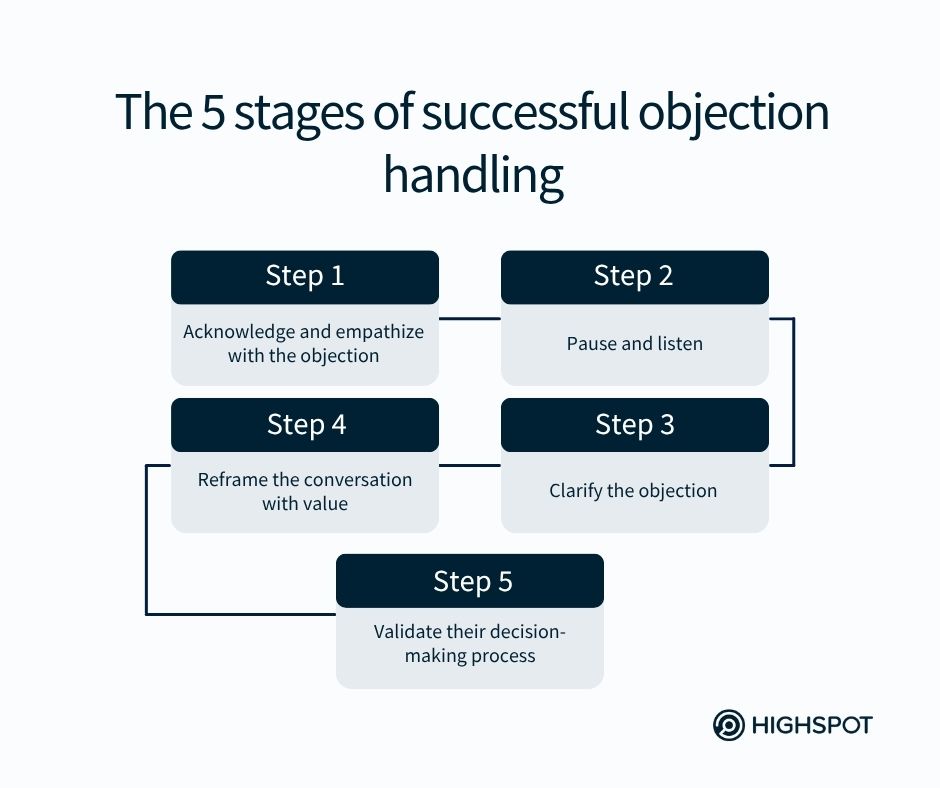
The image below gives a high-level view of a 5-step process for handling objections. Our "Closing Doors" method is a specific application of steps 3 (Clarify) and 4 (Reframe).
This video from Chuck Thokey provides a masterclass in this technique. He methodically "closes the doors" on the product and the company to prove that the real issue is almost always the money.
FULL Objection Breakdown | I Need To Think About It
In this video, Chuck Thokey demonstrates how to systematically uncover the real objection.
Watch the section from this point, where he explains how to close Door #1 (the system), Door #2 (the company), and then open Door #3 (the money). Pay close attention to his tonality and phrasing. Then, continue watching from the next section, where he breaks the money objection down even further into three possibilities: value, affordability, or timing. Asking "Which is it for you?" is the crucial clarifying question.
Here's how you can adapt this for your warm leads:
- Acknowledge: "I understand, and it's smart to think it through."
- Close Door 1 (The Solution): "Just so I'm clear, does the coaching program itself seem like it would solve the problem you mentioned in our DMs?" (They'll likely say yes).
- Close Door 2 (The Provider): "And do you feel like my client is the right person to help you solve it?" (Again, likely yes).
- Isolate the Real Issue (Money): "Okay. So if the program is right and the coach is right, it sounds like the only thing left to 'think about' is the investment and making sure it fits. Is that fair to say?"
- Clarify the Money Issue: "And when it comes to the investment, is it more a question of seeing the value for the price, or is it about the affordability right now?"
This sequence logically funnels the vague "I'll think about it" into a specific, solvable problem.
Technique 2: The Subtle "Before I Go" Reveal
This technique, from Jeremy Miner, is more psychologically nuanced. It involves making the prospect feel like the call is over, which causes them to drop their guard completely.
Prospects say “I need to think about it” and you’ll say “...”
Jeremy Miner explains a powerful technique to get the prospect to reveal their true concern when they think the pressure is off.
The magic happens in two parts. First, watch this section, where he explains that by booking a follow-up call, you make them believe you're about to leave, which lowers their guard. Now, watch the critical part from the "magic" question. Pay extremely close attention to how he phrases it ("what were you wanting to go over in your mind?") and his emphasis on a curious, non-confrontational tone. This delivery is everything.
The script looks like this:
- Acknowledge & Set Follow-Up: "That's not a problem. Let's schedule a brief chat for Thursday. How's 10 AM?"
- The Pivot: Once the appointment is set, and they think the call is ending, you say:
- The Magic Question: "Perfect. Hey, just before we hang up, so I can be prepared for our chat on Thursday... what were you wanting to go over in your mind?"
The shift from "think about" to "go over in your mind" and the curious, helpful tone often prompts an honest answer: "Well, I just need to figure out the budget..." or "I need to talk to my partner." Now you have the real objection to work with.
Conclusion
The phrase "I need to think about it" is an invitation to dig deeper. It's a test of your ability to guide the conversation beyond surface-level statements. By staying calm, acknowledging their position, and then using targeted clarifying questions, you can transform this common stall into a productive conversation.
Key Takeaways:
- "I need to think about it" is a smokescreen. Your job is to find the fire.
- Always start by agreeing and acknowledging. This lowers their defenses and maintains rapport.
- Use structured questioning to uncover the root cause. The "Closing Doors" method (System -> Company -> Money) is a reliable way to isolate the true hesitation.
- Your tone is crucial. Whether you're using a direct or subtle approach, a curious and helpful tone will get you much further than a confrontational one.
In our next lesson, we will focus on what to do once you've successfully uncovered the real objection. We'll learn about "looping" techniques that allow you to address their concern and then seamlessly guide the conversation back to your core value proposition and secure the next step.