Hello! In our last session, you learned how to use the BANT framework to guide your conversations and qualify warm leads. That process is about you proactively asking questions to understand a prospect's situation. Today, we'll look at the other side of the coin: listening for the clues prospects give you without being asked.
The goal of this lesson is to learn how to identify verbal buying signals that indicate a warm lead is ready to move forward. Mastering this skill is like learning to read the subtle signs that a conversation is shifting from discovery to decision. It will tell you when to stop qualifying and start guiding the prospect toward the next step.
From Qualification to Closing: Understanding Buying Signals
After you've used BANT to establish Need, Authority, Budget, and Timeline, the conversation enters a new phase. You've built value, and now the prospect is mentally evaluating your offer. During this phase, they will often unconsciously send "buying signals"—questions and statements that reveal their growing interest and readiness to purchase.
Your job as a setter is to tune your ears to these signals. Missing them is a common mistake; you might keep selling when the prospect is already sold, potentially talking yourself out of a deal. Catching them allows you to smoothly transition to booking the call for your coach.
A great way to conceptualize these signals is to group them into different categories.
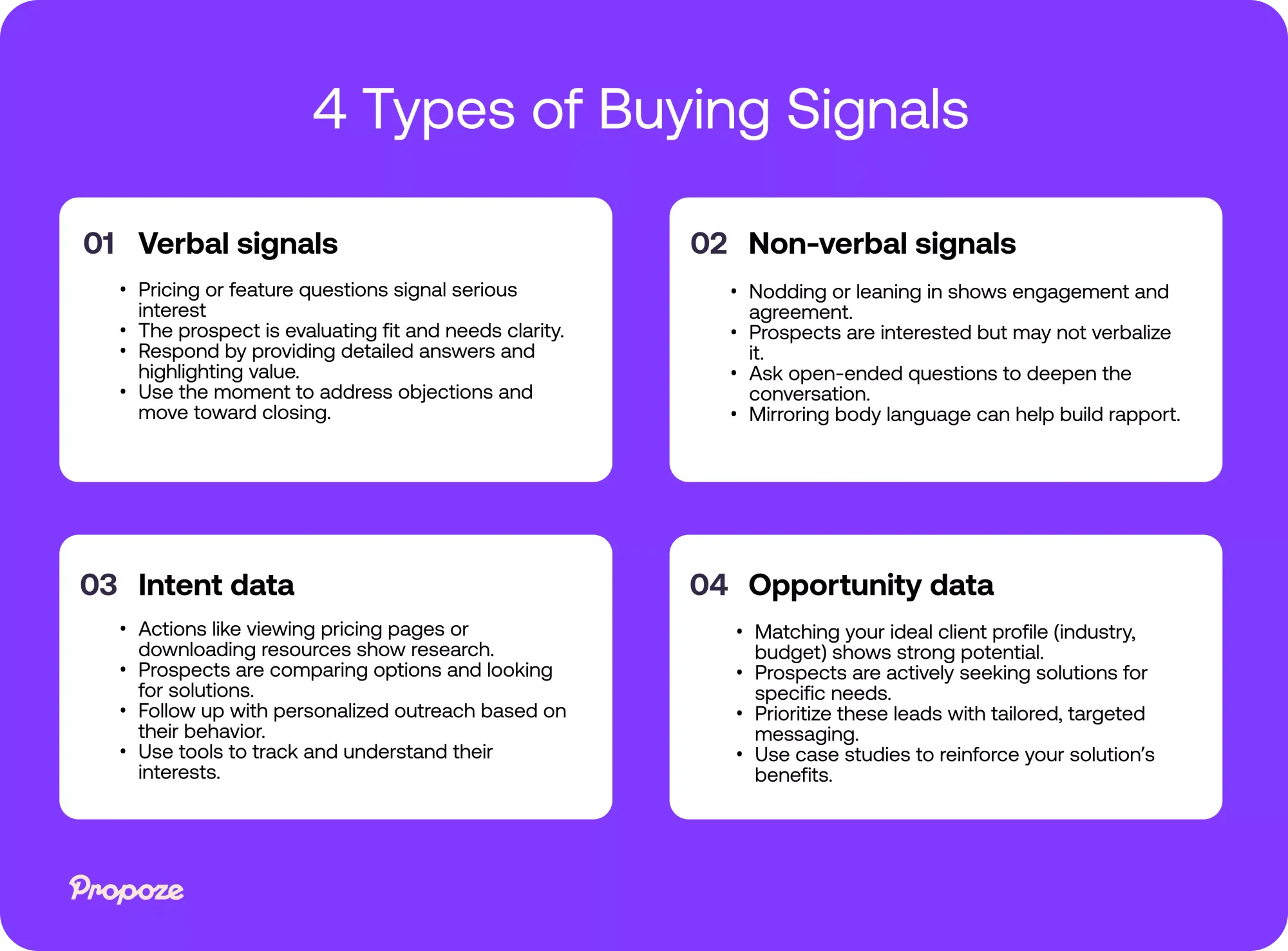
The Categories of Verbal Buying Signals
Verbal buying signals are not always as direct as "I'm ready to buy!" They often come in the form of questions or statements about the future. The following article from HubSpot provides an excellent breakdown of the most common signals, grouping them into six key categories.
25 Phrases That Signal a Prospect Is Ready to Buy
This article provides a fantastic, practical list of buying signals. Pay close attention to the six categories it outlines, as these will become your mental checklist during calls.
Read the section Identifying True Buying Signals. As you read through the six categories, try to imagine a prospect on a call saying these things to you. Purchasing and Financing Questions: Questions about price after you've established value. Possessive Statements: When they start talking about the service as if they already own it. Service and Delivery Dates: Questions about logistics and start dates. Expressions of Desire: When they start verbalizing the "better future" you've discussed. Risk-Minimization Questions: Questions about guarantees or what happens if it doesn't work. Next Step Questions: The most obvious signal—when they ask what to do next.
Seeing Buying Signals in Action
It's one thing to read about these signals, but hearing them in a real conversation is key. Let's return to the live call breakdown from your field that we reviewed in the last lesson. As you watch these clips, listen for the buying signals that fall into the categories you just read about.
Breaking down a full appointment setter call
This call breakdown from Luke Alexander's channel is full of subtle but powerful buying signals from the prospect, Kishan.
Watch these three specific moments from the call: Listen here as Kishan talks about his long-term goals with his girlfriend and getting "set up for that." This is a classic Expression of Desire, linking the purchase to a future life event. Next, watch from this point. When asked about his timeline, Kishan says he wants to start "as soon as I can" and is willing to go "all in." This is a strong signal related to Logistics and Timeline. Finally, watch this exchange. After the price is mentioned, the setter asks if he can afford it. Kishan's confirmation, "yeah I do have it," is a crucial Purchasing/Financing signal.
How to Respond When You Hear a Signal
Identifying a buying signal is only half the battle. How you respond is critical. Your response should acknowledge the signal and smoothly pivot towards the next step. A clumsy response can halt the momentum you've built.
This short video explains this concept perfectly. It categorizes signals into "process" and "price" and, most importantly, demonstrates how to react when you hear one.
Recognize Buying Signals | Sales Training Series #3
This video from Owen Video offers a direct, actionable approach to recognizing and responding to buying signals.
First, watch from the beginning to the list of signals. The presenter gives a clear definition and a list of powerful examples. Then, pay close attention to the role-play scenario from this section. Notice how the seller hears the buying signal ("My wife would love that"), immediately moves to the close ("we can start the installation next Wednesday"), and then gracefully backs off into more feature-talk when the prospect shows slight resistance. This is an advanced and highly effective technique.
This "test the close" technique is powerful. When you hear a buying signal, you can confidently propose the next step. If the prospect agrees, you move forward. If they hesitate, you haven't lost anything; you can simply transition back to the conversation as demonstrated in the video.
The key to all of this is active listening. As you've learned before, you cannot be so focused on what you're going to say next that you miss these golden opportunities. A buying signal is the prospect telling you, "I'm interested, help me get there." Your job is to listen for that invitation and then lead the way.
Conclusion
You've now moved from the structured questioning of BANT to the art of listening for unspoken intent. By recognizing verbal buying signals, you can perfectly time your transition from discovery to decision, making your calls more efficient and effective.
Key Takeaways:
- Buying signals are clues that a prospect is mentally moving towards a purchase.
- They often fall into categories like questions about price, logistics, and next steps, or statements about desire and possession.
- Active listening is essential to catch these signals, which can be subtle.
- When you hear a buying signal, acknowledge it and pivot to the next logical step—this is your cue to start closing or booking the appointment.
In our next lesson, we will focus on crafting the perfect response to a buying signal. You will learn how to structure a compelling call-to-action that clearly defines and secures the next step in the sales process, ensuring you convert that buying interest into a booked call every time.