Welcome back! In our last lesson, you learned how to masterfully transition from the opening pleasantries of a call into its core purpose, setting a clear and professional agenda. Now that you've successfully opened the door and the prospect is ready to talk, it's time to understand their world.
Today's lesson is about qualifying your warm leads. In your DM setting work, you've developed an intuition for identifying promising prospects. We're now going to structure that intuition using a proven sales framework: BANT. The learning outcome for this lesson is for you to be able to apply the BANT (Budget, Authority, Need, Timeline) framework conversationally to qualify warm leads. The goal is not to turn you into a robot that follows a checklist, but to give you a powerful mental map for uncovering the crucial information you need to determine if you can truly help someone.
What is BANT? A Guide, Not a Script
BANT stands for Budget, Authority, Need, and Timeline. It's a framework developed decades ago, but its core principles are timeless for figuring out if a prospect is a good fit for your offer.
For a quick overview of what each component means, the video below provides a clear, concise definition.
What is BANT? (And How to Implement It)
This video from Tech Sales With Higher Levels explains the fundamentals of BANT.
Watch the first part of the video, from the beginning to the explanation of BANT. This will give you a solid definition of each of the four pillars.
The single most important thing to understand about BANT is that it is not a checklist to be read out loud. A common mistake is to ask the questions robotically: "What is your budget? Are you the authority?" This is an interrogation, not a conversation, and it will immediately put your prospect on the defensive.
Instead, we will treat BANT as a guide for a natural conversation. You will learn to weave questions into the discussion to uncover the answers organically.
The Conversational Flow: Start with Need (N)
The acronym B-A-N-T is not the best order for a real conversation. Asking about budget first is usually a recipe for disaster. A much more natural and effective flow begins with the most important pillar: Need.
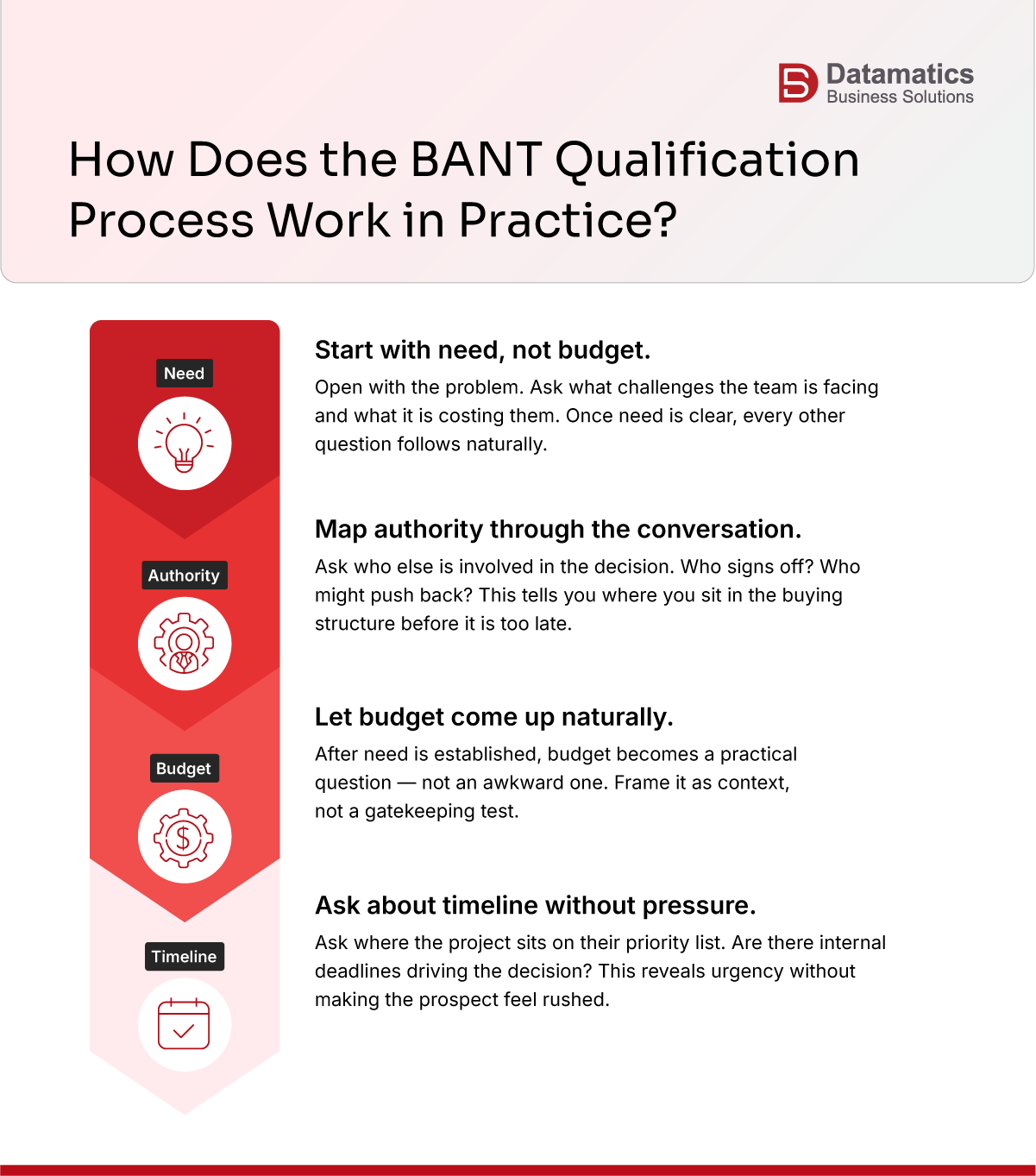
As a DM setter, uncovering need is already your specialty. You find people who are struggling with a problem your coach can solve. On the phone, the principle is the same, but the technique is about guiding the prospect to articulate that need themselves. The most powerful way to do this is by helping them see the gap between their current situation and their desired future.
The following video is a live call breakdown in your exact field—appointment setting for online coaches. Pay close attention to how the setter asks questions to understand the prospect's past struggles and future goals. This is how you uncover and intensify the need.
Mastering Appointment Setting: Live Sales Call Breakdown
This clip from Luke Alexander's channel shows a setter skillfully uncovering the prospect's need and urgency.
Watch the section from this part of the call. Notice how the setter asks "what have you tried so far?", "why is that?", and "what's the long-term goal?". He then creates urgency by asking the crucial question: "why now?"
Your goal is to become a master at asking questions that quantify the prospect's pain. Vague problems don't lead to action. Quantified problems do. The following resource provides an excellent bank of questions you can adapt.
BANT Sales Methodology: 2026 Framework Th...
This article offers a deep dive into each BANT component. We'll focus on its practical questions for uncovering need.
First, read the sections on Quantifying Need and Need Discovery Questions. These questions will help you move from vague pain points to specific, impactful problems. Then, scroll down to the larger question bank and review the 15 variations under Need Questions. You don't need to memorize them all; just get a feel for the different angles you can take.
Map the Decision Makers: Authority (A)
Once a clear need is established, the next logical question is: who is involved in making the decision to solve this problem? In your context of selling to individuals and small business owners, the person you're speaking to is often the sole decision-maker. However, you must always confirm this.
Simple, conversational questions work best:
- "Who else, if anyone, would be involved in a decision like this?"
- "Help me understand your typical decision-making process for investments in your business."
- "Is this a decision you'd be making on your own, or do you have a business partner or spouse you'd review this with?"
Don't assume. A spouse, a business partner, or even a mentor can often be an unmentioned stakeholder. Identifying them early prevents surprises later.
Let Budget Come Up Naturally (B)
This is often the most feared part of the call, but it doesn't have to be. If you've done a good job uncovering the need and quantifying the pain of their current situation, discussing the investment required to fix it becomes a practical matter, not an awkward one.
Never lead with, "What's your budget?" Instead, use framing and indirect questions. Let's return to the live call breakdown. The way the setter handles the budget question is perfect for your situation. He frames it hypothetically, which lowers sales resistance while still qualifying the prospect financially.
Mastering Appointment Setting: Live Sales Call Breakdown
This clip demonstrates a masterful, low-pressure way to qualify for budget.
Watch this short segment from the budget qualification. The key phrases are "just so I can get a better idea" and "hypothetically... do you have capital saved up to potentially invest?" This gives the prospect a price range and asks for their capability without demanding a specific number.
This technique is incredibly effective. Another approach is to discuss the cost of their current situation, which reframes the investment.
- "You mentioned you're losing about X amount per month by not solving this. What would it be worth to you to fix that?"
- "Most clients in your position are typically investing between $X and $Y to achieve [desired outcome]. How does that align with your thinking?"
Uncover Urgency: Timeline (T)
A qualified prospect needs to solve their problem, can afford to, and has the authority to decide. The final piece is understanding when they need to solve it. This is their timeline.
Urgency is directly linked to need. The more pain they are in, the shorter their timeline will be. Your job is to uncover the driving forces behind their timing.
- Why now? As you saw in the video, this is the most powerful timeline question you can ask.
- What happens if you don't solve this? Asking about the consequences of inaction reveals urgency. "What happens if you're still in this same spot 6 months from now?"
- Are there any critical events? Is there a launch, a new year, or a personal deadline driving the decision?
Putting It All Together: A Conversational Example
Let's see how this can all flow together naturally, compared to the robotic checklist approach. The following reading gives a fantastic side-by-side comparison.
BANT Sales Methodology: 2026 Framework Th...
This resource shows the difference between a bad, robotic BANT qualification and a good, conversational one.
Please read the three sections under the heading Common BANT Mistakes. Focus on "Mistake 1: Treating BANT as a Checklist," "Mistake 2: Asking About Budget Too Early," and "Mistake 3: Surface-Level Questions." The "Good example" under Mistake 1 is a perfect illustration of how to weave BANT questions into a natural discovery conversation.
Conclusion
Mastering BANT is about shifting from a seller's mindset ("Can they buy my product?") to a consultant's mindset ("Can I genuinely help this person, and what is their full situation?"). It's a discovery process that, when done right, builds trust and positions you as an expert.
Key Takeaways:
- BANT is a framework, not a checklist. Your goal is a natural conversation, not an interrogation.
- Start with Need. A conversational flow like N-A-B-T is far more effective. Uncover pain and create the "gap" between their current and desired state.
- Frame sensitive topics. Use hypothetical scenarios for budget and ask indirect questions to understand their financial situation without being intrusive.
- Urgency comes from consequence. Help the prospect see the cost of inaction to understand their timeline.
In our next lesson, we will build on this. Once you've qualified a lead and confirmed there's a strong potential fit, you need to listen for the signals that they are ready to move forward. We'll explore how to identify verbal buying signals that tell you it's time to propose the next step.