Welcome back! In our last lesson, we focused on the art of listening, training your ear to catch the subtle verbal buying signals that tell you a prospect is ready to move forward. You learned that when a prospect starts asking about price, logistics, or talking about the future as if they've already bought in, it's your cue to shift gears.
Today, we'll build directly on that skill. Hearing the buying signal is the trigger; this lesson is about pulling it. Our learning outcome is to structure a compelling call-to-action that clearly defines and secures the next step in the sales process. This isn't about being pushy. It's about leading with confidence and making it simple for an interested prospect to take the next logical step with you.
From Desire to Action
A great way to visualize your role in this part of the conversation is through the classic AIDA model, which breaks down a customer's journey into four stages: Attention, Interest, Desire, and Action.
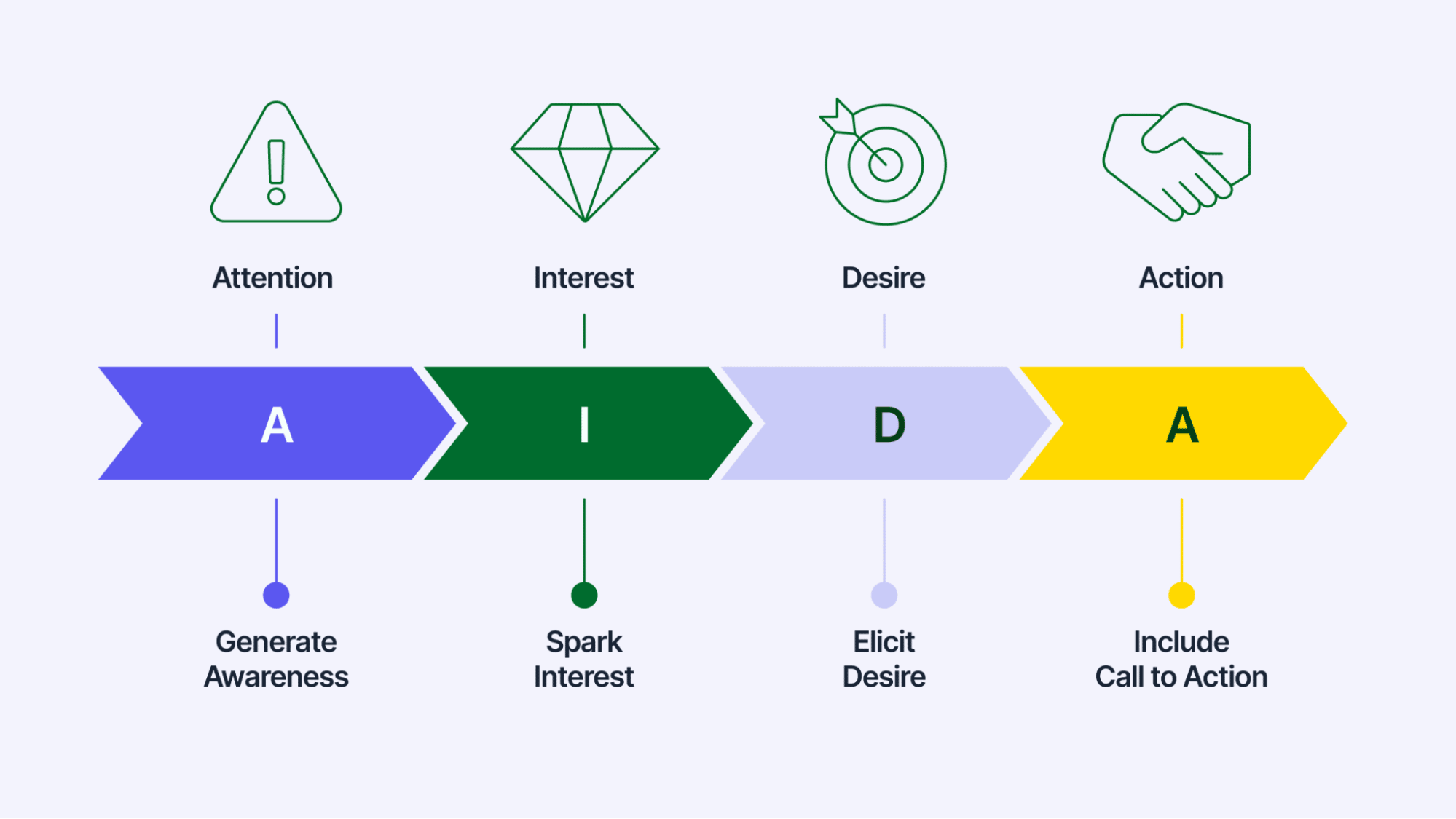
In your work, the DM conversations have already captured Attention and built Interest. The qualification call, where you use frameworks like BANT, is where you stoke Desire by connecting their problems to your coach's solution. Today, we focus on the final, crucial step: Action. This is the moment you convert all the value and rapport you've built into a tangible outcome—a booked appointment.
The Anatomy of a High-Converting CTA
A call-to-action (CTA) on the phone isn't just asking for the next meeting. A compelling CTA is a strategic tool that removes friction, eliminates confusion, and makes it easy for the prospect to say yes. Vague or weak CTAs are where momentum dies.
This article from Superhuman Prospecting breaks down the core elements of a great CTA. While it covers various forms of outreach, the principles are universal and directly applicable to your calls.
High-Converting Sales Call to Action Tips for B2B Success
This article provides a superb framework for understanding what makes a CTA effective. We'll use its core principles as our foundation.
First, read the section The Anatomy of a High-Converting Sales Call to Action. As you read, focus on these key ideas and how they apply to booking a call for your coach: Clarity: There should be no ambiguity. Instead of "Let's talk more soon," you need to be precise about what happens next. Value-Orientation: The next step should be framed for their benefit (e.g., "a 20-minute call to map out a strategy"), not yours. Low Commitment: A "15-minute call" feels much easier to agree to than a "formal sales presentation." Then, jump to the FAQ and read the answer to the first question, "What's the biggest mistake companies make?". This powerfully summarizes the most common pitfall you must avoid.
The single biggest takeaway is to eliminate generic asks. Phrases like "Let me know what you think" or "Would you be interested in learning more?" put the burden of work back on the prospect. Your job is to take that burden away.
The Mechanics: How to Ask for the Call
So, how do you phrase a CTA that is clear, value-oriented, and low-friction? The most effective and widely used technique is the alternative choice close. You don't ask if they want to meet; you ask when they want to meet by providing two specific options.
This simple, powerful technique removes the "yes/no" decision and replaces it with a "this/that" decision, which is psychologically much easier to make.
Appointment Setting Scripts for 7 Industries (Templates)
This resource on appointment setting scripts directly addresses the mechanics of the "closing ask."
Please read the short section titled The Closing Ask. It perfectly encapsulates the technique: offer specific, concrete options. Notice the contrast between the weak, open-ended question and the strong, specific one. This is the exact phrasing you should adopt.
The script is simple:
Weak: "Would you like to schedule a call?"
Strong: "I have availability on Tuesday at 10:00 AM or Thursday at 3:00 PM. Which works better for you?"
Seeing the CTA in Action
Let's watch this technique applied in a live setting. In the following video, appointment setting coach Luke Alexander breaks down a call where the setter seamlessly transitions to booking the next meeting.
Mastering Appointment Setting: Live Sales Call Breakdown
This video provides a masterclass in executing the call-to-action, handling minor hesitation, and maintaining control of the frame.
First, watch the live call segment from this point. As you watch, listen for these key elements: The Transition: How does the setter move from confirming value to proposing the next step? The Offer: He first offers general options ("morning and afternoon") and then drills down to specific times ("two or three"). Handling Hesitation: The prospect asks, "do you even think I have time for this?" Notice how the setter handles this not as an objection to the meeting, but by reinforcing the prospect's own motivation. Confirming Commitment: The light-hearted "Godzilla" line is a subtle but effective way to lock in the appointment and reduce no-shows. After watching the call, continue watching the analysis from this section. The coach explains the psychology of not sounding desperate and framing the call as a step to help the prospect, which is crucial for keeping their guard down.
An Advanced Technique: Asking for Permission
Another powerful way to transition to your CTA is to ask for permission to recommend the next step. This is a high-level technique that shows respect for the prospect's time and positions you as a helpful consultant.
In this next clip, sales coach Matt Macnamara explains his process for securing the next meeting. His approach is brilliant because it's both assertive and respectful.
My EXACT Discovery Call & Demo Script to Close (nearly) ANYONE
This video offers a "killer question" to make your transition to the CTA completely seamless.
Watch the section on booking next steps from this point. Pay close attention to "step number four" at this timestamp. The question is: "Based on our conversation, do you mind if I recommend a next step?" This is incredibly effective. It's almost impossible for a prospect to say "no" to this question. It gives you permission to take the lead, after which you can confidently offer your two time slots. Finally, listen to his warning about ending a call without a next step booked. He calls it "email purgatory," and it's a trap you must avoid at all costs. If the opportunity is real, the next step gets booked on the call.
Conclusion
You've now learned how to turn a prospect's buying signal into a concrete, booked appointment. By structuring a compelling call-to-action, you're not just closing your own loop; you're providing a clear, easy path for an interested person to solve their problem.
Key Takeaways:
- The goal of a CTA is Action: It's the final step that turns a conversation into a scheduled appointment.
- Be Clear and Specific: Avoid vague questions. The biggest mistake is putting the burden of decision back on the prospect.
- Use the Alternative Choice Close: Always offer two specific times. "Tuesday at 2 PM or Thursday at 4 PM. Which works better for you?"
- Ask for Permission: To make your transition even smoother, use the phrase, "Do you mind if I recommend a next step?"
- Never Leave Without a Next Step: A successful call ends with a meeting in the calendar, not a promise to "follow up by email."
Of course, even with a perfect CTA, you will sometimes face resistance. In our next lesson, we will begin our module on navigating objections, starting with how to differentiate between a reflexive "no" and a genuine concern.