Welcome to our next lesson. In our previous sessions, we explored the Income Statement, which measures your business's profitability over time, and the Balance Sheet, which gives a financial snapshot at a single moment. You now have the tools to see what you earned and what you own and owe. However, a crucial piece of the puzzle is still missing: tracking the actual cash moving in and out of your business.
As an entrepreneur, you know that profit on paper doesn't pay the bills. You could have a hugely profitable month from a large catering contract, but if the client hasn't paid you yet, you won't have the cash to pay your suppliers or staff. This gap between reported profit and available cash is a fundamental concept in accounting. This lesson introduces the third core financial statement, the Cash Flow Statement, which is designed to bridge that exact gap. It will show you precisely where your cash came from and where it went, providing a clear view of your business's liquidity. For managing a business day-to-day, especially in a dynamic economy, this statement is arguably the most critical of the three.
Why Profit Isn't Cash
The primary reason profit doesn't equal cash is because of accrual-based accounting, which we've touched on before. Under this method, revenue is recorded when it's earned, not when the cash is received. Expenses are recorded when they are incurred, not when they are paid. The Cash Flow Statement adjusts for these timing differences to show the true cash impact of your operations.
The following video from the Accounting Stuff channel offers a superb explanation of why this statement is necessary and how it differs from the Income Statement.
The CASH FLOW STATEMENT for BEGINNERS
This video, "The CASH FLOW STATEMENT for BEGINNERS," clearly explains the need for this statement by contrasting cash and accrual accounting.
Watch the first two minutes, from the beginning to the end of the introduction. Focus on the distinction between the cash method and the accrual method, and how that leads to the need for a separate Cash Flow Statement alongside the Income Statement and Balance Sheet.
The Three Engines of Cash Flow
The Cash Flow Statement organizes all cash transactions into three distinct categories. This structure is powerful because it allows you to see how your core business, your investment decisions, and your funding activities each contribute to your overall cash position.
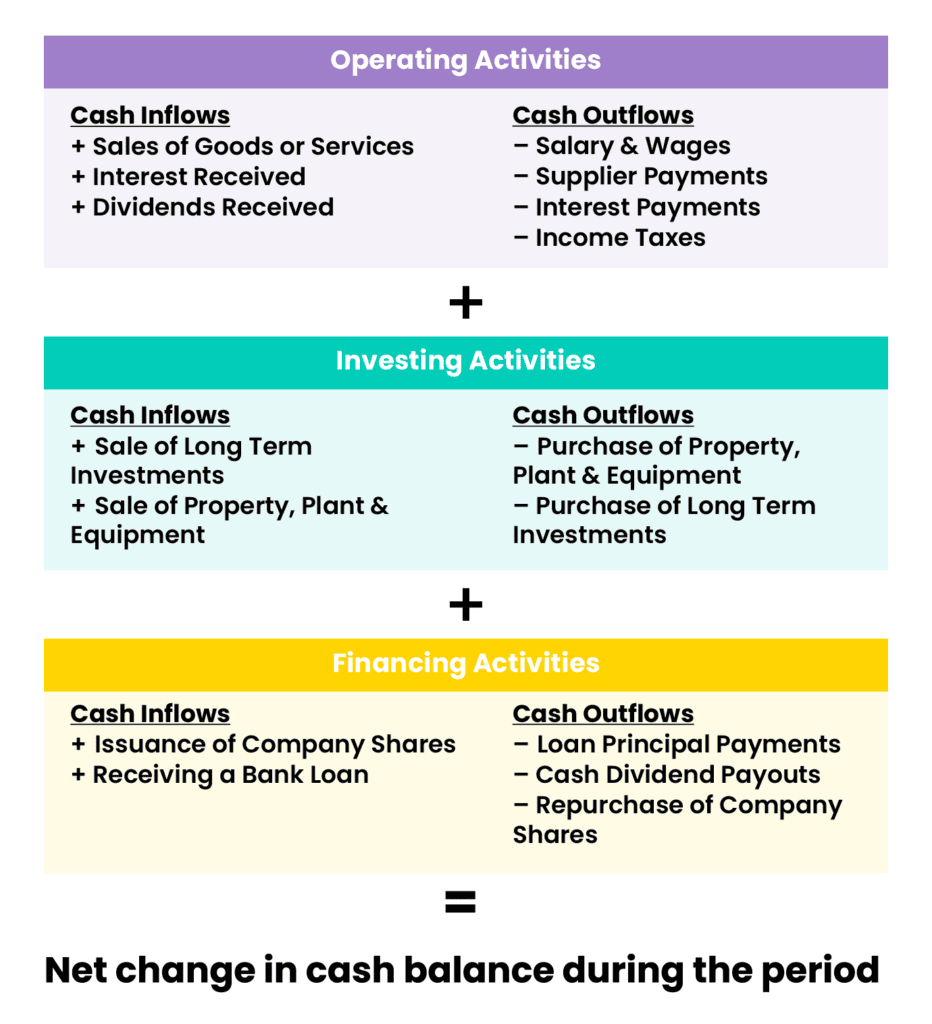
Let's explore these three activities.
-
Cash Flow from Operating Activities (CFO): This is the cash generated by your company's primary business activities. For your food business, this includes cash received from daily sales, delivery orders, and catering events. It also includes cash paid out for inventory (food, packaging), salaries, rent, utilities, and taxes. A healthy business must generate positive cash flow from its operations in the long run.
-
Cash Flow from Investing Activities (CFI): This section reports the cash used for, or generated from, investments in the company's long-term assets. This includes buying or selling property, plant, and equipment (like a new oven, a delivery vehicle, or a new production facility). Your goal of scaling into a semi-industrial retail chain will involve significant cash outflows in this category.
-
Cash Flow from Financing Activities (CFF): This relates to how the business is funded. It includes cash inflows from taking out a bank loan or from owners investing more money into the business. It also includes cash outflows for repaying loan principal and for owners taking money out (dividends or drawings).
To see how these activities are defined with specific examples for a restaurant, it is useful to review an industry-specific guide.
A Guide to Restaurant Cash Flow Management - Back Office
This guide from Back Office is tailored for restaurant leaders and provides highly relevant examples.
Read the sections under "The Cash Flow Statement: A Deeper Look." Focus on the descriptions of Operating Activities, Investing Activities, and Financing Activities to see how your business transactions would be categorized.
The Argentine Standard: Structure and Inflation
Given your business operates in Argentina, it's crucial to understand how these concepts are applied under local accounting standards. A document from the Universidad Católica de Santiago del Estero (UCSE) provides the formal framework according to FACPCE (Federación Argentina de Consejos Profesionales de Ciencias Económicas).
This document reinforces the structure we just discussed and introduces the formal definitions that accountants in Argentina use. It also defines a key term: "Efectivo y equivalentes de efectivo" (Cash and cash equivalents).
[PDF] el estado de flujo de efectivo ajustado por inflación | ucse
This academic paper explains the preparation of the Cash Flow Statement according to Argentine accounting norms, including adjustments for inflation.
First, read the section that defines cash equivalents, found in Chapter 3. This clarifies what counts as "cash"—it's not just physical money, but also highly liquid, short-term investments. Next, review the structure in Chapter 4, specifically the definitions under "Tipificación de las actividades". Notice how Actividades operativas, Actividades de inversión, and Actividades de financiación align perfectly with the concepts we've discussed.
Reconciling Profit to Cash: The Indirect Method
There are two ways to present the Cash Flow from Operating Activities: the direct method and the indirect method.
- The Direct Method is more intuitive. It simply lists the major categories of cash receipts (e.g., cash from customers) and cash payments (e.g., cash paid to suppliers). It's essentially a summary of your cash book.
- The Indirect Method is more common in formal financial reports. It starts with the Net Income from the Income Statement and adjusts it for non-cash items and changes in working capital to arrive at the net cash from operations.
The indirect method is powerful because it explicitly shows the reconciliation between profit and cash flow. The video from Accounting Stuff provides a clear, step-by-step example of building a Cash Flow Statement using this common method.
The CASH FLOW STATEMENT for BEGINNERS
We return to "The CASH FLOW STATEMENT for BEGINNERS" to see how the statement is constructed.
Watch these two key segments: First, the explanation of the two methods. Pay close attention to the three steps used in the indirect method: starting with net profit, adding back non-cash expenses, and adjusting for working capital. Then, watch the detailed worked example from "how do we make a Cash Flow Statement?". Follow along as the presenter builds a complete statement using the indirect method, pulling numbers from the Income Statement and Balance Sheet. This will solidify your understanding of how the three statements are interconnected.
Interpreting the Story: What Makes a Healthy Cash Flow?
Reading the statement is one thing; interpreting it is another. The pattern of cash flows across the three sections tells a powerful story about a company's health and strategic direction.
A mature, healthy company typically exhibits:
- Positive Cash Flow from Operations: The business is generating more cash than it consumes from its core activities.
- Negative Cash Flow from Investing: The company is reinvesting its operating cash into long-term assets (new equipment, new locations) to fuel future growth.
- Negative Cash Flow from Financing: The company is using cash to pay down debt or return capital to owners.
The following video analyzes the cash flow statements of real companies to show you what these patterns look like in practice.
27. How to read a cash flow statement
This video by Preston Pysh is excellent for learning how to interpret the numbers and spot signs of a strong or weak company.
Watch the analysis of Walmart. Notice the strong positive operating cash flow and the significant negative cash flows from investing (reinvestment) and financing (buying back stock, paying dividends). This is the classic profile of a healthy, mature company. Then, watch the contrasting analysis of Sears. See how a negative trend in operating cash flow and a reliance on debt (positive financing cash flow) are clear warning signs of a business in distress.
A Note on Inflation: RECPAM
Finally, we must address the specific reality of operating in Argentina. In a high-inflation environment, the cash you hold today will be worth less tomorrow. Argentine accounting standards require this loss of purchasing power to be recognized. This adjustment is known as RECPAM (Resultado por Exposición a los Cambios en el Poder Adquisitivo de la Moneda).
The UCSE document we looked at earlier explains how this complex but vital adjustment is incorporated into the Cash Flow Statement. While we will cover inflation in detail in Module 4, it is important to know that a standard cash flow statement must be adjusted to be meaningful.
For now, simply be aware that the RECPAM generated by your cash holdings is typically shown as a separate line item or included within operating activities, reconciling the inflation-adjusted figures. The
Conclusion
In this lesson, you've learned to read and interpret the Cash Flow Statement, the financial report that tracks the lifeblood of your business: cash. You now understand how it provides a vital check on the accrual-based numbers of the Income Statement.
Here are the key takeaways:
- The Cash Flow Statement explains the change in a company's cash balance over a period by detailing all cash inflows and outflows.
- It is structured into three key activities: Operating (core business), Investing (long-term assets), and Financing (debt and equity).
- A healthy, growing company typically shows positive cash from operations, which it uses to fund negative cash flows from investing and financing.
- In Argentina, the statement must be adjusted for inflation (RECPAM) to accurately reflect the change in purchasing power.
You are now equipped with a foundational understanding of the three core financial statements. You can measure profitability, assess financial position, and track liquidity. In our next lesson, we will tie everything together by exploring the relationships between the Income Statement, Balance Sheet, and Cash Flow Statement, showing how they work as a cohesive, integrated system to provide a complete picture of your business's financial health.