In our last session, we explored the Income Statement, which tells the story of your business's profitability over a period of time. Now, we shift our perspective from a video of your business in motion to a photograph of its financial state at a single, specific moment. This photograph is the Balance Sheet.
This lesson will guide you through reading and interpreting this crucial statement. You'll learn how it organizes what your business owns (its assets) and what it owes (its liabilities and equity), all held in perfect equilibrium by the fundamental accounting equation. For an entrepreneur planning to scale, the balance sheet is more than a report; it's a map of your financial foundation, revealing your company's structure, solvency, and capacity for future growth.
The Fundamental Equation of Business
At the heart of the balance sheet lies a simple but powerful formula known as the accounting equation:
Think of it this way: everything of value that the business owns (its assets) had to be paid for, or funded, in one of two ways. It was either funded by borrowing from others (liabilities), or it was funded by the owners themselves (equity). The two sides of the equation must always, without exception, be equal—they must balance.
The following video from the Brian Feroldi channel provides an excellent introduction to this concept and the overall purpose of the balance sheet.
The BALANCE SHEET: all the basics in 12 minutes
This video, "The BALANCE SHEET: all the basics in 12 minutes," provides a concise overview of the purpose and structure of the balance sheet.
Watch the first minute and a half to get a solid grasp of the core idea. Focus on the definitions of the three major components (Assets, Liabilities, Shareholders' Equity) and the explanation of the master accounting equation and the "snapshot in time" concept.
The balance sheet provides a static picture. While your Income Statement might be for "the month of March," your balance sheet will be for a single day, such as "as of March 31st."
Deconstructing the Balance Sheet
Let's break down each of the three core components. The structure is not arbitrary; items are generally listed in order of liquidity—how quickly they can be converted to cash.

1. Assets: What Your Business Owns
Assets are the economic resources owned by your company that are expected to provide a future benefit. For your food business, this includes everything from the cash in your register to the ovens in your kitchen. Assets are typically split into two main categories.
Restaurant Balance Sheet: A Guide for Operators - Back Office
This article from Back Office is written for restaurant operators, so its examples will be very familiar. It clearly breaks down the different types of assets.
Read the section titled "Assets". Pay close attention to the distinction between: Current Assets: These are assets you expect to use or convert to cash within one year. This includes your cash, money owed to you by B2B clients (Accounts Receivable), and, crucially, your Inventory of food and drinks. Fixed Assets (or Non-Current Assets): These are long-term assets used to operate the business, like kitchen equipment, delivery vehicles, and any property you own.
An important theoretical point to grasp, which you asked for, is the Cost Principle. Assets are recorded on the balance sheet at their original purchase price (historical cost), not their current market value.
Accounting Principles: In-Depth Explanation with Examples
This article from AccountingCoach explains the foundational rules of accounting.
Read the section "Assets Reported on the Balance Sheet". The key takeaway is that the balance sheet does not reflect an asset's current selling price. An oven you bought for $10,000 is listed at that cost (minus depreciation, which we'll cover later), even if it's worth $12,000 today. This principle also means that incredibly valuable but internally developed assets, like your brand's reputation or a secret family recipe, don't appear on the balance sheet at all.
2. Liabilities: What Your Business Owes
Liabilities are your company's obligations or debts to outside parties. This is the portion of your assets funded by creditors, suppliers, and lenders. Like assets, they are split into two categories based on when they are due.
Restaurant Balance Sheet: A Guide for Operators - Back Office
We'll continue with the same industry-specific guide.
Now, read the section titled "Liabilities". Focus on the difference between: Current Liabilities: Debts due within one year. For you, this primarily includes Accounts Payable (money you owe to your food and packaging suppliers), short-term loans, and accrued expenses like payroll and taxes. Long-Term Liabilities: Debts due in more than one year, such as a multi-year bank loan you might take out to finance a new production facility.
3. Equity: The Owners' Stake
Equity represents the net worth of the business belonging to its owners. It's the residual claim on the assets after all liabilities have been paid off. In your family business, this is your and your mother's stake. It consists of two main parts:
- Contributed Capital: The money the owners have directly invested in the business. This is the initial cash your family used to start the company and any subsequent investments you've made.
- Retained Earnings: This is the crucial link between the Income Statement and the Balance Sheet. It represents the cumulative net profits that the business has earned over time and has retained—that is, not paid out to the owners as drawings or dividends. Every peso of profit you make increases your Retained Earnings, thus increasing the owners' equity in the business.
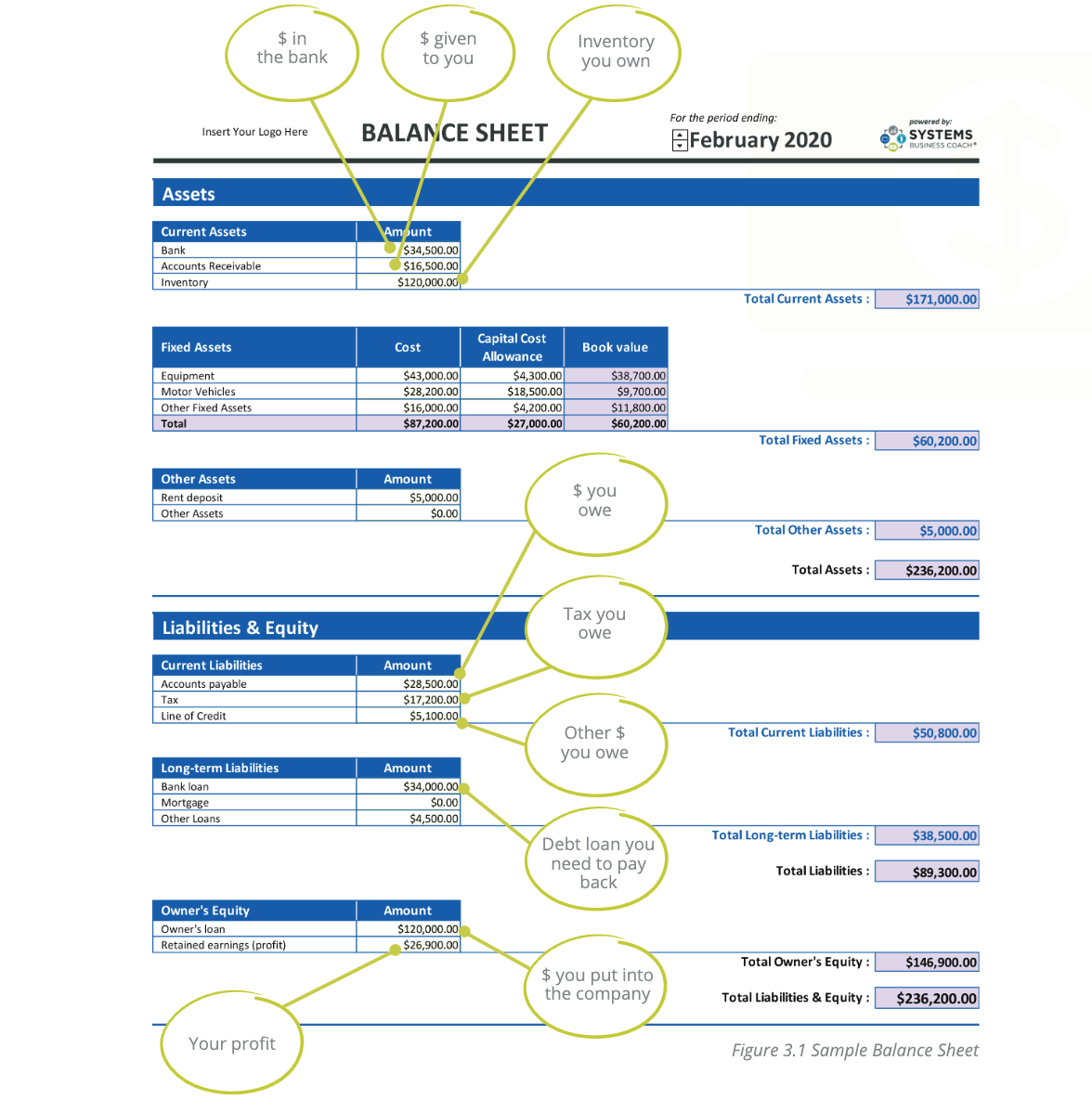
The following annotated balance sheet provides a great visual summary, translating the technical terms into plain language.
Putting It All Together: A Worked Example
Understanding the pieces is one thing; seeing how they assemble is another. The most common point of confusion when building a balance sheet is forgetting that the profits (or losses) from the Income Statement must be included in the Equity section for the sheet to balance.
The following video walks through the process of building a balance sheet and highlights this exact point.
The BALANCE SHEET for BEGINNERS (Full Example)
This video, "The BALANCE SHEET for BEGINNERS," from the Accounting Stuff channel, is an excellent step-by-step guide.
Please watch these segments: The basic structure. This recaps the accounting equation and the classification of assets, liabilities, and equity. The common mistake. Pay close attention to why the balance sheet doesn't balance at first and how including retained earnings (profit from the income statement) solves the problem. The detailed balance sheet. This shows the final, properly categorized report.
From Reading to Interpreting: Making Decisions
A balance sheet is not just an accounting exercise; it's a powerful diagnostic tool. By analyzing it, you can assess your company's financial health and make strategic decisions. For example:
- Can we afford to expand? By looking at your cash levels (current asset) and your existing debt (liabilities), you can assess your capacity to take on a new loan for a semi-industrial kitchen.
- Are we managing our suppliers well? A very high Accounts Payable (current liability) might mean you are stretching your payment terms, which could damage relationships, especially in an inflationary environment like Argentina's.
- How liquid are we? Comparing current assets to current liabilities tells you if you have enough short-term resources to cover your short-term debts. This is a critical measure of stability.
The following video gives practical advice on which numbers to focus on and what they tell you, using a relevant company, Chipotle, as an example.
The BALANCE SHEET: all the basics in 12 minutes
We'll return to the Brian Feroldi video to learn how to analyze the statement.
Watch these two key sections: Five key numbers. The speaker identifies the most important items to check first: cash, debt, goodwill, retained earnings, and treasury stock. Real company example. See how this analysis is applied to Chipotle's balance sheet to quickly assess its financial strength.
This type of quick analysis helps you move from just seeing numbers to understanding the story they tell about your business's financial structure and resilience.
Conclusion
In this lesson, we've pulled back the curtain on the balance sheet, revealing its logical structure and its role as a snapshot of your company's financial health. You now understand how to read and interpret this statement, moving from abstract accounting terms to concrete business insights.
Here are your key takeaways:
- The Balance Sheet is based on the fundamental equation: Assets = Liabilities + Equity.
- It provides a picture of what a company owns (Assets) and what it owes (Liabilities and Equity) at a single point in time.
- Items are categorized as Current (short-term, less than a year) or Non-Current (long-term), which is vital for assessing liquidity and long-term structure.
- Retained Earnings connects the Income Statement to the Balance Sheet, showing how profits increase the owners' stake in the business.
- Interpreting the balance sheet allows you to assess financial stability and make strategic decisions about investment, debt, and operations.
You are now familiar with two of the three core financial statements. You know how to measure performance over time (Income Statement) and how to assess financial position at a moment in time (Balance Sheet). In our next lesson, we will explore the third and final core statement: the Cash Flow Statement. It will show you how to track the actual movement of cash in and out of your business—a critical skill for navigating the day-to-day realities of any company, especially in a dynamic economic climate.