Welcome to the final lesson of our first module. Over the past few lessons, we've individually dismantled the three core financial statements: the Income Statement (measuring profitability), the Balance Sheet (showing your financial position), and the Cash Flow Statement (tracking liquidity). You now have the foundational tools to analyze each of these critical business dimensions.
In this lesson, we will synthesize this knowledge and see how these three reports are not separate documents but parts of a single, dynamic system. Understanding how they interconnect is the key to building a complete financial picture of your business. This is the theoretical bedrock you'll need for financial modeling, forecasting, and ultimately, building the business plan to scale your company.
The Big Picture: Points in Time vs. Periods of Time
Before we dive into the mechanics, let's establish a core concept. The Income Statement and the Cash Flow Statement are reports that cover a period of time (e.g., a month, a quarter, a year). They tell the story of what happened during that interval. The Balance Sheet, in contrast, is a snapshot at a single point in time.
The period-of-time statements explain how the business moved from the Balance Sheet at the beginning of the period to the Balance Sheet at the end of the period.
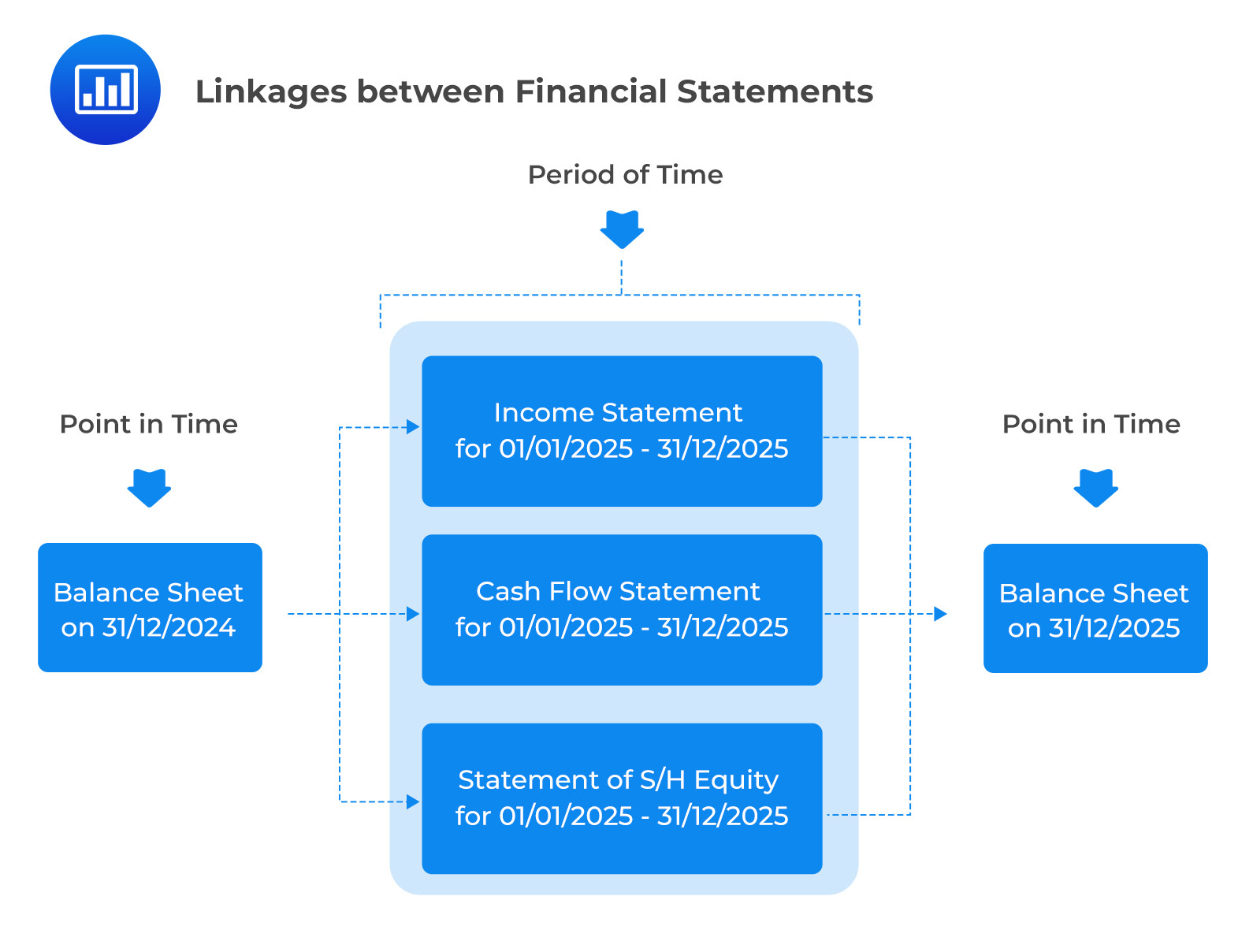
As you've seen in your own business, having a profitable month doesn't mean much if you don't have enough cash to pay suppliers, and having cash doesn't mean much if the business isn't fundamentally profitable. No single statement tells the whole story.
The following article from NetSuite, written for restaurant owners, reinforces this critical point.
Restaurant Financial Statements 101 | NetSuite
This article emphasizes why all three statements are essential for a full financial picture, using a restaurant context.
Focus on these key ideas as you read: Under "Why Are Restaurant Financial Statements Important?", note the sentence: "No one type of statement has all the answers..." In the "Restaurant Balance Sheet" section, see how it states that the balance sheet should be analyzed in conjunction with the other two. Finally, in the "Restaurant Cash Flow Statement" section, observe how creating it requires information from both the P&L and the Balance Sheet.
The Three Core Linkages
Now, let's get into the mechanics of how the statements are connected. There are three primary links that form a feedback loop, ensuring the entire system stays in balance. The article "How are the Three Financial Statements Linked?" from Wall Street Prep provides a clear and detailed explanation.
How are the Three Financial Statements Linked?
This article provides a comprehensive overview of the conceptual connections between the statements.
Please read the following sections to understand the three main pathways of connection: Income Statement → Cash Flow Statement: Read the section explaining this link. The key takeaway is that Net Income is the starting point for the Cash Flow Statement. Cash Flow Statement → Balance Sheet: Read the section detailing this connection. Pay attention to how the ending cash balance, changes in working capital, CapEx, and financing activities all flow from the CFS to update the Balance Sheet. Income Statement → Balance Sheet: Read the section describing this final link. The central concept here is Retained Earnings.
Let's summarize these crucial connections:
- Net Income from the Income Statement is the starting point for the Cash Flow Statement. This is the bridge between accrual-based profit and actual cash flow.
- The ending cash balance from the Cash Flow Statement becomes the cash asset on the Balance Sheet. This ensures the Balance Sheet reflects the true cash position at the end of the period.
- Net Income from the Income Statement (minus any dividends paid) flows into the Retained Earnings account within Shareholders' Equity on the Balance Sheet. This represents the profits you are reinvesting back into the business to fund growth.
Visualizing the Connections
Reading about the links is one thing; seeing them in motion is another. The following video provides a brilliant line-by-line visualization of how transactions on one statement affect the others.
Connecting the Income Statement, Balance Sheet, and Cash Flow Statement
This video, "Connecting the Income Statement, Balance Sheet, and Cash Flow Statement," provides a clear, animated walk-through of the links.
Watch the following segments that correspond to the three links we just discussed: Income Statement → Balance Sheet: See how revenue, expenses, and net income directly impact assets, liabilities, and equity. Income Statement → Cash Flow Statement: Observe how net income and non-cash charges from the IS are used to build the CFS. Balance Sheet → Cash Flow Statement: Watch how changes in Balance Sheet accounts (like inventory or debt) are reflected as cash inflows or outflows on the CFS.
A Practical Walk-Through
Let's apply this knowledge to a concrete example. The image below shows three years of financial statements for a company. We will trace the key numbers from Year 3 to see the links in action.
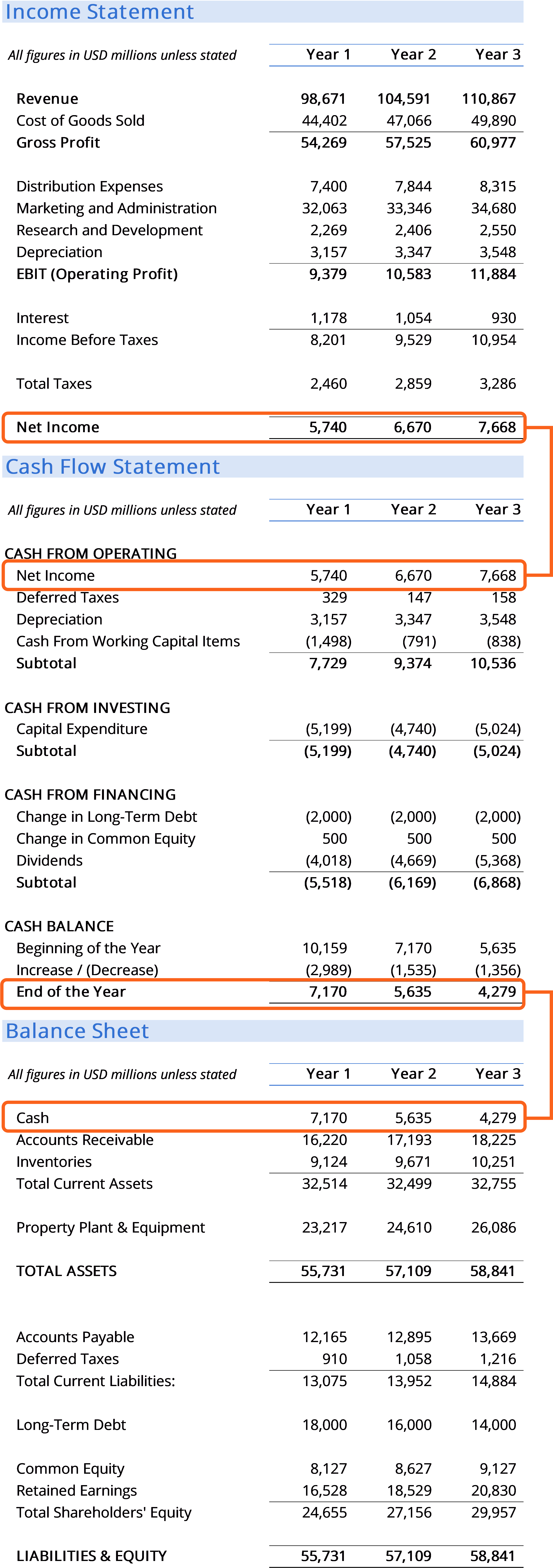
Follow these steps using the data for Year 3:
-
Income Statement → Cash Flow Statement:
- Find the Net Income on the Income Statement for Year 3. It is $7,668.
- Now look at the Cash Flow Statement for Year 3. Notice that the very first line, "Net Income" under "CASH FROM OPERATING," is the same $7,668. This is our first link.
-
Cash Flow Statement → Balance Sheet:
- On the Cash Flow Statement for Year 3, find the End of the Year cash balance. It is $4,279.
- Now, look at the Balance Sheet for Year 3. The Cash line item under "Current Assets" is the same $4,279. This is our second link.
-
Income Statement → Balance Sheet:
- This link is made through Retained Earnings. The formula is:
- From the Balance Sheet for Year 2, find the ending Retained Earnings: $27,109. This is our beginning balance for Year 3.
- From the Income Statement for Year 3, find Net Income: $7,668.
- From the Cash Flow Statement for Year 3, find Dividends paid (under "CASH FROM FINANCING"): $5,368.
- Let's calculate: . The Balance Sheet shows $29,957. The small difference is likely due to other equity transactions not detailed in this simplified view, but the principle holds: profit increases the owners' stake in the company, while paying dividends reduces it.
This flow is the engine of your financial system. The profits you generate (Income Statement) are either paid out or reinvested (Balance Sheet), and the entire process is reconciled with the actual cash movements (Cash Flow Statement).
To see a final, satisfying confirmation of this, the next video explicitly reconciles the change in cash on the Balance Sheet with the net change reported on the Cash Flow Statement.
Financial Statements Explained | Balance Sheet | Income Statement | Cash Flow Statement
This video clip from "Financial Statements Explained" provides a clear, simple proof of the link between the Cash Flow Statement and the Balance Sheet.
Watch the short segment from "How can we cross-check...". This demonstrates how the change in the cash balance on the Balance Sheet over a year perfectly matches the "net change in cash" calculated on the Cash Flow Statement for that same year.
Conclusion
You have now connected all the pieces of the financial accounting puzzle. This lesson demonstrated that the three core statements are an integrated system, each providing a different perspective on the same set of business activities.
Here are the key takeaways:
- The Income Statement and Cash Flow Statement describe performance over a period of time, while the Balance Sheet is a snapshot at a point in time.
- The three statements are linked through three main pathways:
- Net Income connects the Income Statement to the Cash Flow Statement.
- Ending Cash connects the Cash Flow Statement to the Balance Sheet.
- Retained Earnings connects the Income Statement to the Balance Sheet.
- This integrated view is essential for robust financial analysis, forecasting, and planning the strategic investments needed to scale your business.
This lesson concludes our module on the foundations of financial accounting. You've moved from basic definitions to understanding the dynamic interplay of a complete financial reporting system.
In our next module, "Designing Your Financial System," we will shift from theory to practice. You will learn how to take these concepts and build a structured financial system for your own food business, moving beyond "broken and incomplete" spreadsheets toward a robust process that can support your growth ambitions.