In our last session, we established the immediate, acute physiological signature of the Wim Hof Method (WHM): a powerful combination of respiratory alkalosis, severe intermittent hypoxia, and a massive, voluntary spike in plasma epinephrine (adrenaline). You now have the foundational understanding of what happens in the body during a WHM cycle.
Today, we will connect that physiological state to its groundbreaking downstream effects on the immune system. This lesson directly addresses your goal of understanding the science behind the method by performing a deep dive into the landmark 2014 clinical trial that brought the WHM to the attention of the scientific world. Your objective is to analyze the study's design, results, and statistical findings to explain how the WHM can modulate the body's inflammatory response. Given your expertise in clinical trial literature and statistics, we will approach this not as a simple summary, but as a peer-level analysis of the evidence.
The Radboud University Endotoxemia Study
For decades, it was a biological axiom that the autonomic nervous and innate immune systems were just that—automatic and beyond conscious influence. The WHM directly challenged this dogma. The central research question of the study we will examine, conducted by Kox and colleagues at Radboud University Medical Center, was whether a group of healthy volunteers, after a short training period, could voluntarily influence their innate immune response to a standardized inflammatory challenge.
The study used a randomized controlled trial design, the gold standard for clinical evidence.
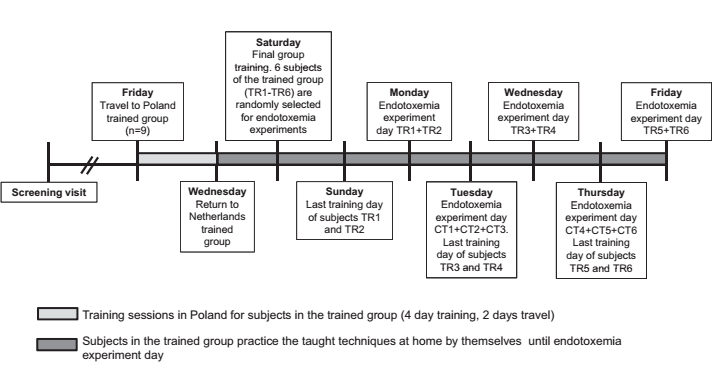
As you can see from the diagram, the experiment involved a training group that learned the WHM techniques over a 10-day period and a control group that received no training. Both groups were then subjected to "experimental endotoxemia"—an intravenous injection of a lipopolysaccharide (LPS), a component of the E. coli bacteria cell wall. LPS is harmless in this context but triggers a powerful, predictable innate immune response, leading to a "cytokine storm" that produces fever, headache, shivering, and nausea. This provides a safe and standardized model to study acute systemic inflammation.
To fully appreciate the methodology, it's worth examining the primary source directly.
Voluntary activation of the sympathetic nervous system and ... - PMC
This paper, published in the Proceedings of the National Academy of Sciences (PNAS), is the seminal work on the WHM's immunomodulatory effects.
Begin by reading the Abstract and the Introduction to understand the study's rationale and high-level findings. Next, review the methodology in detail. Read the Subjects and Study Design sections within "Materials and Methods". Pay particular attention to the randomization process, the description of the three training pillars (meditation, cold exposure, breathing), and the final selection of subjects for the experiment. Finally, read the description of the endotoxemia protocol to understand the experimental conditions, including the timing of the WHM practice relative to the LPS injection. Note the brief section on Statistical Analysis, which confirms the use of standard parametric and non-parametric tests appropriate for this type of data.
Modulating the Cytokine Storm
In the last lesson, we saw the profound epinephrine spike in the trained group. The researchers hypothesized that this self-induced stress response would preemptively modulate the subsequent immune reaction to the endotoxin. The primary outcome to measure this was the level of circulating cytokines—the signaling proteins of the immune system.
- Pro-inflammatory cytokines (like TNF-α, IL-6, and IL-8) are the "alarm bells" that drive the inflammatory cascade, causing the flu-like symptoms.
- Anti-inflammatory cytokines (like IL-10) are the "brakes" that dampen the response and prevent it from spiraling out of control.
The results were striking.
Voluntary activation of the sympathetic nervous system and ... - PMC
Figure 4 from Kox et al. (2014) showing median plasma cytokine concentrations in control (dotted line) and trained (solid line) subjects. A, C, E, G show concentrations over time. B, D, F, H show the total response (Area Under Curve).
Let's analyze these graphs as a researcher would:
- Pro-inflammatory Response (A, C, E): In the control group (dotted line), levels of TNF-α, IL-6, and IL-8 spike dramatically after the LPS injection, peaking around 1.5-2 hours. In the trained group (solid line), this response is massively blunted.
- Anti-inflammatory Response (G): Here, the pattern is reversed. The trained group shows a much faster and significantly higher surge in the anti-inflammatory cytokine IL-10, peaking a full hour before the control group.
- Symptoms: As a direct result of this dampened inflammatory response, the trained group reported significantly fewer flu-like symptoms (a 56% reduction in peak symptoms, as detailed in Figure 1J of the paper).
The data clearly show that the trained subjects were able to suppress their pro-inflammatory response while augmenting their anti-inflammatory response. For the precise statistical details, please refer back to the source text.
Voluntary activation of the sympathetic nervous system and ... - PMC
The "Plasma Cytokines" section provides the quantitative summary of the graphs you just viewed.
Please read the paragraph under the sub-heading Plasma Cytokines. Focus on the specific percentage differences reported for the pro- and anti-inflammatory cytokines, for example, the attenuation figures and the 194% increase in IL-10.
The Mechanistic Link: A Statistical Chain of Evidence
The data show two distinct phenomena: an epinephrine spike and a modulated cytokine response. But to argue for causality, we need to establish a statistical link. This is where the correlation analysis becomes critical. The authors proposed a chain of events:
Breathing Exercises → Epinephrine ↑ → IL-10 ↑ → (TNF-α, IL-6, IL-8) ↓
The study's correlation data provide strong support for this pathway.
Voluntary activation of the sympathetic nervous system and ... - PMC
Figure 5 from Kox et al. (2014). This shows the correlations between epinephrine, IL-10, and pro-inflammatory cytokines in the trained group.
Let's break this down:
- Panel A: Shows a strong, statistically significant positive correlation () between the peak epinephrine levels (the cause) and the early IL-10 levels (the first effect). In simple terms, the bigger the adrenaline spike, the bigger the anti-inflammatory response.
- Panels B, C, and D: Show significant inverse correlations between the early IL-10 levels and the subsequent peaks of the pro-inflammatory cytokines TNF-α, IL-6, and IL-8. This means that a stronger early anti-inflammatory response was associated with a weaker subsequent pro-inflammatory storm.
This correlational evidence builds a compelling case for the proposed mechanism. To solidify your understanding, review the authors' own interpretation of these findings.
Voluntary activation of the sympathetic nervous system and ... - PMC
The "Correlation Analyses" and "Discussion" sections connect all the data points into a coherent mechanistic narrative.
Read the section on <span data-type="resource_reading_textrange" data-resource-subitem-id="87d34f1d" data-range-start="As depicted in Fig. 5A" data-range-end="IL-10T 2: rs = 0.60, P = 0.039).">Correlation Analyses for a textual description of the graphs. Then, read the first four paragraphs of the Discussion, focusing on how the authors link the findings together. Pay attention to the sentence explaining the opposing findings in the control group, which further strengthens their conclusion: These findings indicate.
A Critical Perspective
While the Kox et al. study is a landmark, a single study is never definitive proof. As a researcher, you know the importance of replication and critical appraisal. A 2024 systematic review helps place these findings in the context of all available research and highlights important limitations.
Does the Wim Hof Method have a beneficial impact on physiological ...
This review summarizes the evidence across eight different trials, providing a valuable meta-perspective.
First, read the section titled Pro-inflammatory/anti-inflammatory responses. It confirms that the findings of Kox et al. were largely replicated in a subsequent endotoxemia study by Zwaag et al., strengthening the evidence. Next, read the Discussion section. This is crucial for a balanced view. The authors praise the promising findings but also rightly point out significant limitations that you should be aware of, including low quality, small sample size, the inability to blind participants, and the potential for a placebo effect.
The review's conclusion is sound: the evidence for the WHM's immunomodulatory effects is promising and mechanistically plausible, but the overall body of research is still in its infancy and requires more high-quality, larger-scale trials.
Conclusion
In this lesson, we have moved beyond the acute physiology of the WHM to analyze its profound effects on the innate immune system. By dissecting the Kox et al. (2014) study, you have examined the evidence just as a peer reviewer would.
Key Takeaways:
- The WHM enables trained individuals to voluntarily suppress the pro-inflammatory cytokine response (TNF-α, IL-6, IL-8) and augment the anti-inflammatory cytokine response (IL-10) during an acute inflammatory challenge.
- The proposed mechanism, supported by strong correlational data, is an epinephrine-driven increase in IL-10, which then dampens the subsequent pro-inflammatory cascade.
- This finding represents a paradigm shift, demonstrating that humans can consciously influence systems once thought to be purely autonomic.
- While these findings are significant and have been replicated, the overall body of research on the WHM is still limited, with methodological weaknesses (e.g., small sample sizes, lack of blinding) that warrant a cautious interpretation of the results.
You now possess a detailed, evidence-based understanding of the WHM's most scientifically celebrated effect. In our next lesson, we will explore another intense breathing practice, Tummo, comparing its thermogenic goals and mechanisms to the WHM. We will also formally discuss the risks and contraindications of these powerful hyperventilation-based techniques.