Hello! In our last lesson, we dug into the mechanics of classic Spanning Tree Protocol (STP) and concluded with its primary drawback: the slow convergence time of 30 to 50 seconds after a network topology change. For modern networks that demand high availability, this delay is simply too long.
This lesson introduces the solution: Rapid Spanning Tree Protocol (RSTP), also known as IEEE 802.1w. You'll learn how this evolution of STP achieves convergence in just a few seconds by replacing passive timers with an active negotiation process and introducing more intelligent port roles. Understanding RSTP is crucial, as it's the default STP version on most modern switches you'll be configuring for your project.
An Evolution, Not a Revolution
First, it's important to understand that RSTP doesn't reinvent the wheel. The fundamental goal and many of the core processes remain the same as in classic STP:
- It still elects a single root bridge based on the lowest Bridge ID.
- It still calculates the lowest-cost path to the root.
- The concepts of root ports and designated ports are still central to the process.
The "rapid" nature of RSTP comes from improvements in how it handles topology changes and transitions ports to their final states.
Key Improvements in RSTP
RSTP's speed comes from three main enhancements over classic STP: simplified port states, new port roles, and an active negotiation mechanism.
1. Simplified Port States
Classic STP has five port states, with a 30-second delay for a port to move from blocking through listening and learning to forwarding. RSTP streamlines this by combining three states into one.
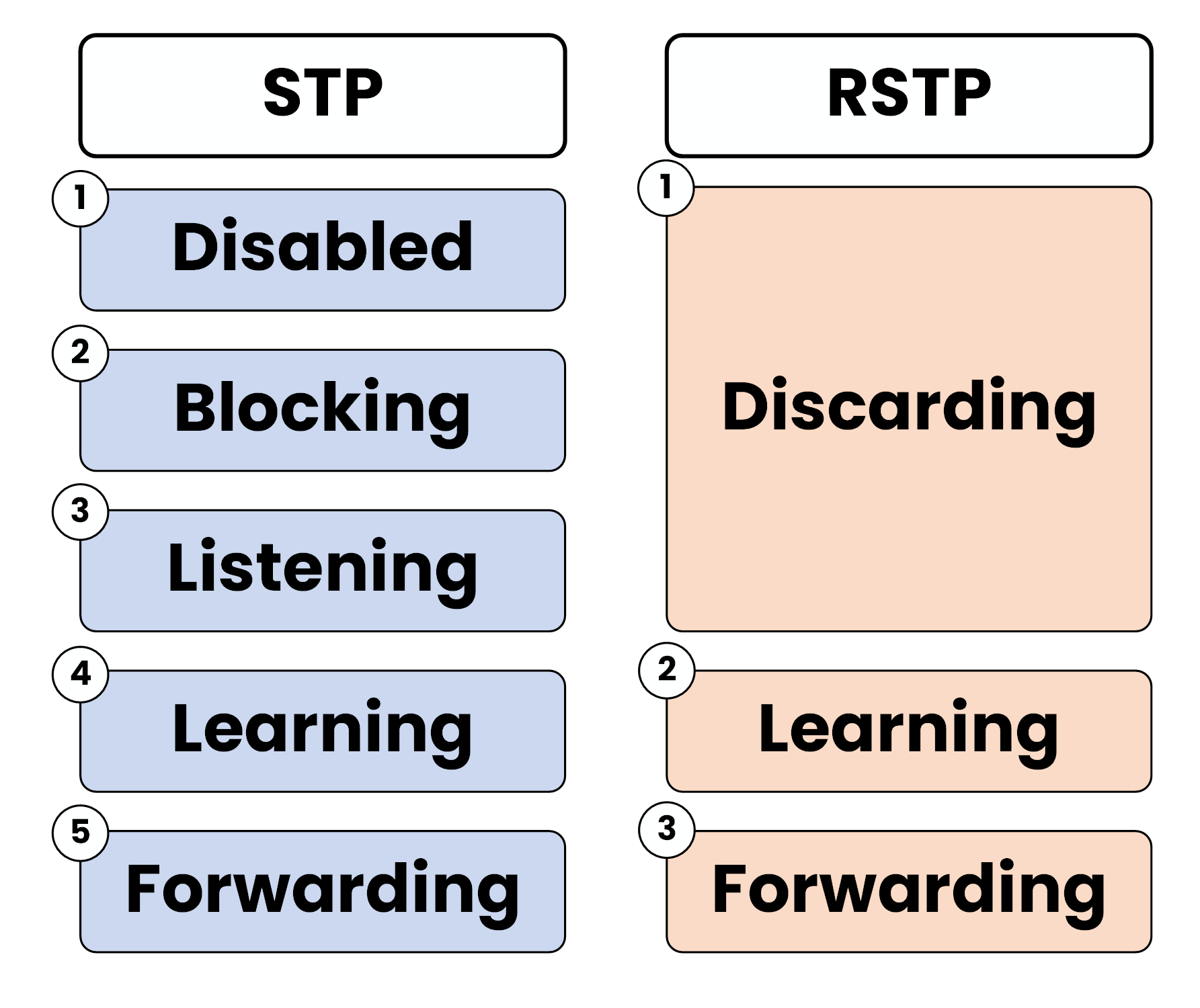
This change means a port no longer needs to wait through the 15-second listening state. The path to forwarding is now much shorter: Discarding -> Learning -> Forwarding.
2. New Port Roles: Alternate and Backup
In classic STP, any port that wasn't a root or designated port was simply a non-designated (blocking) port. RSTP makes this role more intelligent by dividing it into two specific roles:
- Alternate Port: This is a port that offers an alternative path to the root bridge. It's essentially a pre-calculated backup for the switch's root port. If the current root port fails, the alternate port can immediately transition to the forwarding state without going through a long recalculation process. This is the most common and significant new role.
- Backup Port: This is a port that provides a redundant (backup) path to a segment where another port on the same switch is already the designated port. This scenario is rare and typically only occurs when a switch is connected to a hub, which is legacy technology.
The introduction of the alternate port is a massive improvement. The switch is no longer just passively blocking a redundant link; it's actively maintaining a hot-standby path that's ready to take over instantly.
3. Integrated Features and Link Types
RSTP also incorporates several enhancements that were optional, often proprietary add-ons in classic STP:
- Edge Ports: The functionality of PortFast is built into RSTP. A port configured as an edge port (one connected to an end device like a PC) immediately enters the forwarding state, bypassing the learning and discarding states.
- UplinkFast & BackboneFast: The fast-failover capabilities provided by the alternate port role are functionally equivalent to Cisco's old UplinkFast feature. RSTP's negotiation process also includes mechanisms similar to BackboneFast, allowing it to handle indirect link failures much more quickly. These are now standard and operate by default.
To help with its rapid negotiations, RSTP also categorizes links:
- Point-to-Point: A link operating in full-duplex, typically connecting two switches. These links are candidates for rapid transition.
- Shared: A link operating in half-duplex, assumed to be connected to a hub. These links fall back to the slower, classic STP timer-based process.
The following video provides an excellent summary of these differences.
Free CCNA Rapid Spanning Tree Protocol Day 22 CCNA 200-301 Complete Course
This video from Jeremy's IT Lab details the key differences between classic STP and RSTP.
Watch these two segments carefully: Differences in STP and RSTP: This section covers the updated port costs, the new simplified port states, and the new port roles (Alternate and Backup). RSTP link types: This part explains the concept of Edge, Point-to-Point, and Shared links.
The Mechanism for Speed: Synchronization
So how does the alternate port take over so quickly? And how do new links come up without the 30-second delay? RSTP replaces classic STP's passive timers with an active Proposal-Agreement handshake, also known as the synchronization process.
Here's how it works on a new point-to-point link between two switches:
- Proposal: Both switches initially put their ports into a
Designated Discardingstate and send BPDUs with a proposal flag set. - Evaluation: When a switch receives a proposal, it compares the BPDU with its own. Let's say Switch-A sends a superior BPDU to Switch-B.
- Synchronization: Switch-B recognizes the superior proposal. To prevent a loop, it immediately blocks all its other non-edge ports (this is the "sync" part).
- Agreement: Once synchronized, Switch-B changes its port role to
Rootand sends a BPDU back to Switch-A with an agreement flag set. - Forwarding: When Switch-A receives the agreement, it knows the segment is loop-free and can immediately transition its designated port to the forwarding state. Switch-B's root port also transitions to forwarding.
This explicit handshake happens at the speed of BPDU transmission—milliseconds, not tens of seconds.
RSTP Tutorial - Rapid Spanning Tree Protocol - Howtonetwork
This article provides a concise textual explanation of the key RSTP mechanisms.
Please read the following sections to solidify your understanding: RSTP Port Roles: Review the definitions for Root, Designated, Alternate, and Backup ports. RSTP Rapid Transition: Focus on the concepts of Edge Ports and Link Types. RSTP Synchronization: Read this carefully to understand the proposal-agreement handshake. RSTP Integrated Enhancements: See how Uplink Fast and Backbone Fast functionalities are built-in.
Putting It All Together
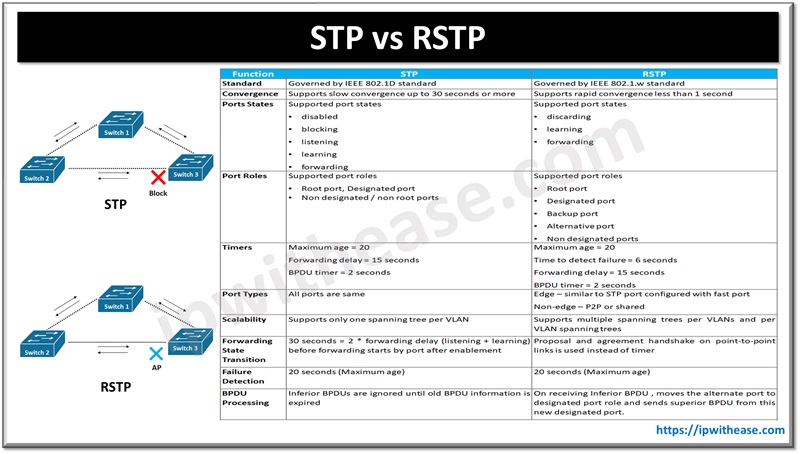
The combination of new port roles and the rapid synchronization process makes RSTP vastly superior to its predecessor.
Cisco's Implementation: Rapid PVST+
Just as Cisco created PVST+ to run a separate classic STP instance per VLAN, their implementation of RSTP is called Rapid Per-VLAN Spanning Tree Plus (Rapid PVST+ or RPVST+). This is the mode you will typically configure, as it combines the speed of RSTP with the load-balancing flexibility of a per-VLAN implementation.
RSTP is also backward-compatible. If an RSTP-enabled switch port is connected to a switch running only classic 802.1D STP, that port will automatically fall back to classic STP behavior, losing the rapid convergence benefits for that specific link.
Conclusion
In this lesson, you've seen how Rapid Spanning Tree Protocol addresses the major shortcomings of classic STP. By evolving the protocol, RSTP provides the fast network recovery time expected in modern environments.
Key Takeaways:
- RSTP (802.1w) is an evolution of STP that provides much faster convergence (typically under 10 seconds).
- It simplifies port states to just three: Discarding, Learning, and Forwarding.
- It introduces two new intelligent port roles: the Alternate Port (a hot-standby for the root port) and the Backup Port.
- Instead of passive timers, RSTP uses an active Proposal-Agreement handshake to quickly and safely bring links into a forwarding state.
- Cisco's implementation, Rapid PVST+, runs a separate RSTP instance per VLAN and is the default on modern switches.
This concludes our look at Spanning Tree. You now have the foundational knowledge of how switches prevent loops, both with the classic protocol and its modern, rapid successor. In our next lesson, we will move on to another fundamental Layer 2 technology: VLANs, which allow you to segment your network into separate broadcast domains.