Hello! In our last lesson, you learned how to enable communication between different VLANs using the "router-on-a-stick" method. This is a key skill for segmenting your network. Now, let's address another common challenge in network design: what happens when the traffic between two core devices, like switches, exceeds the capacity of a single link, or if that single link fails?
This lesson introduces EtherChannel, a technology designed to solve exactly these problems. You will learn how EtherChannel bundles multiple physical links into a single, logical link to increase bandwidth and provide high availability. Understanding the purpose of EtherChannel is the first step before we move on to configuring it, and it's a fundamental concept for building robust and scalable networks for your project.
The Problem: Redundant Links and Spanning Tree Protocol
Based on your previous studies, you know that connecting two switches with multiple cables creates a Layer 2 loop, which can cause broadcast storms and destabilize the network. Spanning Tree Protocol (STP) prevents this by blocking all but one of these redundant links.
While this prevents loops, it creates a new problem: the blocked links sit idle, wasting potential bandwidth. If you have four 1 Gbps links between two switches, STP ensures only one is active, limiting your total throughput to 1 Gbps. Adding more physical links doesn't increase speed; it just adds more blocked backup links.
The following video provides an excellent demonstration of this exact scenario.
Free CCNA | EtherChannel | Day 23 | CCNA 200-301 Complete Course
The video from Jeremy's IT Lab clearly illustrates why simply adding more cables between switches doesn't increase bandwidth.
Watch the section from the problem scenario. Notice how the network administrator adds more links, but performance doesn't improve because STP puts the new ports into a blocking state (indicated by the orange lights). This is the core problem that EtherChannel is designed to solve.
The Solution: Bundling Links with EtherChannel
EtherChannel resolves the conflict between redundancy and bandwidth. It works by grouping multiple physical Ethernet interfaces into a single logical connection, known as a port channel.
From the perspective of Spanning Tree Protocol, this entire bundle of physical links is seen as a single logical link. Since STP sees only one link, it doesn't detect a loop and therefore doesn't block any of the physical ports. All links within the EtherChannel can be active and forward traffic simultaneously.
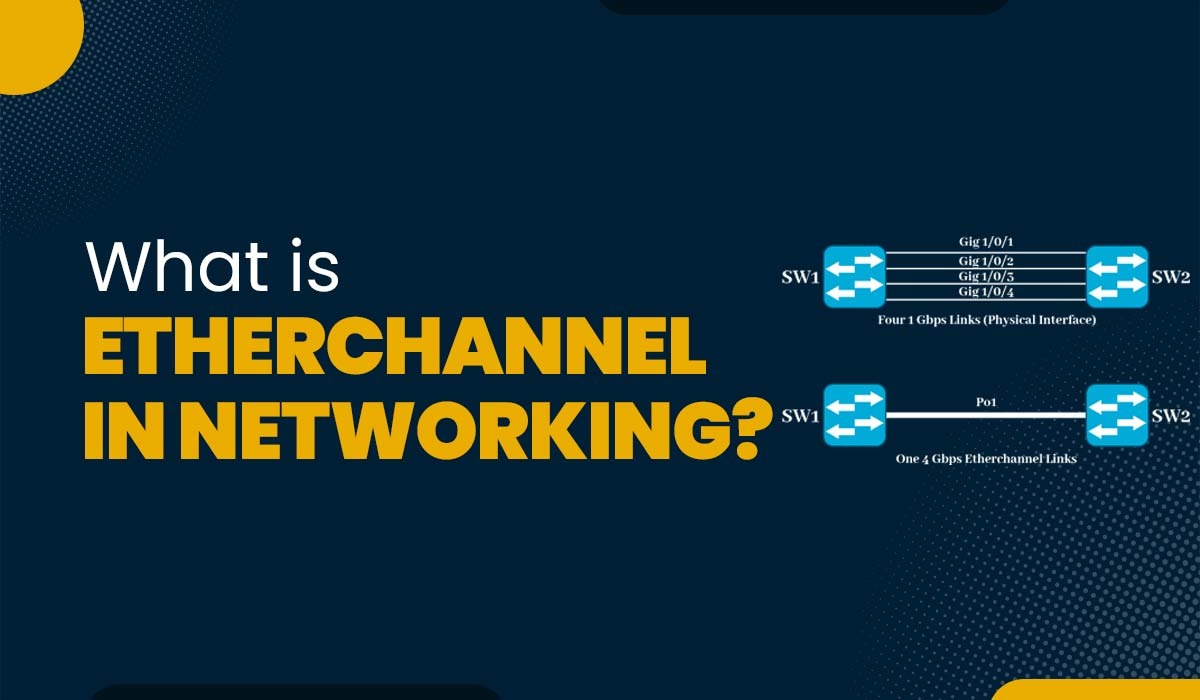
This bundling provides two primary benefits:
- Increased Bandwidth (Link Aggregation): The capacity of the physical links is combined. For example, bundling four 1 Gbps links creates a logical 4 Gbps link. Traffic is load-balanced across the physical links in the bundle.
- Redundancy (Fault Tolerance): If one physical link within the EtherChannel fails, traffic is automatically and transparently redirected to the remaining links in the bundle. The logical link stays up as long as at least one physical link is active. This provides a much faster recovery than waiting for STP to unblock a backup port.
To see how this works in practice, let's continue with the video from Jeremy's IT Lab.
Free CCNA | EtherChannel | Day 23 | CCNA 200-301 Complete Course
This segment shows how configuring the links into an EtherChannel solves the problem demonstrated earlier.
Watch from the EtherChannel solution. Pay close attention to how the switch handles a broadcast frame once the EtherChannel is formed. It sends only one copy over the logical link, which prevents a loop from forming, even though all physical links are active.
EtherChannel in Context
To solidify your understanding, the following reading from NetworkLessons.com provides another excellent, concise explanation using a slightly different scenario focused on a traffic bottleneck.
Etherchannel on Cisco IOS Catalyst Switch - NetworkLessons.com
This article reinforces the core concepts of EtherChannel by walking through a practical example of network congestion and how link aggregation provides a solution.
Read the "Key Takeaways" and "How EtherChannel Works" sections. The diagrams clearly illustrate the transition from two blocked links to a single, load-balanced logical link.
Finally, it's useful to know that while EtherChannel is the term Cisco uses, this technology is an industry standard. Other vendors use different names for the same concept.
Cisco CCNA - What is EtherChannel?
This short clip from Network Direction clarifies the terminology you might encounter in a multi-vendor environment.
Watch the brief segment from the terminology. Knowing terms like Link Aggregation Group (LAG) will be helpful as you expand your networking knowledge beyond Cisco-specific equipment.
Conclusion
In this lesson, you've learned about the fundamental purpose of EtherChannel. By understanding the limitations of Spanning Tree Protocol when multiple links are present, you can now appreciate how EtherChannel provides an elegant solution.
Key Takeaways:
- Adding multiple physical links between switches without EtherChannel results in STP blocking redundant links to prevent loops, thus wasting bandwidth.
- EtherChannel bundles multiple physical links into a single logical port channel.
- STP sees the port channel as a single link, allowing all bundled physical links to forward traffic simultaneously.
- The two primary benefits of EtherChannel are increased bandwidth through link aggregation and redundancy through automatic failover.
Now that you know why EtherChannel is used, our next lesson will focus on the practical side: you will learn how to configure a Layer 2 EtherChannel using the standard Link Aggregation Control Protocol (LACP).