Introduction
In our last lesson, we established a framework for evaluating Developer Experience (DevEx) through the lenses of feedback loops, cognitive load, and flow state. We concluded by introducing "golden paths" as a powerful strategy for improving all three dimensions by creating supported, automated workflows. You saw that they are a solution; today, we'll explore what they are and, more importantly, how they function.
This lesson directly addresses a core challenge in platform engineering and system design: balancing standardization with flexibility. Our learning outcome is to explain the concept of 'golden paths' and their role in guiding developers without constraining their autonomy. We will deconstruct this concept, moving from the organizational problem it solves to the architectural principles that make it effective. For someone with your experience in system design, this is about understanding the sociotechnical patterns that enable an organization to scale effectively.
The Core Problem: Anarchy vs. Autocracy
Before defining what a golden path is, it's essential to understand the problem it's designed to solve. In large organizations, engineering practices often drift towards one of two undesirable extremes: technology autocracy or technology anarchy.
- Technology Autocracy: A top-down, command-and-control environment with rigid standards and a central authority (like an architecture review board) that must approve every decision. This leads to high alignment but low team autonomy, creating bottlenecks and stifling innovation.
- Technology Anarchy: An environment with high team autonomy but low alignment. Every team chooses its own tools, languages, and patterns. This avoids bottlenecks but leads to a fragmented ecosystem, duplicated effort, high cognitive load, and a lack of economies of scale.
The following video provides an excellent summary of these two poles and introduces the ideal middle ground that platform engineering aims to achieve.
When Platform Engineering Devolves Into ANARCHY
This talk from the Modern Software Engineering channel frames the central tension that golden paths address.
Please watch these three short segments: First, watch the definition of technology anarchy (this section) and its consequences, like duplicated work and high cognitive load. Next, see the definition of technology autocracy (this section), the more common anti-pattern that often provokes a swing toward anarchy. Finally, watch the key insight on how to achieve high alignment and high autonomy (the solution), which sets the stage for golden paths.
As you just saw, the goal is not to trade autonomy for alignment, but to achieve both. This is where golden paths come in. They are the mechanism for providing "context, not command and control" and "guidance, not rules."
Defining the Golden Path
The term "golden path" was popularized by Spotify to describe their solution to the "rumour-driven development" and fragmentation that emerged from their high-autonomy culture.
How We Use Golden Paths to Solve Fragmentation in Our Software ...
This article from Spotify's engineering blog is the definitive origin story for the golden path concept.
Please read from the beginning of the article through the section "The Golden Path today". Pay close attention to: The initial problem of fragmentation. The original goals: discoverability, a clear journey, and obvious support. The official definition: the 'opinionated and supported' path to build something.
A golden path is essentially a curated, well-supported, and automated workflow for accomplishing a common, recurring task, such as creating a new microservice, setting up a data pipeline, or deploying a web application. It represents the platform team's opinion on the best way to get a job done, bundling together tools, best practices, and infrastructure.
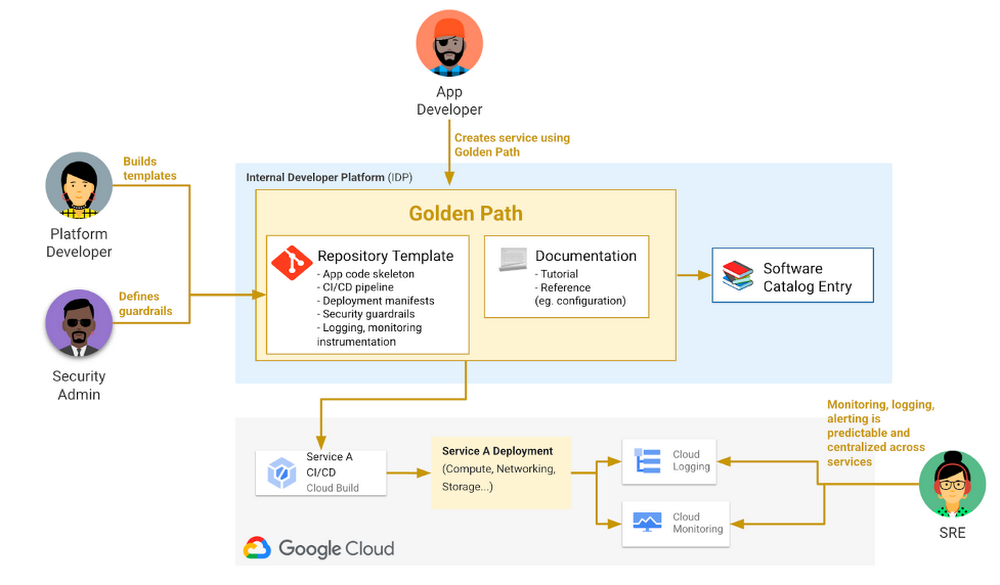
The diagram below illustrates how a golden path fits within an Internal Developer Platform (IDP). A platform team defines the path, which includes templates and guardrails. An application developer uses this path to create a new service, which is then automatically provisioned with the necessary infrastructure, logging, and monitoring.
The Balancing Act: Guidance Without Constraint
This all sounds efficient, but it also sounds dangerously close to the "autocracy" we wanted to avoid. If there's one "golden" way, what happens to developer autonomy and creativity? How do you prevent the golden path from becoming a golden cage?
The answer lies in two critical principles: optionality and extensibility.
A golden path is the "paved road," not the only road. It's designed to cover the most common use cases (the 80%) with a solution that is so easy and effective that most developers choose to use it. For the remaining 20% of cases that have unique requirements, developers must have the freedom to take a different route. This is the concept of an escape hatch.
This talk, which we briefly touched on in the last lesson, provides a clear explanation of this balance.
Achieving High Performance with an Internal Developer Platform • Alex Bikfalvi • GOTO 2022
This segment from Alex Bikfalvi's talk at GOTO 2022 explains the 80/20 principle and the concept of escape hatches.
Please watch the section from common ground. Focus on the idea of the golden path for the 80% use case and the need for escape hatches to allow teams to plug in customized components.
The ability to opt-out or extend the path is what preserves autonomy. Developers are guided, not forced. The trade-off is made explicit: if you stay on the golden path, you get full support, automation, and a frictionless experience. If you use an escape hatch to go off-road, you take on more responsibility for building and maintaining your custom solution.
This Venn diagram perfectly captures this desired outcome: the intersection of standardized golden paths and the flexibility for individual solutions is where you achieve both support and autonomy.

What Makes a Path "Golden"?
To ensure a golden path provides guidance without becoming a rigid mandate, it must be designed with specific characteristics in mind.
This guide from Pulumi synthesizes the key attributes of a well-designed golden path and the common pitfalls to avoid.
Please read two sections: "What Makes a Golden Path Golden?" This provides a five-point checklist for a successful path. "Common Pitfalls and How to Avoid Them". Pay special attention to "Insufficient Escape Hatches."
Synthesizing from the resources, a well-designed golden path is:
- Opinionated and Supported: The platform team makes choices about tools and patterns and commits to supporting them.
- Optional but Recommended: Developers can opt-out, but the path is the easiest and most attractive option.
- Extensible: It's not an all-or-nothing proposition. Teams can often use parts of the path and customize others.
- Transparent: It's not a magical black box. Developers should be able to understand what the path is doing under the hood. This builds trust and enables easier debugging.
- Evolutionary: A golden path is not a static artifact. It's a product that must be improved over time based on developer feedback and changing requirements.
By adhering to these principles, a platform team can provide powerful accelerators that reduce cognitive load and improve DevEx, while still empowering developers to make the right decisions for their specific contexts. This is the essence of building an enabling platform rather than a controlling one.
Conclusion
In this lesson, we have dissected the concept of golden paths, positioning them as a sophisticated solution to the classic organizational tension between autonomy and alignment. They are far more than just project templates; they are a manifestation of a platform-as-a-product mindset, designed to make the right way the easy way.
Key Takeaways:
- Golden paths are the antidote to the extremes of technology anarchy (low alignment, high autonomy) and technology autocracy (high alignment, low autonomy).
- They are opinionated, supported, and automated workflows for common development tasks, designed to reduce cognitive load and accelerate delivery.
- The key to preserving developer freedom is the principle of optionality and the availability of escape hatches, allowing teams to deviate from the path when necessary.
- A successful golden path is not a rigid cage but a transparent, extensible, and evolving product that developers choose to use because it provides a superior experience.
Preview of the Next Lesson
We've now defined the core components of an IDP and the philosophy behind its key offerings like golden paths. But how do you decide what to build first? In the next lesson, "Designing and Evolving an Internal Platform," we will move into the practicalities of product management for platforms. You will learn how to conduct user research with internal developers to identify their most critical pain points and use that data to define a Minimum Viable Platform (MVP).