Introduction
In our last lesson, we deconstructed the architecture of an Internal Developer Platform (IDP), identifying its five core planes and the key components—from service catalogs to platform orchestrators—that enable developer self-service. You now have the blueprint for what an IDP is. However, a technically complete platform is not necessarily a successful one. Its value is ultimately determined by whether developers use it and whether it genuinely makes their work easier and more effective.
This brings us to the focus of today's lesson. Our goal is to evaluate the developer experience (DevEx) of a given platform by applying key DevEx dimensions and proposing measurable improvements. We will move beyond the technical implementation to the human experience of using the platform. You'll learn a framework to diagnose friction, measure what matters, and justify improvements, ensuring that the significant investment an IDP represents delivers a real return.
What is Developer Experience?
First, it's crucial to define what we mean by "Developer Experience." It's not about office perks or superficial benefits. DevEx refers to the quality of the interactions developers have with the tools, platforms, and processes they must use to do their jobs. A good DevEx removes friction and cognitive overhead, allowing developers to focus their mental energy on creative problem-solving. A poor DevEx, conversely, leads to frustration, burnout, and slow delivery.
To make this concept tangible, let's explore two contrasting scenarios from an article by Tim Cochran on Martin Fowler's blog.
Maximizing Developer Effectiveness - martinfowler.com
This article provides two powerful vignettes that illustrate the real-world difference between a high- and low-effectiveness development environment.
Please read the two sections detailing the "day in the life" of a developer: first, in a highly effective environment, and then in a low effective environment. As you read, reflect on which aspects of each scenario feel familiar from your own 15 years of experience.
These two stories vividly capture the essence of DevEx. The "highly effective" environment is characterized by momentum, clarity, and autonomy. The "low effective" environment is a story of "death by a thousand cuts," where small, compounding inefficiencies destroy productivity and morale. The goal of a platform engineering team is to intentionally create the conditions for the first story and systematically eliminate the blockers described in the second.
The Three Dimensions of Developer Experience
To move from a gut feeling about DevEx to a structured evaluation, we need a framework. Research has shown that DevEx can be broken down into three core, measurable dimensions: Feedback Loops, Cognitive Load, and Flow State. Improving a platform is fundamentally about making targeted improvements across these three areas.
A comprehensive guide from the company DX provides excellent definitions for these dimensions.
What is developer experience? Complete guide to DevEx ... - DX
This article clearly defines the three core dimensions that shape the developer experience.
Please read the section The three forces. Focus on understanding the definitions of feedback loops, cognitive load, and flow state, as well as the examples provided for each.
Let's briefly synthesize these concepts:
- Feedback Loops: This refers to the speed and quality of information a developer receives after taking an action. How long does it take to know if a code change works? Fast, automated feedback (from local tests, CI pipelines, or deployments) enables rapid iteration. Slow feedback loops kill momentum and introduce context switching, as developers are forced to wait.
- Cognitive Load: This is the mental effort required to perform a task. In software development, extraneous cognitive load comes from navigating complex architectures, deciphering poor documentation, dealing with inconsistent tools, or trying to understand opaque processes. An effective IDP reduces cognitive load by abstracting away underlying complexity and providing clear, consistent interfaces.
- Flow State: This is the state of deep, uninterrupted concentration that is essential for solving complex problems. A developer's environment can either protect or destroy this state. Constant meetings, disruptive notifications, and frequent context switching are the enemies of flow. A good platform promotes flow by automating toil and providing self-service capabilities that don't require waiting for others.
These three dimensions are interconnected. For example, a slow feedback loop (waiting 30 minutes for a build) increases cognitive load (trying to remember the context of the change) and breaks flow state (getting distracted while waiting).
How to Measure Developer Experience
You cannot reliably improve what you don't measure. Evaluating DevEx requires a balanced approach that combines objective system data with subjective developer perceptions. Neither tells the full story on its own.
In this video, Nicole Forsgren, creator of the renowned DORA and SPACE frameworks, discusses this dual approach to understanding developer productivity and experience.
Developer productivity with Nicole Forsgren (the creator of DORA)
This interview with Nicole Forsgren offers an expert perspective on measuring engineering performance holistically.
First, watch her explanation of the SPACE framework and the need for a "constellation of metrics" combining qualitative feedback with objective system data. Watch from constellation of metrics. Next, she defines developer experience as the "lived experience" of a developer, emphasizing the need to identify and remove friction, blockers, and confusion. Watch from lived experience. Finally, listen to her practical advice on making the case for investment in platform teams, which involves combining data (the "what") with stories (the "why"). Watch from data and stories.
As Dr. Forsgren explained, a robust measurement strategy integrates two types of data:
- System & Workflow Metrics (Quantitative): This is objective data pulled from your engineering systems. These metrics tell you what is happening.
- Developer Perceptions (Qualitative): This is subjective feedback gathered directly from developers, typically through surveys. This data tells you how it feels and why it matters.
The following table provides examples of metrics across both categories, mapped to the three DevEx dimensions we've discussed.

Let's break down how to gather these metrics.
Measuring with System Data
System data provides the hard numbers about your engineering process performance. These often align with the well-known DORA metrics (Deployment Frequency, Lead Time for Changes, Change Failure Rate, Time to Restore Service), which primarily measure the velocity and stability of your commit-to-deploy pipeline. Other key metrics include:
- Time to run local tests
- CI build and test duration
- Code review turnaround time (time from PR creation to merge)
- Time to provision a new environment
These metrics are powerful for identifying bottlenecks. For example, a long code review turnaround time directly indicates a slow feedback loop.
Measuring with Developer Perceptions
System data alone can be misleading. A "fast" build time of 5 minutes might feel excruciatingly slow if it's for a trivial change. This is where developer surveys become essential for capturing the qualitative "lived experience."
What is developer experience? Complete guide to DevEx ... - DX
This article offers a practical guide to measuring DevEx, focusing on the combination of perception data and system data, and provides concrete advice on designing effective surveys.
Please read the following sections: How to measure, which introduces the framework combining perceptions and workflows. Designing effective surveys, which gives actionable tips for creating surveys. Combining data, which reinforces the need for a balanced approach.
Key principles for effective DevEx surveys include:
- Focus on the three dimensions: Ask specific questions like, "How satisfied are you with the time it takes to validate a local change?" (Feedback Loop) or "How easy is it to find the documentation you need to do your work?" (Cognitive Load).
- Keep them short and frequent: Quarterly surveys of 5-10 questions are often more effective than an annual behemoth.
- Segment the results: Analyze responses by team, role, or tenure. The experience of a new hire is a powerful indicator of your onboarding effectiveness and documentation quality.
By combining the "what" from system data with the "why" from surveys, you can build a comprehensive picture of your platform's DevEx and accurately pinpoint the most impactful areas for improvement.
Proposing Improvements: The Role of Golden Paths
Evaluating DevEx is only the first step. The ultimate goal is to propose measurable improvements. One of the most powerful strategies for improving DevEx is the creation and promotion of "golden paths."
As we touched on in the previous lesson, a golden path is a curated, supported, and well-documented workflow for a common task, like creating a new microservice or deploying an application. It represents the "paved road" that the platform team provides.
Achieving High Performance with an Internal Developer Platform • Alex Bikfalvi • GOTO 2022
In this talk, Alex Bikfalvi from Adevinta discusses how platform teams use golden paths to improve developer effectiveness.
Please watch the segments where he explains: The concept of the golden path for the 80% use case, and the necessity of escape hatches for the other 20%. Watch from common ground. The critical importance of developer experience, treating the platform as a product, and the role of interfaces and "glue" code. Watch from developer experience glue.
Golden paths directly improve all three dimensions of DevEx:
- They reduce cognitive load by providing a default, recommended way of doing things, complete with templates and pre-configured tools. Developers don't have to reinvent the wheel.
- They shorten feedback loops by baking in best practices for CI/CD, testing, and observability from the start.
- They protect flow state by automating away manual setup and configuration, allowing developers to get to the actual coding faster.
When proposing improvements, you can frame them as establishing or enhancing a golden path. For example:
- Problem: "Survey data shows developers are frustrated with the time it takes to set up a new service (high cognitive load). System metrics confirm it takes an average of 3 days."
- Proposed Improvement: "We will create a 'New Service' golden path via a software template in the developer portal. This will automate the creation of the code repository, CI/CD pipeline, and default monitoring dashboard."
- Measurable Outcome: "Our goal is to reduce the time to create a production-ready 'hello world' service from 3 days to under 15 minutes and improve developer satisfaction with this workflow by 50% in the next quarter."
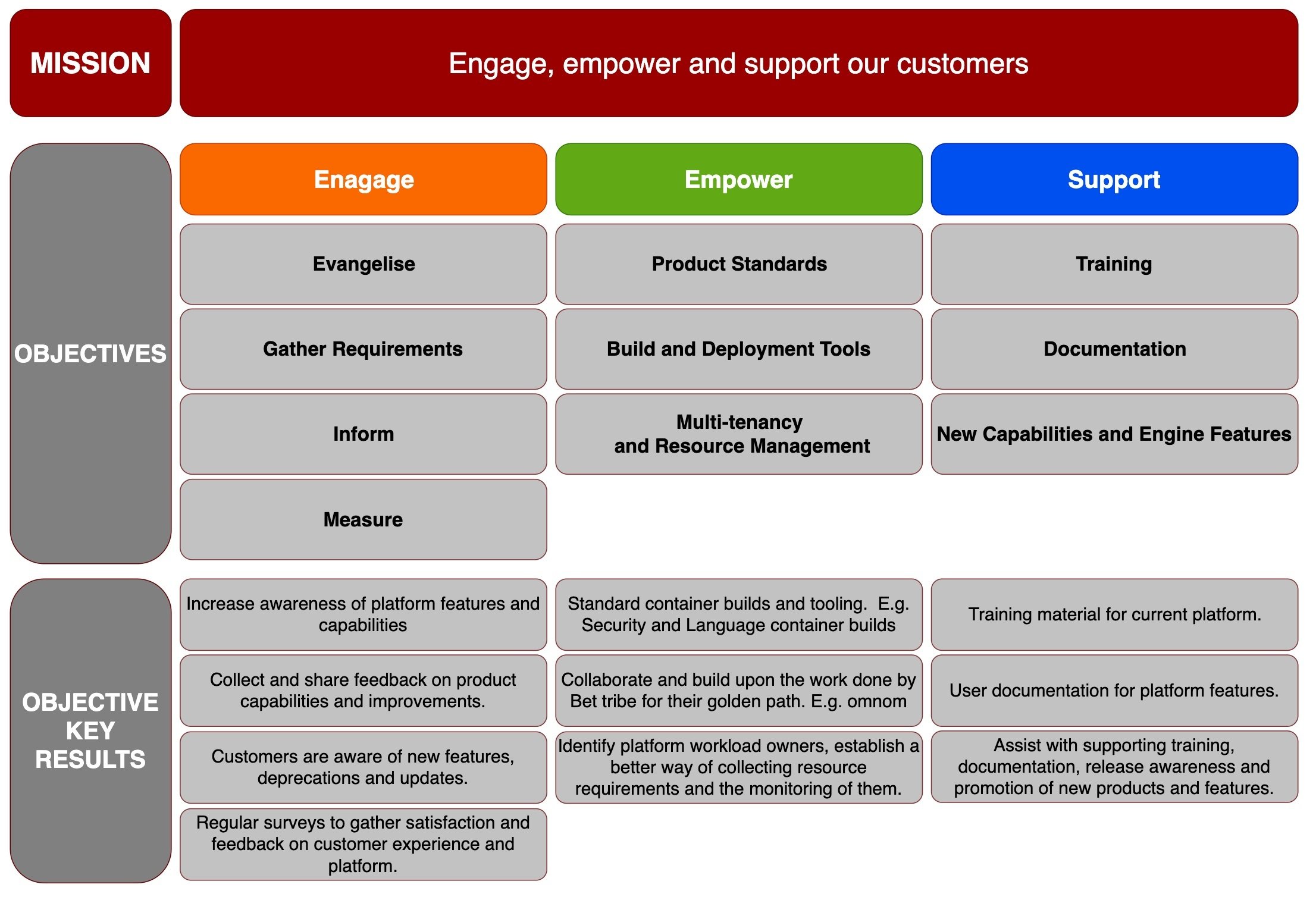
This approach connects a specific DevEx pain point to a concrete platform feature with a measurable business outcome. The following diagram shows how a platform team's mission can be structured to deliver these kinds of results.
Conclusion
Today, we've established a robust framework for moving beyond the technical architecture of a platform to evaluating its human impact. A great platform is not just about having the right tools; it's about how those tools come together to create a frictionless, productive, and satisfying experience for developers.
Key Takeaways:
- Developer Experience (DevEx) is the quality of developers' daily interactions with their tools and processes, defined by three dimensions: Feedback Loops, Cognitive Load, and Flow State.
- Evaluating DevEx requires a hybrid approach, combining quantitative system data (the "what") with qualitative developer perceptions from surveys (the "why").
- A structured evaluation maps specific metrics—like CI build times or survey satisfaction scores—back to the three core DevEx dimensions to identify key pain points.
- Proposing improvements should be framed as creating or enhancing "golden paths"—supported, automated workflows that reduce cognitive load, shorten feedback loops, and protect flow state.
- Improvements should be tied to measurable outcomes, such as reducing the time for a specific task or increasing a developer satisfaction score.
Preview of the Next Lesson
We've learned the framework for what to measure when evaluating DevEx. But how do you effectively gather the rich, qualitative insights needed to understand the developer's "lived experience"? In our next lesson, we will dive into the practical skills of conducting user research with internal developers to identify critical pain points and platform requirements. You will learn how to plan and execute interviews and other feedback sessions that yield the actionable insights needed to build a platform your developers will love.