Introduction
In our last lesson, we explored the concept of "golden paths," establishing them as a key strategy for building an effective Internal Developer Platform (IDP) that guides developers without restricting their autonomy. This embodies the "platform as a product" mindset. Now, we shift from the what to the how. If your platform is a product, your internal developers are its customers. How do you figure out what product they actually need and want?
This lesson directly addresses that question, focusing on the learning outcome: to conduct user research with internal developers to identify critical pain points and platform requirements. For an experienced software engineer like yourself, this is about changing your perspective—from being a consumer of internal tools to becoming the architect and product owner who systematically understands and serves the needs of your fellow engineers. We will cover the essential mindset, frameworks for analysis, and practical methods for gathering the data you need to build a platform that developers will actually love to use.
The Mindset: Start with Doubt
Before diving into techniques, it's crucial to adopt the right mindset. When building an internal platform, the most dangerous assumption is that you, as an engineer, already know what other engineers need. Your experience is valuable, but it's only one data point. A successful platform owner must begin with humility and curiosity.
The philosopher René Descartes famously began his method with the principle of dubito—I doubt. This is the perfect starting point for user research. You must doubt your own assumptions and actively seek to understand the lived experience of your users.
Some Principles From Real World Internal Developer Platform Engineering • Russ Miles • GOTO 2024
In this clip from his GOTO 2024 talk, Russ Miles explains why starting with doubt and actively following the needs and the "chaos" are fundamental to building a successful platform.
Please watch the segment from dubito. Pay close attention to his points on why "you are not the expert" and how support queues and user struggles are "gold mines" of information.
As Russ Miles argues, you must "follow the needs" and "follow the chaos." This means systematically investigating where developers are getting lost, frustrated, or slowed down. Our goal in this lesson is to give you the tools to do just that.
A Framework for Understanding: The Three Dimensions of DevEx
To "follow the chaos" effectively, you need a map. It's not enough to collect random complaints; you need a framework to categorize and understand developer pain points. The concept of Developer Experience (DevEx) provides this structure.
Let's begin by watching a short narrative that brings a typical developer's frustrations to life.
Transforming Developer Experience: A Tale of Recovery & Innovation • Michaela Greiler • GOTO 2024
In this talk from GOTO 2024, researcher Dr. Michaela Greiler tells the story of "Rose," a developer whose day is derailed by a series of common friction points. This story perfectly illustrates what poor DevEx feels like in practice.
Watch the opening of the talk, which details Rose's frustrating day. As you watch, consider which of these obstacles you've encountered in your own career.
Rose's day was filled with interruptions, unclear requirements, and slow, flaky tools. These aren't just isolated annoyances; they are symptoms of poor developer experience. Research has categorized these issues into three core dimensions. Understanding them gives you a powerful lens for your user research.
What is developer experience? Complete guide to DevEx ... - DX
This article from DX provides a concise and well-researched overview of the three core dimensions of Developer Experience.
Please read the section titled "The three forces that shape developer experience". Focus on understanding the definitions of feedback loops, cognitive load, and flow state.
These three dimensions—feedback loops, cognitive load, and flow state—are the key areas you will investigate. Your research questions should be designed to uncover pain points related to them:
- Feedback Loops: Where are developers waiting? For builds, for tests, for reviews, for deployments?
- Cognitive Load: What is hard to understand? The architecture, the deployment process, the documentation? Where is there unnecessary complexity or inconsistency?
- Flow State: What is interrupting developers? Meetings, notifications, context switching due to slow tooling?
The Methods: Combining the "What" and the "Why"
With a framework in place, you can now select your research methods. The most effective approach combines two types of data:
- Quantitative Data (The "What"): This is numerical data that tells you what is happening at scale. Examples include system metrics (build times, deployment frequency) and survey results (e.g., "On a scale of 1-5, how satisfied are you with code review speed?").
- Qualitative Data (The "Why"): This is descriptive, narrative data that tells you why it's happening. It comes from interviews, open-ended survey questions, and direct observation.
A skilled researcher uses quantitative data to identify potential problem areas and qualitative data to understand the root cause and human impact.
Transforming Developer Experience: A Tale of Recovery & Innovation • Michaela Greiler • GOTO 2024
Dr. Greiler provides a clear overview of the different data gathering methods, categorizing them into human-centered and system-centered approaches.
Watch the segment on the "Identify" phase of improving DevEx, starting from how to gather data. This will give you a menu of options for your research toolkit.
For the remainder of this lesson, we will focus on the two most powerful and accessible methods for platform teams: surveys (for quantitative insights) and interviews (for qualitative depth).
Deep Dive 1: Designing Effective Surveys
Surveys are your tool for getting broad feedback from the entire engineering organization. They help you quantify pain points and track sentiment over time. However, a poorly designed survey is worse than no survey at all.
What is developer experience? Complete guide to DevEx ... - DX
This article provides excellent, high-level principles for designing surveys that generate honest and actionable feedback.
Read the section "Developer experience surveys". Pay close attention to the advice on defining objectives, keeping it short, using simple language, and acting on feedback.
Now let's get more tactical. What specific questions should you ask, and what common traps should you avoid?
How to create a developer experience survey: The ultimate guide
This guide from Port.io offers very practical advice on question design and avoiding common pitfalls.
First, read the section "What should I avoid in my survey?" to understand the dangers of leading questions and trying to validate your own assumptions. Next, review the section "What should I ask?". You don't need to memorize all the questions, but notice how they are categorized to probe different areas: importance vs. satisfaction, specific pain points, and overall well-being.
Deep Dive 2: Conducting Insightful Interviews
While surveys tell you what hurts, interviews tell you why. This is where you uncover the stories, context, and root causes behind the numbers. The goal of a user interview is not to validate a solution, but to deeply understand a problem from the user's perspective.
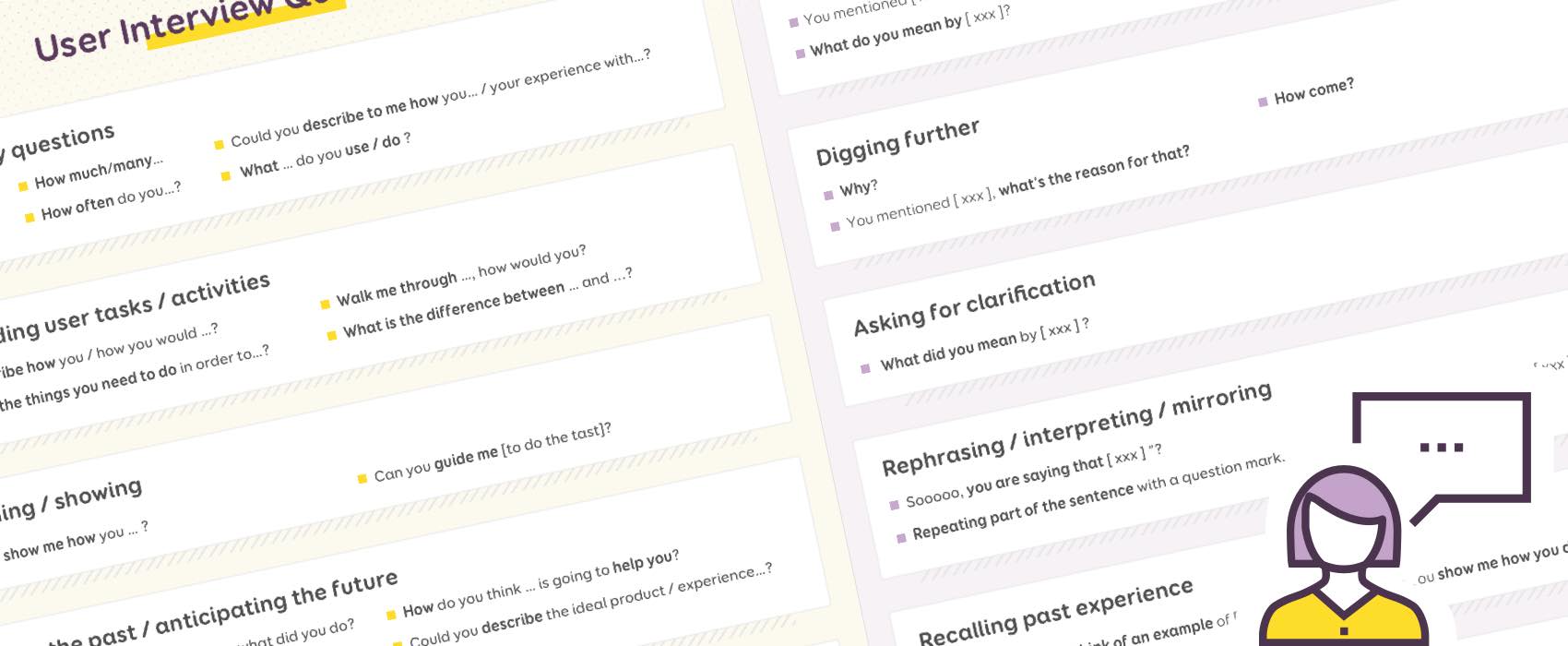
Effective interviewing is about asking open-ended questions that encourage storytelling. Instead of "Is the build slow?", ask "Walk me through the last time you deployed a change. What was that process like?"
The most critical skill in user research is digging past the initial symptom to find the true root cause. A team might complain about "slow code reviews," but simply measuring and trying to speed up review time might not solve the problem—and could even make things worse.
Transforming Developer Experience: A Tale of Recovery & Innovation • Michaela Greiler • GOTO 2024
Dr. Greiler uses her case study of Rose to demonstrate how "slow code review turnaround times" is often a symptom, not the cause. She then walks through a root cause analysis that uncovers the real issues.
Watch this segment from symptom not the cause. Notice how the investigation moves from the surface problem (slow reviews) to deeper issues like expert overload, lack of confidence in junior members, and poor tests.
This is why qualitative interviews are indispensable. You would never uncover that chain of causality from a survey alone. It's in the stories that the real insights lie.
Some Principles From Real World Internal Developer Platform Engineering • Russ Miles • GOTO 2024
Russ Miles makes a powerful case for why stories, not just numbers, are the key to understanding user needs and building empathy.
Watch his concluding thoughts on the importance of stories and empathy. His concept of "Gemb-overguessing"—taking a vacation to go and experience the life of your users—is the essence of good qualitative research.
From Research to Requirements: Prioritizing What to Build
After conducting surveys and interviews, you will have a rich set of quantitative and qualitative data. The final step is to synthesize this data into a prioritized list of platform requirements. A simple but effective tool for this is the impact/effort matrix.
You can take the pain points and potential solutions identified in your research and map them onto a 2x2 grid:

- Quick Wins (High Impact, Low Effort): These are the most attractive opportunities. They address significant developer pain without requiring massive investment. They are perfect candidates for your initial platform offering, or Minimum Viable Platform (MVP).
- Big Projects (High Impact, High Effort): These are major strategic initiatives. They deliver huge value but require significant planning and resources. They should form the core of your long-term platform roadmap.
- Fill-in Jobs (Low Impact, Low Effort): These are minor improvements that can be tackled when you have spare capacity, but they shouldn't distract from more important work.
- Thankless Tasks (Low Impact, High Effort): These should be avoided. They consume a lot of resources for very little developer benefit. Your research helps you identify and steer clear of these.
By plotting your findings on this matrix, you transform a messy collection of feedback into a clear, prioritized action plan.
Conclusion
In this lesson, we have laid the foundation for building a developer platform that is truly user-centric. You've learned that effective platform design starts not with technology, but with empathy and a systematic process of inquiry.
Key Takeaways:
- Start with Doubt (
dubito): The foundation of user research is acknowledging that you are not the expert on other developers' experiences. - Use a Framework: The three dimensions of DevEx—feedback loops, cognitive load, and flow state—provide a structured way to analyze developer pain points.
- Combine Methods: Use quantitative tools like surveys to understand the "what" at scale, and qualitative methods like interviews to uncover the "why" and find the root cause.
- Seek Stories, Not Just Numbers: The richest insights come from understanding the narratives and lived experiences of your fellow engineers.
- Prioritize Ruthlessly: Use frameworks like the impact/effort matrix to translate your research findings into an actionable, prioritized roadmap.
Preview of the Next Lesson
You now have a toolkit for understanding what your developers need. But you can't build everything at once. In our next lesson, we will focus on "Defining the scope and core capabilities of a Minimum Viable Platform (MVP)." We will take the "Quick Wins" and high-priority "Big Projects" identified in your research and learn how to shape them into a coherent, valuable first version of your platform.