Introduction
In our last lesson, we established a framework for listening to your internal customers—the developers—by designing feedback loops. You learned how to turn their experiences, both good and bad, into a prioritized list of pain points. Now, we shift from listening to acting. This lesson focuses on translating that understanding into a concrete plan by learning to define the scope and core capabilities of a Minimum Viable Platform (MVP) based on prioritized developer pain points.
This isn't about building a "minimal" or incomplete platform. It's a strategic exercise in delivering maximum impact with a focused initial effort. For a senior engineer accustomed to designing complex systems, this is a lesson in strategic subtraction: identifying the single, critical thread to pull that will unravel the biggest tangle of developer friction. We will explore how to scope this first iteration to solve a real problem, demonstrate value quickly, and build the momentum needed for the platform to succeed and grow.
From MVP to "Thinnest Viable Platform"
The term "Minimum Viable Product" is often associated with startups launching a new product to external customers. In platform engineering, the concept is similar, but the context is internal. Your goal is to create an initial version of your Internal Developer Platform (IDP) that is compelling enough for a first group of "pioneer" teams to adopt.
A powerful way to frame this is the concept of the Thinnest Viable Platform (TVP), popularized by the book Team Topologies. This reframes the question from "What's the minimum we can build?" to "What's the thinnest possible slice of platform we can provide to accelerate delivery and reduce cognitive load for stream-aligned teams?"
This article from the creators of Team Topologies introduces the TVP concept. It forces a crucial shift in mindset, away from technology and towards user needs.
Read the section titled "Definition of 'Platform'" to understand the core principle: the primary goal of any internal platform is to reduce the cognitive load on its users. Then, continue to the next section, "Where to start with your Platform?", which emphasizes that the right purpose is improving developer experience (DevEx) by reducing this load.
This focus on reducing cognitive load is your guiding star. Every decision about what goes into your MVP should be validated against the question: "Does this feature materially reduce the cognitive burden on our developers for a high-friction task?"
Mapping Pain Points to MVP Capabilities
In the previous module, you learned how to identify and prioritize developer pain points. The highest-impact, lowest-effort problems from that analysis are your primary candidates for the MVP. The goal is to find the "low-hanging fruits" that are causing the most significant slowdowns or frustration.
What is Platform Engineering and how it fits into DevOps and Cloud world
In this video, "What is Platform Engineering," TechWorld with Nana provides excellent context on the problems platform engineering solves and how to begin.
First, watch the segment that describes the challenges of autonomous DevOps teams. This effectively illustrates the "cognitive load" and "inefficiency" that developer pain point analysis uncovers. Next, jump to the section on where to start. The advice here is critical: begin with the "low-hanging fruits" and solve the biggest bottlenecks that developers are already facing.
The video rightly points out that forcing a new standard on teams without first solving a real problem for them is a recipe for failure. Your MVP's capabilities must be a direct answer to the pain points you've discovered.
Consider the common developer workflow. Where are the points of friction?

If your research revealed that setting up a new service takes weeks of manual configuration and ticket-chasing, then service scaffolding ("Scaffold new service") is a prime MVP candidate. If deploying to a development environment is a complex, error-prone ritual, then a one-click dev environment deployment is a clear winner.
Defining the "Golden Path" and "Escape Hatches"
An MVP cannot be everything to everyone. Attempting to support every programming language, framework, and deployment pattern in your organization from day one is a path to failure. Instead, a successful platform MVP defines a "golden path" (also called a "paved road").
The golden path is the supported, opinionated, and streamlined way to accomplish a task for the most common use case (the "80%"). It's a bundle of tools, services, and patterns that are tested, documented, and work seamlessly together. By using the golden path, developers trade some flexibility for a massive reduction in cognitive load and a significant increase in speed.
Of course, what about the other 20%? This is where "escape hatches" become critical. An escape hatch is a well-defined interface that allows a team with a specialized need to bypass or replace a part of the golden path with their own custom component, without being completely cut off from the platform.
Achieving High Performance with an Internal Developer Platform • Alex Bikfalvi • GOTO 2022
Alex Bikfalvi's talk, "Achieving High Performance with an Internal Developer Platform," gives a fantastic real-world explanation of these concepts.
Watch the section where he explains the "common ground" and "golden path," and how they build "escape hatches" to provide flexibility. This balance is key to platform adoption. Then, continue watching the next segment on developer experience, glue, and interfaces. This highlights that the platform team's job is not to rebuild everything, but to integrate existing tools and provide a thin layer of "glue" that makes them work well together.
For your MVP, you might define a golden path for a new microservice using Java, Spring Boot, and PostgreSQL. The escape hatch could be an interface that allows a data science team to deploy a Python service and connect it to the platform's observability stack, even if it doesn't use the rest of the golden path. This approach provides value to the majority while not blocking the minority.
Core Capabilities of a Platform MVP
So, what does a concrete MVP often look like? While the specifics depend entirely on your organization's pain points, most successful MVPs deliver a coherent, end-to-end slice of the development lifecycle.
Here are some common capabilities included in a platform MVP:
- Developer Interface: A single point of entry, whether it's a CLI, a simple web UI (like Backstage), or even just a set of Git repositories with templates.
- Service Scaffolding:
cookiecuttertemplates or similar tools to create a new, production-ready service skeleton in minutes, complete with CI, testing, and documentation boilerplate. - CI/CD Pipeline: A standardized, reusable pipeline for building, testing, and deploying applications along the golden path.
- Environment Provisioning: Self-service creation and destruction of development and testing environments.
- Core Infrastructure Resources: A way to easily provision standard resources like a database, a cache, or a message queue.
- Basic Observability: Pre-configured logging, metrics, and tracing for any service deployed via the platform.
Achieving High Performance with an Internal Developer Platform • Alex Bikfalvi • GOTO 2022
Let's return to Alex Bikfalvi's talk to see a real-world example of an MVP and its evolution.
Watch the segment where he details the components of their internal platform. Notice how it covers the full lifecycle from development to monitoring. This is a great example of a mature platform, but the seeds of it were in their MVP. Next, watch his summary of their platform's journey. He explicitly mentions that in 2019, they focused on "nailing the MVP" by focusing on automation and defining the common tooling. This is exactly the process we're discussing.
From Viable Product to Viable Architecture
Finally, a list of features is not enough. The MVP must be built on a Minimum Viable Architecture (MVA). The features must be valuable, but the underlying system must also be scalable and supportable.
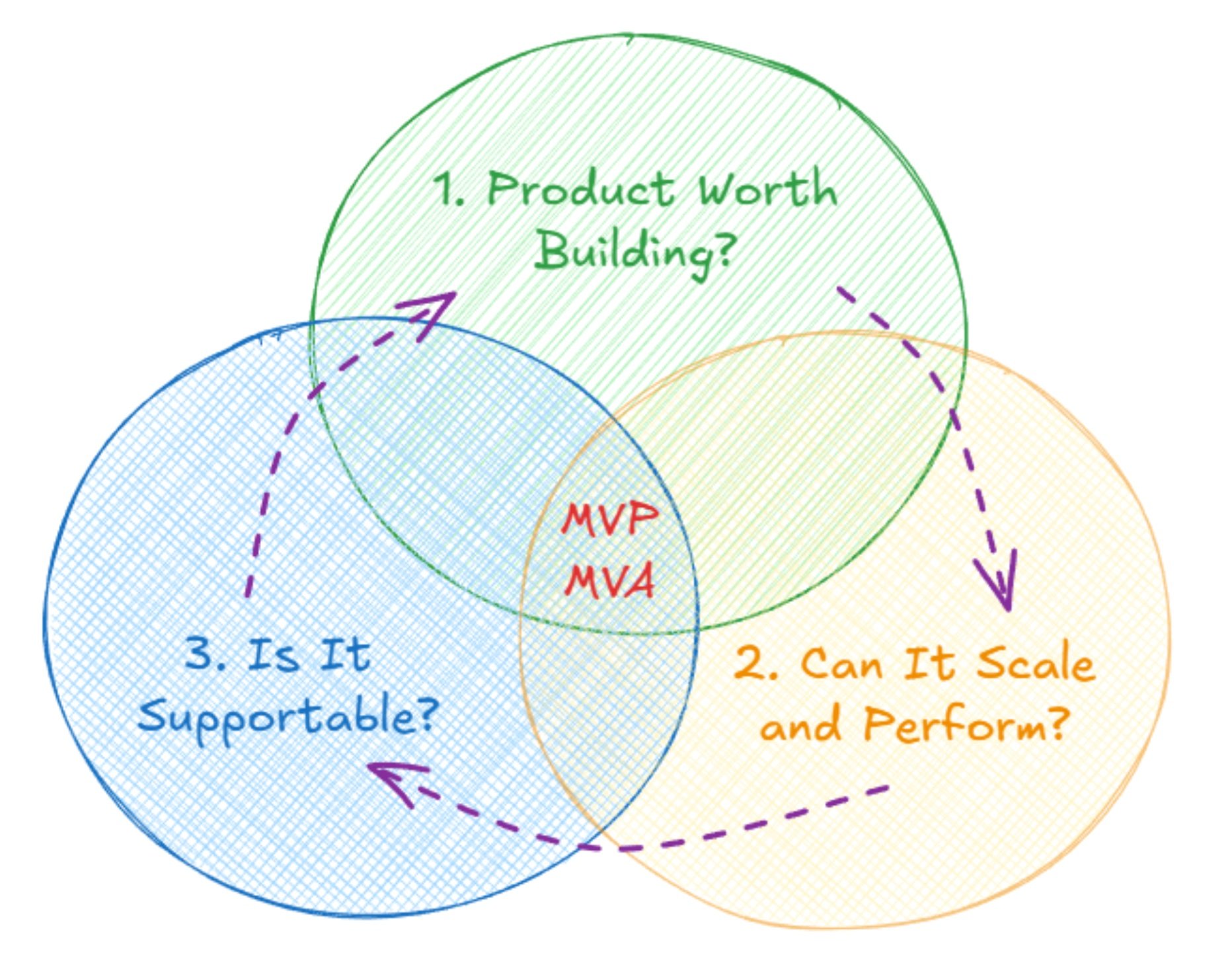
- Product Worth Building? (Value) - This is what we've been discussing. Does the MVP solve a real, high-priority pain point for developers?
- Can It Scale and Perform? (Feasibility) - Will the chosen architecture for the MVP support more teams and more complex services in the future, or is it a dead end? You must design the core with evolution in mind.
- Is It Supportable? (Business Viability) - Can your platform team realistically operate, maintain, and secure the MVP? Choosing a complex technology that no one on the team knows how to run is not a viable starting point.
Your defined MVP scope must satisfy all three of these criteria. An MVP that solves a developer problem but constantly falls over or requires heroic effort from the platform team to maintain is not truly "viable."
Conclusion
Defining the scope of your Minimum Viable Platform is a crucial strategic step that sets the tone for your entire platform engineering initiative. It's where your user research transforms into an actionable plan that can deliver immediate value and build trust with your developer community.
Key Takeaways:
- Focus on the "Thinnest Viable Platform": Aim to build the smallest possible slice of functionality that demonstrably reduces developer cognitive load and accelerates delivery.
- Start with Pain: Your MVP's capabilities must be a direct response to the most significant, prioritized pain points identified through developer research.
- Define a Golden Path with Escape Hatches: Create a streamlined, opinionated path for the common case to maximize velocity, while providing well-defined interfaces for teams with special requirements.
- Deliver an End-to-End Slice: A good MVP often provides a coherent experience across a segment of the development lifecycle, such as from
git initto a running service in a dev environment. - Ensure a Minimum Viable Architecture: Your MVP must not only be valuable to users but also be built on a technical foundation that is scalable and supportable by your team.
Preview of the Next Lesson
Now that you understand the principles of scoping an MVP, the next step is to give it a concrete form. In our next lesson, we will "Create a high-level architectural diagram for an MVP, identifying its key technical components." You will take the capabilities you've defined and translate them into a technical blueprint, laying the groundwork for actually building your platform.