Welcome to the next lesson in our exploration of strategic AI integration. In our previous session, we delved into architectural patterns for managing the inherent complexity of AI systems, focusing on abstraction layers and robust monitoring. We established how to build systems that are both controllable and maintainable.
Now, we will zoom out from those implementation details to a broader, more strategic view. The goal of this lesson is to map the entire spectrum of AI assistance in software development, from the familiar territory of code autocompletion to the frontier of semi-autonomous agents. For you as an architect, understanding this landscape is not just about knowing what the latest tools can do; it's about making informed decisions on how to deploy them. It involves choosing the right level of autonomy for the right task, understanding the associated architectural and workflow implications, and guiding your organization through this transformation.
From Reactive Assistant to Proactive Agent
The journey into AI-driven development begins with a fundamental distinction: the difference between a reactive assistant and a proactive agent. Your experience with tools like GitHub Copilot places you at the "assistant" end of the spectrum, where the AI reacts to your immediate actions by providing suggestions. An agent, on the other hand, possesses a degree of autonomy; it can plan, reason, and execute a series of actions to achieve a goal you've defined.
This distinction isn't just semantic; it represents a significant architectural gap. An excellent article from Augment Code breaks down the key technical differences that enable this shift from assistance to agency.
AI Coding Agents vs Autocomplete: 6 Key Architecture Gaps | Augment Code
This article provides a crisp, technical comparison between autocomplete tools and coding agents, which will ground our discussion in concrete architectural concepts.
Please read the introduction and the first three "Architecture Gaps." Start with the section defining the two tool types to solidify the core distinction. Next, review the sections on Architecture Gap 1: Autonomy and Planning, Architecture Gap 2: Context Window and Memory, and Architecture Gap 3: Task Scope and Workflow Integration. Focus on how capabilities like multi-step planning, extended context, and workflow orchestration are the architectural enablers for true agentic behavior, moving far beyond the simple request-response pattern of an autocomplete tool.
As the article highlights, the leap from autocomplete to agent involves a move from stateless, reactive suggestions to stateful, goal-oriented execution. This requires more sophisticated infrastructure, including orchestration servers and persistent memory, which are critical considerations from a system design perspective.
We can visualize this relationship between user involvement and agent autonomy on a simple spectrum.
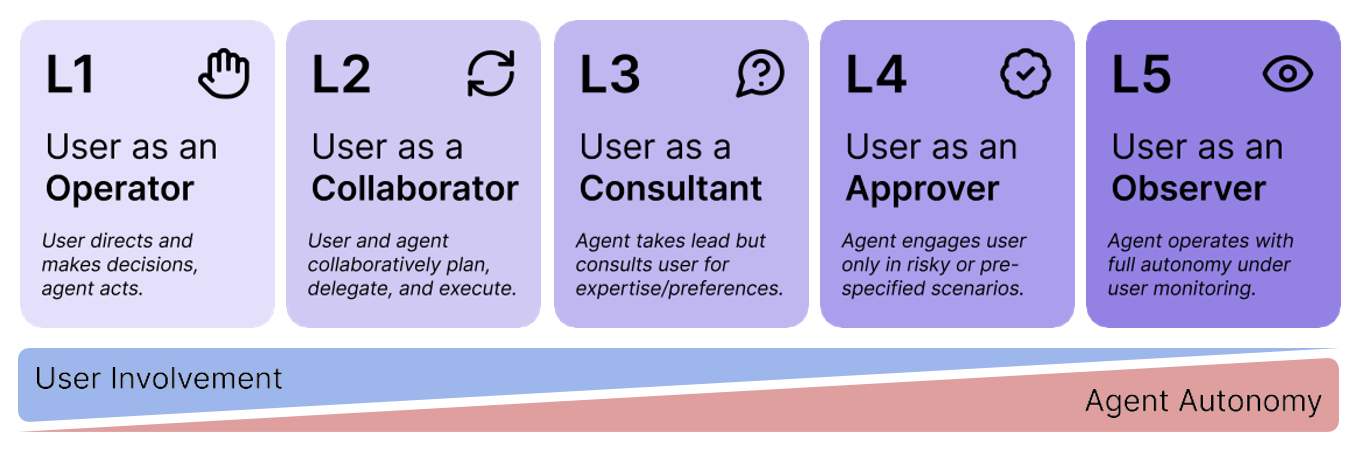
This visual provides a high-level mental model. Now, let's explore more detailed frameworks that map directly to the software development process.
A Practical Framework: Five Levels of Autonomy
To make this spectrum more concrete, we can use a five-level framework that categorizes AI coding tools by the amount of work they perform autonomously before requiring human feedback. This model provides a practical guide for assessing tools and deciding which level of autonomy is appropriate for a given task.
Five levels of AI coding agent autonomy, and why higher isn't always ...
The Swarmia blog provides a clear and practical five-level taxonomy for AI agent autonomy in coding. Reading this will give you a solid framework for the rest of our discussion.
Please read the descriptions for each of the five levels: Level 1: Assistive - This is the world of inline suggestions, your starting point with tools like the original GitHub Copilot. Level 2: Conversational - Think of this as interactive pair programming. You provide the goal and steer the agent through multi-file changes. Level 3: Task agent - This is the first major leap into "agentic engineering." You delegate a well-defined task, and the agent returns a pull request. Level 4: Autonomous teammate - Here, the agent proactively picks up work from a backlog, much like Dependabot but with broader capabilities. Level 5: Agentic avalanche - This is the frontier of multi-agent systems, where an orchestrator agent delegates work to specialized sub-agents.
This framework clearly illustrates that advancing through the levels isn't just about adopting a more powerful tool; it's about fundamentally changing the developer's role and the underlying engineering process.
- Levels 1 & 2 represent the developer as a "conductor," actively directing the AI in real-time. This is likely where most of your current experience lies.
- Level 3 marks the transition to the developer as an "orchestrator," setting objectives and reviewing outcomes. This shift has profound architectural implications. As the article notes, L3 agents only work well if your engineering pipeline (CI, testing, review process) is robust. This reinforces the importance of the platform engineering principles we've discussed. A flaky CI/CD pipeline becomes a critical blocker to leveraging agentic automation.
- Levels 4 & 5 build on this, moving towards proactive and coordinated automation. This connects directly to our earlier discussions on multi-agent architectures, where coordination, task decomposition, and self-regulation become key architectural concerns.
Another, complementary framework from Dan Shapiro frames this progression in terms of the developer's evolving role.
The 5 Levels of AI Coding (Why Most of You Won't Make It Past Level 2)
This video from AI News & Strategy Daily presents Dan Shapiro's five levels of AI coding, which focuses on the changing role of the human engineer. It offers a slightly different, but very insightful, perspective.
Please watch the segment from the five levels. Pay attention to how the developer's role is described at each stage: Level 0: Spicy Autocomplete Level 1: Coding Intern Level 2: Junior Developer Level 3: Manager Level 4: Product Manager Level 5: Dark Factory
The "Dark Factory" concept is a powerful metaphor for a fully autonomous, spec-to-software pipeline. The key insight here is the shift in human value from implementation to specification. As an architect, your ability to define problems with rigor and clarity becomes paramount.
Navigating the Spectrum: Anti-Patterns and Best Practices
Knowing the levels is one thing; successfully navigating them is another. Many teams stumble by either expecting too much from AI too soon or by failing to adapt their workflows to capitalize on its potential. This results in two common anti-patterns.
AWS re:Invent 2025 - Introducing AI driven development lifecycle (AI-DLC) (DVT214)
In this talk from AWS re:Invent, the speakers identify two common anti-patterns in AI adoption and propose best practices for working effectively with AI tools.
First, watch the segment discussing the two anti-patterns: the "AI-managed" approach (expecting full autonomy for ambiguous tasks) and the "AI-assisted" approach (using AI only for trivial, narrow tasks). Then, watch the segment on best practices for engineers. The advice here is invaluable for anyone working with these tools, covering topics like task decomposition, context management, and the importance of semantic richness in your instructions.
The key to avoiding these pitfalls lies in finding the collaborative middle ground. Instead of either abdicating responsibility ("AI-managed") or micromanaging ("AI-assisted"), the most effective approach is an iterative cycle of Plan -> Validate -> Execute -> Verify.
- AI Plans: You ask the agent to outline its approach to solving a problem.
- Human Validates: You review the plan, correcting assumptions and providing guidance before any code is written. This is the crucial human-in-the-loop checkpoint.
- AI Executes: The agent proceeds with the validated plan.
- Human Verifies: You review the final output.
This methodology allows you to leverage the speed of AI execution while retaining strategic control and ensuring the output aligns with your architectural vision. The practical tips from the video—like decomposing tasks, carefully managing the context window, and providing semantically rich instructions—are the ground-level skills required to make this collaboration work.
Conclusion
In this lesson, we have mapped the evolving landscape of AI in software development. You now have a set of frameworks to categorize different forms of AI assistance and a strategic understanding of what it takes to move along the spectrum from simple assistance to powerful automation.
Key Takeaways:
- A Spectrum of Autonomy: AI's role in software development spans a spectrum from reactive assistants (autocomplete) to proactive agents (task automation). The key architectural differentiators are planning capabilities, context management, and workflow integration.
- The Five-Level Model: Frameworks like the one from Swarmia provide a practical way to think about levels of autonomy, from Level 1 (Assistive) to Level 5 (Agentic Avalanche).
- The Evolving Role of the Architect: As autonomy increases, the developer's role shifts from "conductor" to "orchestrator." Your value moves from implementation to rigorous specification, system design, and outcome evaluation.
- Collaborative Workflow is Key: Successfully leveraging higher levels of autonomy requires moving beyond old workflows. Adopting an iterative, collaborative model where humans validate AI-generated plans is essential to avoid common anti-patterns.
Preview of the Next Lesson:
We have now established a clear map of the types of AI assistance available. In our next lesson, we will build on this by asking a critical strategic question: Where in the software development lifecycle should you apply this technology? We will evaluate different phases of the SDLC—from planning and design to testing and maintenance—to identify the areas where AI can deliver the most value, and you will justify these choices with trade-off analysis.
