In our previous lesson, we focused on making AI systems controllable by embedding human oversight directly into their architecture. By establishing clear mechanisms for approval, supervision, and intervention, we ensured that we can guide and govern agentic workflows. However, control is only one part of the equation. The very nature of AI—especially its non-determinism and reliance on ever-changing data—introduces significant complexity into our systems.
This lesson addresses that challenge head-on. Our goal is to equip you with architectural strategies to manage this new form of complexity. We will explore two powerful, classic software engineering techniques applied to the AI domain: creating abstraction layers to decouple components and implementing robust monitoring to detect silent failures like model drift. By the end of this lesson, you will be able to propose these strategies to build AI-integrated systems that are not just controllable, but also maintainable, evolvable, and resilient.
Taming Complexity with Abstraction Layers
As an experienced software engineer, you know that tight coupling is an antagonist to scalable, maintainable systems. Integrating AI, particularly Large Language Models (LLMs), presents a modern version of this classic problem. Hard-coding calls to a specific model provider's API (like OpenAI or Anthropic) throughout your application creates a brittle architecture. What happens when you want to switch providers, use a new open-source model, A/B test different models, or even just update to a new API version? You face a significant and risky refactoring effort.
The answer, as it often is in software architecture, is abstraction. By introducing a layer that insulates your core application logic from the specifics of the AI models it uses, you regain architectural flexibility.
A Mental Model for LLM Abstractions
To reason about these layers systematically, it's helpful to have a structured model. The OSI model provides a layered framework for network communication; a similar approach can be applied to LLM-based systems. A guide from Two Sigma introduces the Language Model System Interface (LMSI) model, which provides an excellent framework for architects.
A Guide to Large Language Model Abstractions
This article provides a comprehensive review of LLM frameworks, organizing them into a 7-layer model analogous to the OSI model. This will give you a structured way to think about different levels of abstraction.
Please read the introduction and the section on the LMSI model. Start with the Introduction to understand the core problem: LLMs have limitations that make them difficult to integrate directly into programs. Next, read the section on the LMSI model. As you review the seven layers, from "Neural Network" to "User," think about where different parts of an AI-powered application might live. For instance, a platform team might provide abstractions at layers 3-6, while application teams build on top of them.
The LMSI model gives you, as an architect, a vocabulary to discuss and design the boundaries in your system. Instead of just thinking about "calling an LLM," you can make conscious decisions about which layer of abstraction your teams should be working at, promoting separation of concerns.
Architectural Pattern: The AI Gateway
One of the most effective ways to implement an abstraction layer is with a Gateway. A centralized AI Gateway acts as a single-entry point for all AI model interactions within an organization. This pattern offers several architectural advantages:
- Decoupling: Service consumers are completely decoupled from the backend model providers. The gateway can route requests to different models (OpenAI, an open-source model on SageMaker, a model from Bedrock) without any changes to the client code.
- Centralized Control: It provides a single place to implement cross-cutting concerns like authentication, authorization, rate limiting, and cost tracking.
- Observability: All requests and responses flow through the gateway, making it the ideal place to collect logs, metrics, and traces for monitoring and debugging.
- Efficiency: A gateway can implement caching strategies to reduce redundant calls to expensive models, lowering both latency and cost.
The diagram below illustrates a robust architecture for a Generative AI Gateway on AWS.
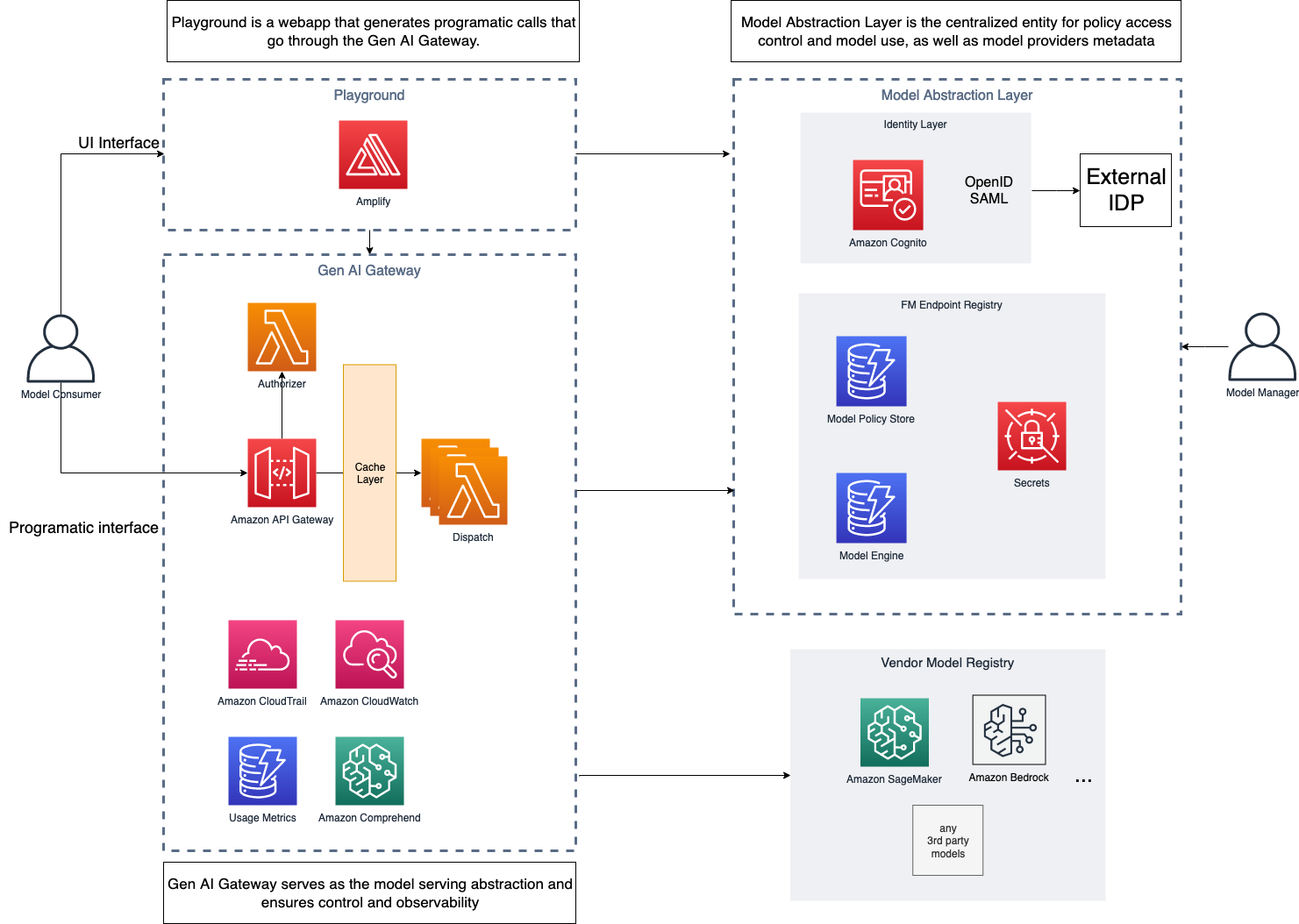
This architecture centralizes the logic for interacting with a diverse and evolving set of AI models. It treats model access as a managed internal service, which is a key principle of platform thinking.
Abstraction Through Frameworks
Frameworks like LangChain, LlamaIndex, and DSPy also offer powerful abstractions, but they operate at a different level than a gateway. They provide a developer-facing toolkit to manage the complexity of building LLM-powered logic. The Two Sigma article you read earlier categorizes these into "families."
- Controlled and Schema-Driven Generation: Frameworks like
Guidance,LMQL, andMarvinhelp manage the non-determinism of LLMs by forcing their output to conform to a specific structure, such as a regular expression or a Pydantic schema. This is an abstraction that guarantees a contract between the LLM and the code that consumes its output. - Compilation of LLM Programs: A framework like
DSPytakes abstraction a step further. It separates the what (the program logic, defined by signatures) from the how (the specific prompting technique, like Chain-of-Thought or ReAct). A "compiler" then optimizes the prompts for a given model and task. This abstracts away the messy and model-specific work of prompt engineering. - Prompt Engineering Utilities: Frameworks like
LangChainact as a broad toolkit, offering pre-packaged abstractions for "chains" and "agents" that combine LLM calls with other tools.
As an architect, understanding these different abstraction strategies allows you to guide teams toward the right tools for the job, balancing developer productivity with system maintainability.
Detecting Silent Failures with Monitoring
Abstraction helps manage the development complexity of AI systems, but what about the operational complexity? AI models introduce a new and insidious type of failure mode: silent degradation. A model can continue to produce syntactically correct outputs that are increasingly wrong, biased, or irrelevant, without ever throwing an exception. This happens because the real world changes, and the model's knowledge, frozen at its training time, becomes stale.
This phenomenon is known as drift. Monitoring for drift is not optional for production AI systems; it is a fundamental requirement for ensuring reliability.
Understanding Model Drift
The "Model monitoring for ML in production" guide from EvidentlyAI provides a clear and comprehensive overview of this critical topic.
Model monitoring for ML in production: a comprehensive ...
This guide is an excellent deep-dive into the "why" and "what" of ML model monitoring, with a specific focus on drift.
Please read the following sections: The first part defines ML monitoring and explains the key reasons it's necessary, including concept drift and data drift. Pay close attention to these two definitions, as they are the root causes of model performance degradation. Next, read the section Why ML monitoring is hard. This highlights the unique challenges, such as "silent failures" and the "lack of ground truth," that distinguish ML monitoring from traditional software monitoring. Finally, review the metrics you should track. Focus on the distinction between direct model quality metrics (which require ground truth) and proxy metrics like data and prediction drift (which do not).
The key takeaway is that when you can't immediately measure a model's true accuracy (because ground truth labels are delayed), you must monitor for drift in the model's inputs and outputs. A significant shift in the distribution of input data (data drift) or the model's predictions (prediction drift) is a strong leading indicator that the model's performance is likely degrading.
Architectural Pattern: The Monitoring Service
Implementing a monitoring strategy requires its own architecture. You need a pipeline to collect data, compute metrics, and visualize the results.

When designing such a system, a key decision is whether to perform monitoring in batch or in real-time.
- Batch Monitoring: Jobs run on a schedule (e.g., hourly or daily) to analyze logs. This is often simpler to implement and is sufficient for many use cases. The architecture above is a prime example.
- Real-time (Streaming) Monitoring: The production service sends data directly to a monitoring service for continuous analysis. This is more complex but necessary for critical applications where near-instant detection of issues is required.
Your choice depends on the model's criticality, the rate of change in the environment, and your existing infrastructure.
The concept of monitoring is also a core pattern in designing robust agentic systems. It's not just for traditional ML models.
Master ALL 20 Agentic AI Design Patterns [Complete Course]
This video on agentic design patterns has an excellent segment on the "Evaluation and Monitoring" pattern, which directly applies to managing the complexity of AI agents.
Please watch the segment on evaluation and monitoring. The speaker frames this as a "factory quality control system" and explicitly calls out the need to monitor for drift, regressions, and anomalies in production.
This reinforces that monitoring is a universal strategy for managing the operational risk and complexity of any AI system, from a simple classifier to a complex multi-agent workflow.
Conclusion
In this lesson, we've explored how to apply two fundamental architectural strategies—abstraction and monitoring—to manage the complexity introduced by AI. You've seen how to design systems that are both maintainable in development and reliable in operation.
Key Takeaways:
- Embrace Abstraction to Manage Development Complexity: Use patterns like the AI Gateway to decouple your services from specific AI models. This provides architectural flexibility, centralized control, and better observability. Leverage frameworks like DSPy or Marvin to abstract away the complexities of prompt engineering and output parsing.
- Implement Monitoring to Manage Operational Complexity: AI models fail silently. You must monitor for concept drift and data drift to detect performance degradation. When ground truth is unavailable, tracking shifts in input and output distributions serves as a critical proxy.
- Design for Maintainability and Resilience: These strategies are not just for AI; they are core principles of good software architecture. Applying them rigorously allows you to build AI-integrated systems that are robust, evolvable, and worthy of trust.
Preview of the Next Lesson:
Now that we have established architectural patterns for building controllable and manageable AI systems, we will zoom out to a more strategic perspective. In the next lesson, we will map the spectrum of AI's role in the software development lifecycle, from simple code completion to semi-autonomous agents. This will help you strategize where and how to apply these powerful technologies for maximum impact in your organization.