In our last lesson, we built a foundational understanding of the spectrum of AI assistance, moving from simple reactive tools to proactive, autonomous agents. We established that unlocking the true potential of AI involves a shift in our own workflows, adopting a collaborative model where we guide and verify the AI's work.
Now, we will take this understanding and apply it strategically across the entire software development lifecycle (SDLC). Your goal for this lesson is to learn how to evaluate and prioritize where AI can deliver the most significant value. As an architect, your role is not just to understand individual tools but to orchestrate their use for maximum system-level impact. This means looking beyond isolated productivity gains to analyze how AI reshapes bottlenecks, risks, and the overall economics of software delivery. We'll explore which parts of the SDLC are ripe for AI-driven transformation and which require a more cautious, human-centric approach, justifying these decisions with robust trade-off analysis.
Let's begin by visualizing the landscape we'll be exploring.
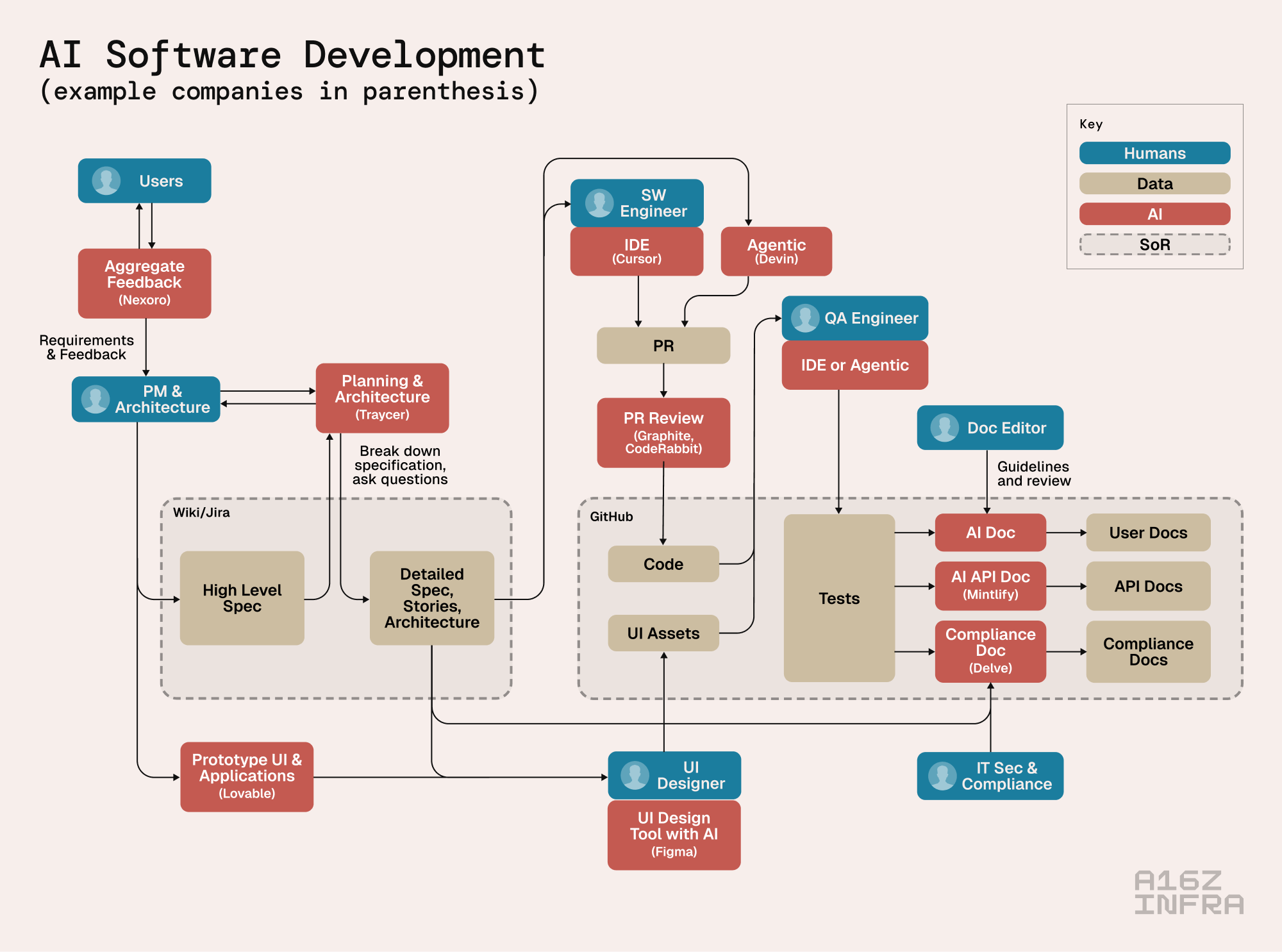
The System-Level View: AI as a Shifter of Bottlenecks
A common misconception is that AI simply makes individual developers faster. While tools like code generators do accelerate coding, their true impact is systemic. When you drastically speed up one part of a complex system, you don't necessarily make the whole system faster. Instead, you shift the bottleneck.
For decades, the most expensive and time-consuming part of software development was the act of writing code. AI is rapidly changing this equation, making code generation cheaper and faster. As a result, the primary constraints are moving downstream. An excellent guide from Hivel.ai provides a system-level analysis of this shift.
Impact of AI on Software Development: A System-Level Guide
This article offers a crucial architect-level perspective on AI's impact. It moves beyond individual productivity to analyze how AI transforms the entire engineering system.
Please read the introduction and focus on the table under the heading AI's Impact Across Every Stage of the SDLC. As you read, pay close attention to the "System-Level Impact" column. Notice the recurring theme: while immediate gains are often related to speed and volume, the systemic effects involve new bottlenecks in review, increased load on testing infrastructure, and potential stability risks.
The key takeaway is that an "AI-native" engineering practice isn't just about writing code faster; it's about building the capacity to validate, test, and deploy that code safely and efficiently. An explosion in pull request volume is meaningless if your CI/CD pipelines are flaky or your code review process becomes a swamp. Your architectural focus must therefore expand to include the health and capacity of these downstream systems.
High-ROI vs. Low-ROI: Prioritizing AI Integration
With this system-level view in mind, the next logical step is to identify where AI offers the highest return on investment. Not all applications of AI are created equal. Some tasks are perfectly suited for automation, while others remain firmly in the domain of human expertise.
A detailed analysis on Medium breaks down these scenarios, offering a pragmatic guide to finding the "sweet spots" for AI integration.
The ROI of AI in Coding Development: What Teams Need to Know in 2025
This article provides a data-driven look at where AI coding tools provide the most and least value, which is essential for our prioritization task.
Please read the sections on High-ROI and Low-ROI scenarios. Note how high-ROI tasks are often repetitive, pattern-based, or involve navigating unfamiliar territory, whereas low-ROI tasks require deep, nuanced context or novel problem-solving.
The distinction between high and low ROI scenarios is critical. Your role as an architect is to steer investment towards opportunities that play to AI's strengths—interpolation and pattern matching—while protecting your team from its weaknesses, such as a lack of deep business context or the inability to perform true extrapolation for novel problems.
Let's walk through the SDLC and see concrete examples of these principles in action. The following video provides a comprehensive tour of how modern AI tools are being applied at each stage.
AI Has Changed How We Build Software // What You Need to Know
This video gives a practical overview of AI tools across the entire development workflow. We will watch specific segments corresponding to different SDLC stages.
Please watch the following segments to see how AI is applied in practice: Planning & Documentation: Watch the segments on planning and architecture and documentation. Notice how AI can synthesize requirements and generate boilerplate docs, but the crucial why still requires human input. Implementation: Watch the segment on actually writing code. This covers the core use case of code generation and refactoring within an IDE. Testing & Debugging: The segment from testing and debugging shows how AI can generate test suites but often misses complex edge cases that require human domain knowledge. Code Review: The segment on code review highlights tools that perform an initial automated pass, freeing up human reviewers to focus on architectural and logical soundness. DevOps & Deployment: Finally, watch the segment from Git, DevOps, and deployment. This is a major high-ROI area, where AI can generate tedious configuration files (Docker, Kubernetes, CI/CD), but the presenter correctly warns that reviewing this infrastructure code is critical due to the high impact of failure.
This survey demonstrates a clear pattern: AI excels at accelerating tasks that are well-defined, follow established patterns, or are tedious for humans. The greatest value is often found not in replacing core creative work, but in automating the surrounding scaffolding, freeing up developers to focus on the truly hard problems.
Justifying Your Choices: A Framework for Trade-Off Analysis
Evaluating where to use AI requires more than just identifying potential use cases; it demands a rigorous analysis of trade-offs. This is where your interest in economics and business becomes a powerful asset. The "value" of an AI tool is not just its sticker price but its net effect on the entire system, including hidden costs and risks.
Beyond Productivity: Measuring What Matters
First, we must redefine what we measure. Traditional engineering metrics like "lines of code" or "number of commits" are poor proxies for value and become actively misleading in an AI-assisted world. An AI can generate thousands of lines of code that increase complexity and rework, leading to a net loss.
We need to shift our focus from activity metrics to outcome metrics.
Impact of AI on Software Development: A System-Level Guide
This section of the Hivel.ai guide explains why traditional productivity metrics are insufficient and introduces a better framework based on system-level outcomes.
Please read the section Metrics That Reflect Real AI Impact. Pay particular attention to the three categories of outcome metrics: Flow and speed, Quality & stability, and Workflow health. These align closely with the DORA metrics you are likely familiar with but add a layer of workflow analysis (e.g., review time, code churn) that is essential for diagnosing AI's specific impact.
Calculating ROI: The Full Picture
Armed with the right metrics, you can perform a more honest Return on Investment (ROI) analysis. This involves balancing the obvious gains (time savings) against both direct costs (tool licenses) and, more importantly, the hidden costs.
The ROI of AI in Coding Development: What Teams Need to Know in 2025
This article provides a clear breakdown of the hidden costs and offers a simple formula for calculating a more realistic ROI.
Please read the sections on Hidden Costs and the example ROI calculation. These "hidden costs"—decreased stability, security vulnerabilities, and increased technical debt—are the critical counterweights in your trade-off analysis. The formula provides a concrete model for presenting a business case.
This ROI framework gives you a powerful tool to justify your architectural decisions. You can now move from "this tool will make developers faster" to "this initiative will save X hours, cost Y in licenses and remediation, for a net benefit of Z, which we will validate by tracking our change failure rate and rework ratio." This is the language that resonates with business leadership.
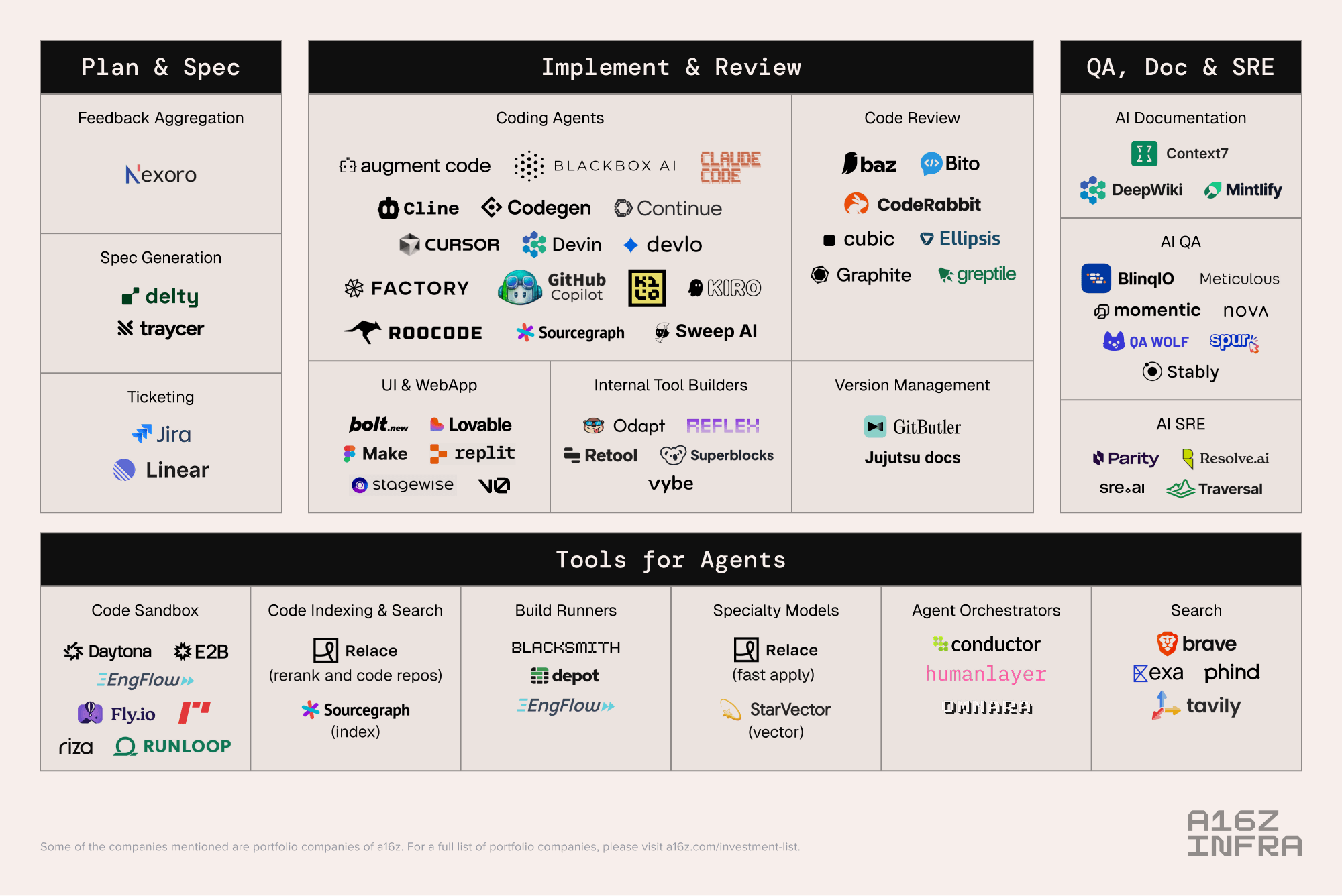
A Strategic Framework for Prioritization
So, how do you decide where to start? A pragmatic approach is to balance potential value with risk. You can think of AI adoption in two modes: standardization and experimentation.
- Standardize at the Core: These are low-risk, high-return applications that can be rolled out broadly. They typically involve assisting with tasks that are tedious and have clear success criteria.
- Experiment at the Edges: These are higher-risk, potentially higher-return applications. They require careful oversight, dedicated teams, and a willingness to iterate.
Here is a practical prioritization matrix based on this idea:
-
High-Value, Low-Risk (Standardize First):
- Task: Generating unit tests for existing functions, creating boilerplate documentation (e.g., JSDoc, OpenAPI specs), and automating initial code reviews for style and simple bugs.
- Why: These tasks are repetitive, easy to verify, and provide immediate time savings. The risk of error is low and easily caught. This is the "low-hanging fruit" that builds momentum for AI adoption.
-
High-Value, High-Risk (Experiment with Guardrails):
- Task: Refactoring legacy systems, tackling significant technical debt, generating CI/CD pipelines, or implementing entire features in a well-understood domain.
- Why: The potential value is enormous—rewriting a legacy component in weeks instead of quarters is a game-changer. However, the risk is also high. An error in a CI/CD pipeline or a poorly executed refactoring can have major consequences. These initiatives should be treated as focused experiments, using the Plan -> Validate -> Execute -> Verify cycle we discussed previously, with strong human oversight.
-
Low-Value, High-Risk (Avoid or Defer):
- Task: Asking an AI to make fundamental architectural decisions, invent novel algorithms, or solve highly ambiguous business problems from scratch.
- Why: These tasks fall squarely into AI's weaknesses. They require deep context, creativity, and an understanding of nuanced trade-offs that models currently lack. The output is likely to be confidently wrong, leading to significant wasted effort.
By categorizing opportunities this way, you can create a phased, rational adoption strategy that maximizes early wins while safely exploring the frontier.
Conclusion
In this lesson, we have moved from understanding what AI can do to strategically deciding what it should do within your organization's SDLC. You now have a comprehensive framework for evaluating and prioritizing AI integration opportunities from an architect's perspective.
Key Takeaways:
- AI shifts bottlenecks: The primary constraint in software development is moving from writing code to reviewing, testing, and validating it. Your architectural strategy must account for this.
- Prioritize based on ROI: Focus on high-return areas like automating boilerplate, documentation, and testing. Be cautious with novel, architecturally significant, or ambiguous tasks where AI currently provides low ROI.
- Measure outcomes, not activity: To justify your decisions and measure true impact, use outcome-based metrics like lead time, change failure rate, and rework ratio, not vanity metrics like lines of code.
- Analyze the full trade-off: A complete evaluation includes not only time savings but also direct tool costs and hidden costs like increased technical debt, security risks, and potential skill atrophy.
- Adopt a phased strategy: Begin by standardizing low-risk, high-value applications of AI. Use controlled experiments with strong human oversight to explore higher-risk, higher-reward opportunities.
Preview of the Next Lesson:
You now have the tools to evaluate where AI can be most effective. The final lessons of this course will focus on turning this strategy into action. In the next lesson, you will select a focus area—either platform engineering or software architecture—and define strategic goals for AI integration. This will be the first major step in building the vision for your capstone project.