Introduction
In our last lesson, we explored the Inverse Conway Maneuver, a powerful strategy for shaping your organization to produce the architecture you need. By creating autonomous, aligned teams, you set the stage for faster delivery and greater innovation. However, this newfound autonomy presents a new and critical challenge: how do you empower dozens or even hundreds of teams to make their own architectural decisions without the system descending into chaos? Simply replacing a central architecture bottleneck with a fragmented free-for-all is not a solution.
This lesson introduces the foundational concept for managing this challenge. Your goal is to define architectural guardrails and distinguish them from rigid standards or mandates. We will explore how to establish "rules of the road" that grant teams the freedom to innovate safely, balancing their autonomy with the need for system-wide coherence. This is the first step toward building a truly decentralized yet aligned architectural practice.
Part 1: Finding the Balance: The Flexibility vs. Governance Spectrum
The challenge of governing autonomous teams can be understood as a spectrum. On one extreme lies absolute governance, characterized by rigid standards, centralized review boards, and top-down mandates. While this provides predictability and control, it inevitably leads to bottlenecks, stifles innovation, and disempowers teams, resulting in stagnation.
On the other extreme is pure flexibility, where every team has complete freedom. This can spark pockets of innovation and rapid execution, but often at the cost of the larger system. Without shared rules, you get fragmentation, duplicated effort, inconsistent security, and operational chaos.
The ideal lies in the middle.
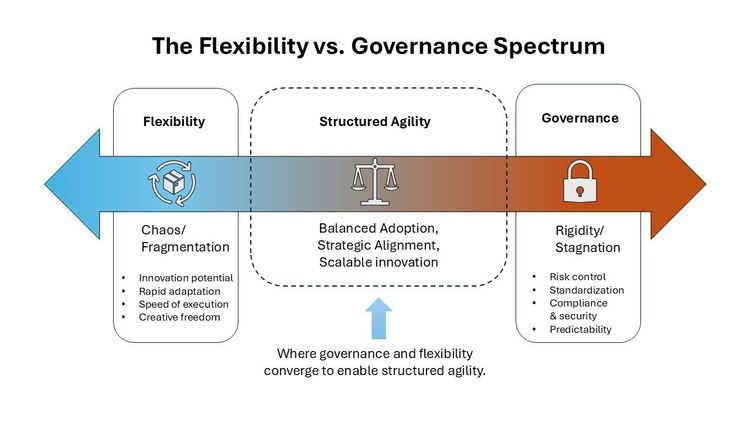
Achieving this balance requires a more sophisticated approach than simply issuing commands. It requires a system of governance that enables rather than constrains. This is the role of architectural guardrails.
Part 2: What is a Guardrail? A Precise Definition
The term "guardrail" is frequently used in platform engineering and architecture, but its meaning is often ambiguous. To use the concept effectively, we need a precise definition that separates it from other forms of control.
A helpful way to think about this is through a taxonomy of platform controls. The following article from Google Cloud provides an excellent framework.
Platform engineering control mechanisms
This article clarifies the often-confused terminology around platform governance by providing a practical taxonomy.
Start by reading the introduction, which sets up the problem of ambiguous terminology. Then, read the section "Golden paths" to understand what a guardrail is not. Finally, read the section "Guardrails: The crash barriers" for a clear and actionable definition.
As the article makes clear, a guardrail is not a suggestion or a best practice. It is a hard stop designed to prevent a catastrophic event. Key distinctions to draw are:
- Golden Paths (or Paved Roads): These are the recommended, well-supported ways of doing things. They are steering mechanisms designed to make the right choice the easy choice (e.g., a pre-configured CI/CD pipeline template, a blessed Terraform module for creating a web service). They guide, but don't strictly prevent deviation.
- Guardrails: These are the non-negotiable "crash barriers." Their purpose is not to guide workflow but to prevent actions that would compromise the fundamental integrity of the system, such as its security, compliance, or operational stability. A developer should rarely encounter a guardrail; when they do, it's because they were about to do something truly dangerous.
A rigid mandate might say, "You must use database X." A golden path would provide a pre-configured, easy-to-use instance of database X. A guardrail, in contrast, would say, "You must not expose any database to the public internet, regardless of which database you choose." The guardrail focuses on preventing a disastrous outcome, not on dictating a specific implementation.
In the following video, architect Gregor Hohpe offers a powerful analogy that makes this distinction incredibly clear.
Platform Engineering is Domain Driven Design - Gregor Hohpe - DDD Europe 2025
In this excerpt from his talk "Platform Engineering is Domain Driven Design," Gregor Hohpe uses the metaphors of railways and lane assist to distinguish between guiding mechanisms and emergency stops.
Please watch the segment from Guardrails. Pay close attention to his explanation of why a train stays on the tracks (self-centering conical wheels) versus what the flange is for (emergency). This perfectly illustrates the difference between a guiding "golden path" and a "guardrail."
Hohpe's core message is that you want systems to be self-centering, guided by rapid feedback and well-paved roads. The guardrail is the last line of defense, not the primary steering device. No one drives a car by scraping along the guardrail.
Part 3: From Mandate to Enablement
With this precise definition, the difference between a guardrail and a rigid standard becomes clear.
- Rigid Standards/Mandates are prescriptive and focus on how things are done. They are often born from a desire for uniformity and control. Examples: "All microservices must be written in Java," or "All teams must use the enterprise service bus for communication." They limit choice and can quickly become outdated.
- Architectural Guardrails are constraining but not prescriptive. They focus on what outcomes to prevent. They define a safe "playing field" within which teams have the autonomy to choose their own tools and approaches. Examples: "All personally identifiable information (PII) must be encrypted at rest," or "All inter-service calls must have a configured timeout of less than 2 seconds."
The shift from mandates to guardrails reflects a broader shift in the architect's role from a gatekeeper to an enabler. The following article explores this evolution using a "parental metaphor."
Architecting Autonomy at Scale: Raising Teams without Creating ...
This article provides a framework for how the architectural role evolves as an organization matures, moving from control to enablement.
Please read the sections The Parental Metaphor and Guardrails in Practice. Note how it frames the architect's journey from controlling every move to setting boundaries and cultivating judgment.
The article emphasizes that the goal is not to eliminate failure but to prevent catastrophic failure. By defining clear safety boundaries, you empower teams to experiment and learn without putting the entire system at risk.
Part 4: Automated Guardrails as Fitness Functions
A guardrail isn't just a rule written in a document; its power comes from its enforcement. In modern systems, this enforcement is often automated. This introduces the concept of an architectural fitness function: an automated mechanism that continuously checks for adherence to an architectural characteristic.
Architecting Autonomy at Scale: Raising Teams without Creating ...
This section explains how to make guardrails tangible and continuously effective through automation.
Read the section on Outcome-based KPIs and fitness functions. This connects the abstract idea of a guardrail to the concrete implementation of an automated check in a pipeline or monitoring system.
For example, a guardrail stating "No service can have a direct dependency on another service's database" can be implemented as a fitness function:
- A static analysis check in the CI pipeline that fails the build if it detects forbidden cross-database queries.
- A runtime monitoring alert that fires if network traffic is detected between a service and another domain's database port.
This makes the guardrail an active, living part of your system, not a passive rule that can be ignored. It provides the rapid, self-centering feedback that Gregor Hohpe described, automatically keeping teams within the safe boundaries. This is the ultimate distinction from a rigid standard, which often relies on manual reviews and can quickly fall out of sync with reality.
Conclusion
In this lesson, we have established a precise and actionable definition of architectural guardrails, distinguishing them from the rigid mandates of traditional, centralized governance. You now have a conceptual toolkit for thinking about how to enable autonomy responsibly.
Key Takeaways:
- Guardrails are Crash Barriers, Not Steering Wheels: They are hard, non-negotiable stops designed to prevent catastrophic failures in security, compliance, or stability. They are not meant to guide day-to-day development.
- Guardrails Enable, Mandates Prescribe: Unlike rigid standards that dictate how to build something, guardrails define the safe boundaries within which teams have the freedom to choose their own solutions.
- Focus on Outcomes, Not Implementations: A good guardrail constrains a system property (e.g., "latency must be below 500ms") rather than a specific technology (e.g., "you must use this caching library").
- Automation is Key: The most effective guardrails are automated as "fitness functions" within your delivery pipeline and observability platform, providing continuous, active enforcement.
Preview of the Next Lesson
Now that you can define what a guardrail is and what it is not, the next logical step is to learn how to create one. In the next lesson, we will focus on how to specify a guardrail for a given cross-cutting concern that balances team autonomy with system-wide coherence. You will learn a practical process for identifying a risk, defining a principle, and then crafting a guardrail that effectively mitigates that risk without becoming an unnecessary bottleneck.