Introduction
In our last lesson, we established a clear, precise definition of architectural guardrails. You learned to distinguish them from golden paths and rigid mandates, understanding them as the non-negotiable "crash barriers" that prevent catastrophic system failures. This conceptual foundation is crucial, but to be effective, an architect must move from theory to practice.
This lesson takes the next vital step. Your objective is to learn how to specify a guardrail for a given cross-cutting concern that balances team autonomy with system-wide coherence. We will deconstruct this process into actionable steps: starting with a high-level principle, defining a concrete rule, and finally, selecting an appropriate enforcement mechanism. By the end of this lesson, you will be equipped with a framework for crafting effective guardrails that enable your teams to move quickly and safely.
From Principle to Practice: The Anatomy of a Guardrail
An effective guardrail is never an arbitrary rule. It is the tangible manifestation of a shared architectural principle. Without a clear "why" rooted in a principle, a guardrail feels like bureaucratic overreach. When grounded in a shared value, it becomes a logical and necessary safety measure.
The article "Architecting Autonomy at Scale," which we looked at previously, provides an excellent example of this hierarchy.
Architecting Autonomy at Scale: Raising Teams without Creating ...
This section demonstrates how to connect a high-level principle to practical, actionable guidelines that form the basis for guardrails.
Please read the section titled Architecture principles and guidelines. Focus on how the abstract principle about data as a strategic asset is translated into concrete expectations for team behavior.
As the article illustrates, the process flows from the abstract to the concrete:
- The Principle: A high-level statement of value or intent. It is qualitative and directional.
- Example: "Data is a strategic organizational asset and must be managed, protected, and governed accordingly."
- The Guideline: A more specific interpretation of the principle that describes expected behavior. It starts to answer, "What does this mean we should do?"
- Example: "All personally identifiable information (PII) must be encrypted at rest."
- The Guardrail: The specific, verifiable, and often automated implementation of the guideline. It is a pass/fail test.
- Example: A policy that fails any infrastructure deployment attempting to create a database or storage bucket without encryption enabled.
This structured thinking ensures that every rule you implement serves a clear architectural and business purpose, moving beyond personal preference to establish a shared social contract for your engineering organization.
Specifying Guardrails with Policy as Code
With a principle and a guideline defined, the next task is to specify the rule in a way that is unambiguous, verifiable, and automated. In modern cloud-native environments, the industry-standard approach for this is Policy as Code (PaC).
Given your extensive programming background, you'll recognize the power of this paradigm immediately. Instead of writing rules in a Word document that becomes quickly outdated, you define them in a high-level programming language. These policies are then integrated directly into your deployment pipelines, providing automated, repeatable enforcement.
The following article offers a superb, hands-on look at how to implement guardrails for common cross-cutting concerns using Policy as Code.
How to Implement Robust Security Guardrails Using Policy as Code | Pulumi Blog
This article from Pulumi's blog provides a practical guide to turning architectural requirements into automated guardrails with concrete code examples.
First, briefly review the definition to connect with our previous lesson. Then, read the short section on Pulumi CrossGuard to understand the framework. Finally, focus your attention on the section Building Practical Guardrails. Analyze the three examples provided—port security, resource limits, and S3 encryption—and how the code directly implements a specific rule.
Let's dissect the examples from the article to solidify the pattern:
-
Example 1: Port Security
- Principle: Minimize the system's attack surface.
- Guideline: Administrative services should not be exposed to public traffic.
- Guardrail (as code): A policy that inspects any
aws:lb/targetGroupresource and fails the deployment if theportproperty is in a list of forbidden ports (e.g., 22, 3389).
-
Example 2: Resource Limits (Cost Control)
- Principle: Ensure fiscally responsible use of cloud resources.
- Guideline: Microservices should be right-sized to avoid waste.
- Guardrail (as code): A policy that checks the
memoryproperty of a customMicroservicecomponent and issues a warning if it exceeds a recommended limit (e.g., 1Gi). This directly ties into your interest in the business and economics of software.
-
Example 3: Cross-Resource Security (Encryption)
- Principle: Protect sensitive data at all stages.
- Guideline: Data stored in S3 by our services must be encrypted at rest.
- Guardrail (as code): A stack-level policy that checks all
aws:s3/bucket:Bucketresources within a deployment and ensuresserverSideEncryptionConfigurationis present and correctly configured.
These examples demonstrate how Policy as Code provides a precise, executable language for specifying the "what" of your guardrails.
The Art of Enforcement: Balancing Autonomy and Coherence
A guardrail's effectiveness hinges on its enforcement. A rule that is too strict or introduced too abruptly can feel like a return to the old world of centralized control, stifling autonomy. A rule that is too lax fails to provide system-wide coherence. The key is to treat the enforcement strategy as a design choice in itself.
You can think of enforcement as a dial you can tune. The Pulumi article introduces several models for this, which are critical for finding the right balance.
How to Implement Robust Security Guardrails Using Policy as Code | Pulumi Blog
This part of the article discusses the different ways policies can be enforced and the best practices for rolling them out without alienating developers.
Please read the sections on Policy Enforcement Models and Best Practices. Pay close attention to the concepts of progressive enforcement (advisory vs. mandatory) and the importance of documented "escape hatches."
Synthesizing the concepts from the reading, here are the crucial levers you have for balancing autonomy and coherence:
-
Enforcement Level: This is your primary tool for tuning the "hardness" of a guardrail.
- Advisory: The policy runs and logs a warning if violated, but does not block deployment. This is the perfect starting point. It respects team autonomy by giving them the information and the choice to act on it, while also providing the architecture function with valuable data on how often a rule is being broken.
- Mandatory: The policy violation blocks the deployment. This should be reserved for critical, non-negotiable rules that protect the entire system's security, compliance, or stability. This is where you enforce coherence.
- Remediate: The policy automatically corrects the misconfiguration. Use this with caution for simple, unambiguous fixes (like adding a required tag), as it reduces developer agency.
-
Progressive Rollout: Never surprise teams with a new, mandatory rule. The best practice is to roll out a new policy in
advisorymode first. This socializes the rule, gathers feedback, and gives teams time to adapt. Once adoption is high and the policy has been refined, you can graduate it tomandatory. -
Escape Hatches: No policy is perfect. There will always be legitimate exceptions. Providing a clear, documented process for requesting an exemption builds trust and prevents teams from resorting to "shadow IT" to bypass the rules. This explicitly acknowledges the need for autonomy in special cases.
By thoughtfully combining these techniques, you can implement guardrails that provide strong safety guarantees without creating a rigid, bureaucratic environment.
Putting It All Together: Designing a Reliability Guardrail
Let's walk through a complete example. Imagine your organization is adopting microservices, and as an architect, you are concerned about system resilience. A common failure mode is a cascading failure, where one slow service causes a chain reaction of failures in upstream services.
Here is how you would specify a guardrail to mitigate this risk.
- Identify the Principle: Services must be resilient to downstream dependencies.
- Define the Cross-Cutting Concern: Timeout configuration for all outbound network calls.
- Specify the Guardrail (The Rule): "All outbound HTTP client configurations must have a connection and read timeout explicitly set to a value less than 2 seconds."
- Design the Enforcement Strategy (Progressive Rollout):
- Phase 1 (Advisory): Implement a static analysis check in the CI/CD pipeline that scans code for HTTP client instantiations. If a timeout is missing or exceeds the 2-second threshold, it prints a clear warning message to the build log with a link to a wiki page explaining the rationale. This gives teams the autonomy to fix it on their own schedule.
- Phase 2 (Mandatory): After a few weeks of observation and communication, change the policy enforcement level. The CI/CD pipeline now fails the build if the rule is violated. This ensures system-wide coherence on this critical reliability pattern.
- Phase 3 (Runtime Fitness Function): As a complementary measure, configure your observability platform (e.g., Prometheus) with an alert that fires if the p99 latency for any internal service-to-service API call exceeds the 2-second threshold. This acts as a runtime fitness function, catching cases missed by static analysis or dynamic configurations that cause violations in production.
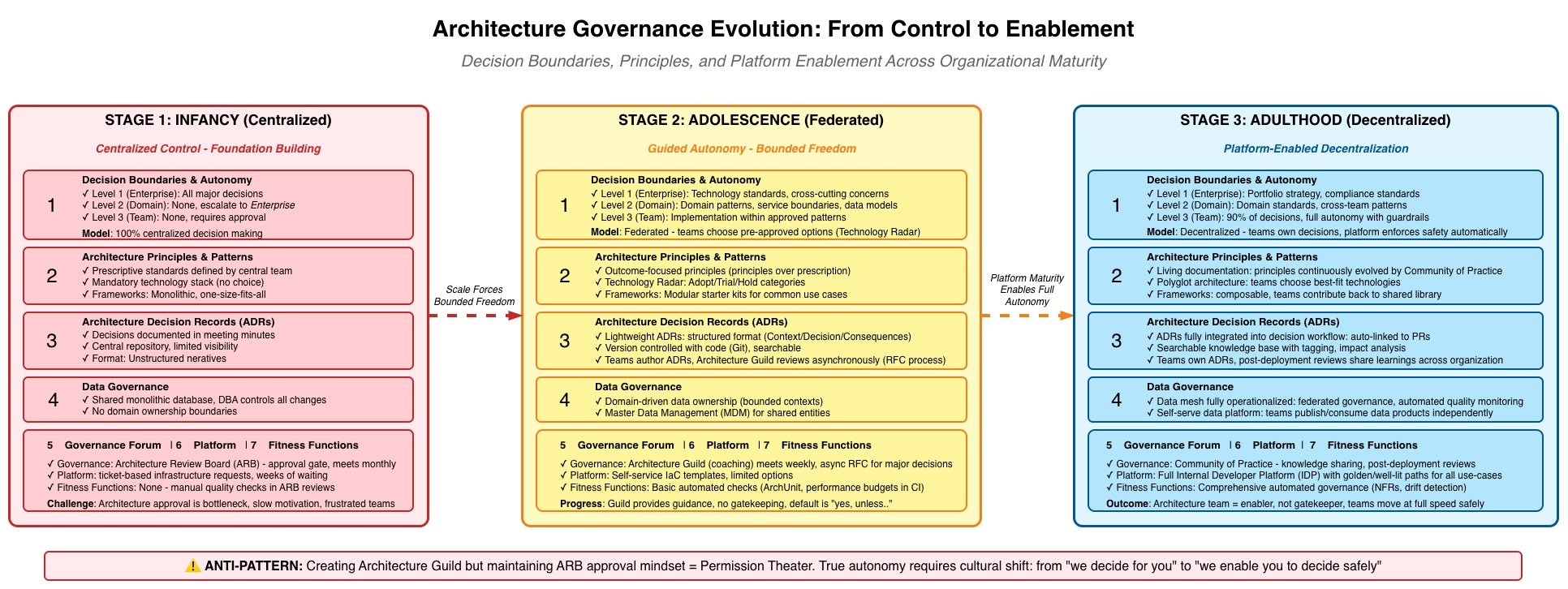
This phased approach allows an organization to mature its governance model, moving from centralized principles to platform-enforced, decentralized capabilities, as illustrated in the governance evolution model.
Conclusion
In this lesson, you have moved from the "what" to the "how" of architectural guardrails. You now have a systematic process for creating them, ensuring they are not arbitrary rules but well-reasoned, automated controls that support both developer autonomy and system-wide integrity.
Key Takeaways:
- Start with Why: Effective guardrails are born from clear architectural principles.
- Be Specific and Verifiable: Define a concrete rule that can be tested with a clear pass/fail outcome.
- Automate with Policy as Code: Use PaC to make your guardrails living, breathing parts of your development lifecycle, not static documents.
- Balance Through Enforcement: Use progressive enforcement (advisory then mandatory) and documented escape hatches to introduce controls without destroying trust or autonomy.
Preview of the Next Lesson
Specifying a guardrail is a significant architectural decision. But the decision itself is only part of the story. The context and rationale behind that decision are invaluable assets that are often lost over time. In our next lesson, we will address this by learning how to explain the purpose and structure of Architecture Decision Records (ADRs), a lightweight but powerful tool for documenting and communicating your architectural choices.