Introduction
In our last lesson, you learned to diagnose the health of a sociotechnical system by identifying the organizational signals—bottlenecks, communication overhead, and awkward team interactions—that point to a misalignment between your teams and your architecture. We established that when an organization's structure is at odds with its software's intended design, friction is inevitable.
This lesson moves from diagnosis to treatment. Your objective is to learn how to apply the inverse Conway maneuver to realign team boundaries with a desired target architecture. Instead of passively allowing your org chart to dictate your system design, you will learn to proactively shape your organization to produce the architecture you need. This is one of the most powerful strategic tools available to a modern architect, turning Conway's Law from an observational constraint into a creative force.
Part 1: From Observation to Action: The Inverse Conway Maneuver
Conway's Law states that a system's architecture will mirror the communication structure of the organization that built it. The Inverse Conway Maneuver flips this on its head: if you want a particular system architecture, you should organize your teams to mirror that desired architecture.
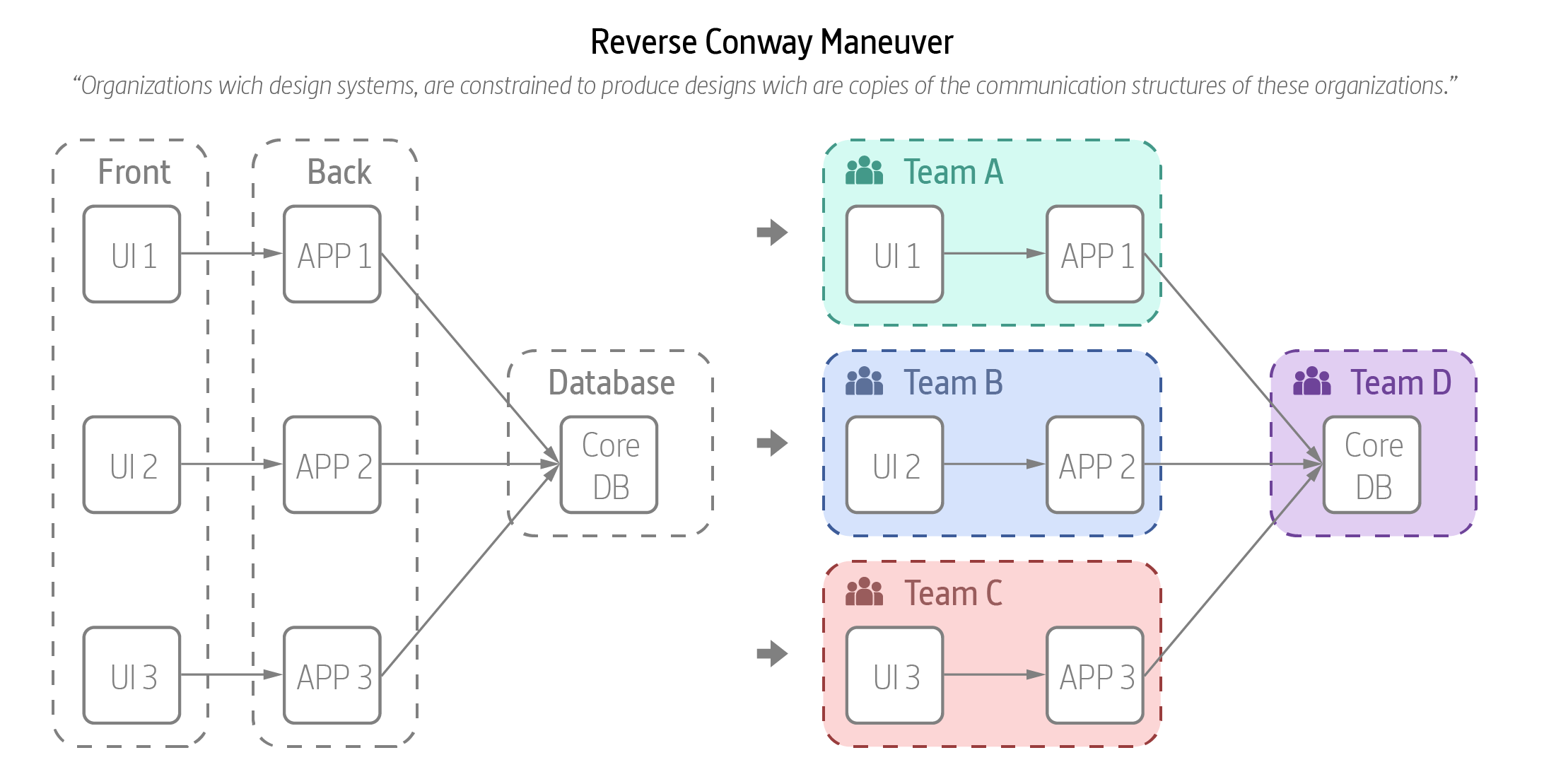
This strategic move is at the heart of many modern software success stories, from microservices to platform engineering. The following article provides a clear definition and introduces foundational examples like Spotify's squads and Amazon's two-pizza teams.
Conway's Law of Digital Transformation: Organizational Structure as ...
This article frames the Inverse Conway Maneuver as a deliberate strategic response to the constraints of Conway's Law.
Please read the introductory section and the section titled "The Inverse Conway Maneuver". Focus on how it reframes the relationship between organizational design and system architecture from a passive reflection to an active choice.
The core idea is simple yet profound: To get a loosely coupled microservices architecture, you create small, autonomous teams that communicate through well-defined interfaces. To build a robust internal developer platform, you create a dedicated platform team whose "product" is that platform and whose "customers" are other developers. You design the organization you need to get the system you want.
Part 2: A Practical Roadmap for Application
Applying the Inverse Conway Maneuver is a significant organizational change, not just a technical one. It requires careful planning and a phased approach. The article we just looked at provides a practical, stage-by-stage roadmap for implementation.
Conway's Law of Digital Transformation: Organizational Structure as ...
This section moves from theory to a concrete action plan for executing the maneuver.
Read the section titled "The Inverse Conway Maneuver: A Practical Roadmap". Pay close attention to the five stages, as this provides a blueprint you could adapt for a real-world transformation.
Let's summarize the key stages of this roadmap:
- Stage 1: Define Target Architecture. You begin with the end in mind. Based on business goals and domain-driven design principles, you define the desired service boundaries, APIs, and ownership lines. This is a purely architectural exercise, intentionally ignoring the current org chart.
- Stage 2: Design the Organization. You design a new team structure that maps directly onto your target architecture. This is where you apply concepts like Team Topologies, deciding which teams will be stream-aligned, platform, or complicated-subsystem. The goal is to align team boundaries with the service boundaries you defined in Stage 1.
- Stage 3: Pilot. You don't execute a "big bang" re-org. You select a meaningful but contained business domain for a pilot. You form the new cross-functional team and have them build or migrate services according to the new model. This validates the approach and provides valuable learning.
- Stage 4: Scaled Rollout. Based on the success of the pilot, you expand the transformation in waves, tackling progressively more complex or core domains.
- Stage 5: Continuous Alignment. The process never truly ends. As the business evolves, so must the architecture and the organization. This stage involves continuous assessment to detect and correct emerging misalignments.
In the following video, speaker Dylan Beattie provides a very tangible description of what this looks like in practice, linking the abstract concept of "interfaces" to concrete communication patterns like meetings and even the physical layout of an office.
Domain Architecture Isomorphism and the Inverse Conway Maneuver - Dylan Beattie
This segment from Dylan Beattie's talk, "Domain Architecture Isomorphism," offers a practitioner's view on how to manifest architectural boundaries in the real world.
Watch the portion from the idea of a team. Notice how he connects the cost of changing an interface to the "cost" of calling a meeting between teams, a brilliant practical analogy for an engineer.
Beattie's point is crucial: if you want changes within a service to be cheap and easy, you put the people responsible for it on the same team where communication is high-bandwidth and informal. If you want changes to the interface between services to be more deliberate and costly, you put those services under the ownership of different teams, forcing more formal, lower-bandwidth communication (like scheduled meetings) to make changes.
Part 3: Real-World Application and Its Pitfalls
Theory and roadmaps are useful, but seeing how these principles play out in complex, real-world organizations provides the most valuable lessons.
First, let's examine a large-scale success story. ING Bank undertook a massive transformation, reorganizing from traditional departments into multidisciplinary "squads" aligned with customer journeys. This is a textbook example of the Inverse Conway Maneuver.
Conway's Law of Digital Transformation: Organizational Structure as ...
This case study details how ING's organizational redesign directly led to a microservices architecture and dramatic improvements in business and engineering metrics.
Please read the section "Case Study 1: ING Bank's Agile Transformation". Note the cause-and-effect relationship: they first changed the organization, and the architectural changes followed.
However, even the most famous examples are not without their complexities. Spotify's "squad" model is widely cited, but its evolution shows that the Inverse Conway Maneuver is not a static solution. As their product matured, features began to cut across squad boundaries, forcing them to evolve their organizational model once again to handle this new reality. They introduced platform teams and feature teams to manage cross-cutting concerns, and their architecture evolved in lockstep. This demonstrates that you must be prepared to continuously adapt your structure as business needs change.
Finally, it's just as important to understand what happens when you violate this principle. What happens when the architecture demands one communication pattern, but the organization is structured for another?
Domain Architecture Isomorphism and the Inverse Conway Maneuver - Dylan Beattie
In this segment, Dylan Beattie presents a classic cautionary tale of architectural intentions clashing with organizational reality.
Watch the example he gives starting at outsourcing some work. He describes a scenario where an architectural rule (no direct database access) is undermined by the team structure (the web and database teams are co-located, while the API team is remote).
This scenario perfectly illustrates why the Inverse Conway Maneuver is so important. An architectural diagram is meaningless if the human communication paths of least resistance directly contradict it. The engineers will inevitably follow the path that allows them to deliver value fastest, even if it violates the "official" architecture. To make the architecture real, you must make the organizational structure support it.
Part 4: The Inverse Conway Maneuver for AI Systems
Your interest lies in the intersection of system design and AI. The principles we've discussed are not limited to traditional web services; they are arguably even more critical when designing complex, agentic AI systems. An uncoordinated set of AI agents, each built in a different departmental silo, will lead to the same architectural chaos as uncoordinated microservices.
The concept of an "agent organization chart" becomes a powerful tool. You can design the ideal collaboration patterns for your AI agents and then use the Inverse Conway Maneuver to structure the human teams that build and govern them.
The following article explores this cutting-edge application of Conway's Law.
How organizations shape their agentic systems
This article extends the classic sociotechnical concepts we've been discussing into the realm of agentic AI, providing a framework for intentionally designing your human and AI organizations in parallel.
Read the sections "The inverse Conway Maneuver in the age of agents" and "Practical Design Guidelines". Focus on the workflow it proposes: design the agent mesh first, then map it to team ownership.
This forward-looking application shows the enduring relevance of these sociotechnical principles. As systems become more autonomous, ensuring they are built by an organization that is intentionally designed for coherence and effective governance becomes paramount. By designing the "agent org chart" and the human org chart in tandem, you can use the Inverse Conway Maneuver to prevent your AI ecosystem from becoming a fragmented collection of siloed bots.
Conclusion
This lesson has moved you from a passive observer of Conway's Law to an active practitioner of its inverse. You now have a strategic framework for creating a virtuous cycle where organizational design and system architecture positively reinforce each other.
Key Takeaways:
- Shape, Don't Be Shaped: The Inverse Conway Maneuver is a proactive strategy to achieve a desired architecture by first restructuring the organization's communication pathways.
- Follow a Roadmap: Successful application involves a phased approach: define the target architecture, design the organization to match, run a pilot, and then scale the rollout.
- Align Teams with Value: The goal is often to create autonomous, cross-functional teams (like Team Topologies' stream-aligned teams) that own a vertical slice of business value, reducing handoffs and cross-team dependencies.
- The Principle is Universal: Whether you are designing microservices or a multi-agent AI system, the underlying principle holds: the system you get will be a mirror of the organization that builds it. Design the organization accordingly.
Preview of the Next Lesson
We have now established how to diagnose misalignment and how to proactively restructure your organization to achieve a target architecture. But once you have these newly autonomous teams, how do you empower them to make decisions without creating architectural chaos? Forcing every decision through a central committee would defeat the purpose of the new structure.
In our next lesson, we will begin exploring how to enable decentralized architecture. We will start by learning to define architectural guardrails and distinguish them from rigid standards or mandates, creating the "rules of the road" that give teams the freedom to move fast while ensuring the entire system remains coherent and stable.