Introduction
In our previous lesson, we connected the dots between technical architecture and team communication, establishing how service coupling directly dictates the required interaction modes between teams. We concluded that high communication overhead is a primary architectural "smell." This lesson builds directly on that foundation. Your goal is to identify a broader range of organizational signals—such as bottlenecks and coordination overhead—that indicate a misalignment between your team structure and system architecture.
Think of this as moving from a single diagnostic test to a full physical exam. An architect who understands these signals can detect underlying structural problems long before they manifest as major outages or project failures. By learning to read these organizational cues, you are effectively learning to sense the health of the entire sociotechnical system, a critical skill for anyone leading complex engineering efforts.
Part 1: The Sociotechnical Lens
Before we dive into specific signals, it's crucial to adopt the right perspective. Modern software delivery doesn't happen in a purely technical vacuum; it's a product of a sociotechnical system, an ecosystem where technology and people are deeply intertwined. Problems rarely have a single, isolated cause. More often, they emerge from the friction at the intersection of your technical architecture and your social (organizational) architecture.
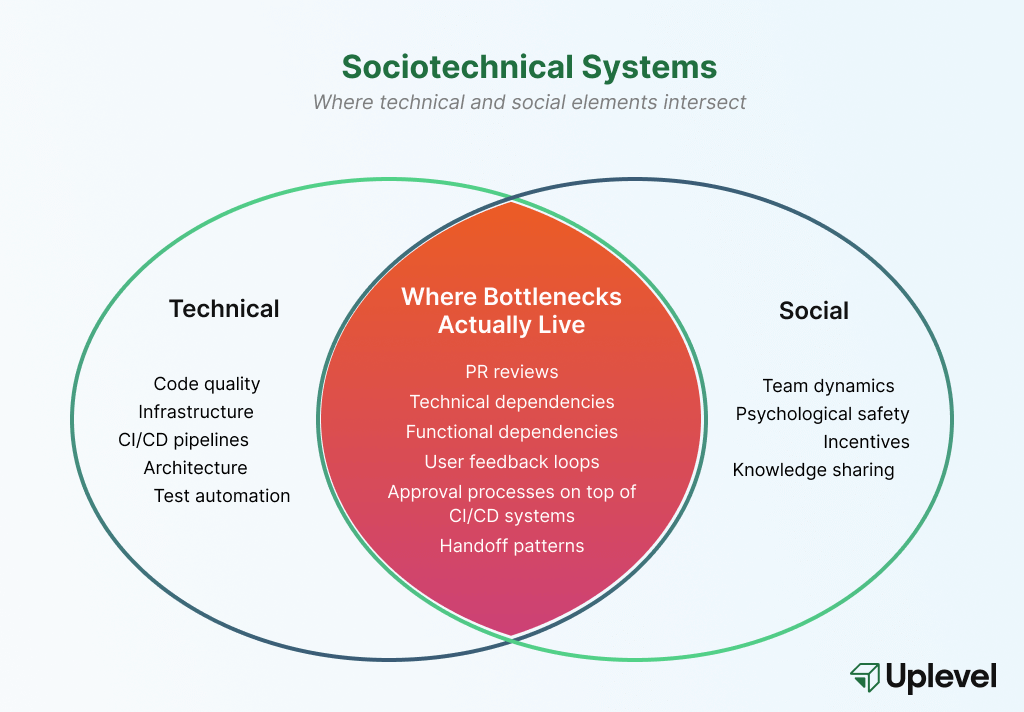
This diagram provides a mental model for where to direct your attention. The signals of misalignment we will discuss are symptoms of dysfunction in this overlapping, orange area.
Part 2: Reading the Tea Leaves of Conway's Law
In previous lessons, we discussed Conway's Law: "Organizations which design systems... are constrained to produce designs which are copies of the communication structures of these organizations." While this can be seen as a constraint, for a practicing architect, it's also a powerful diagnostic lens. The problems you observe in your systems often provide a direct reflection of the problems in your organizational chart.

Your experience as a programmer has likely given you an intuitive feel for this. When you see duplicated code, you might suspect two teams solved the same problem in isolation. When a simple change requires modifying multiple, seemingly unrelated services, you might suspect the service boundaries don't align with the real-world domain.
The following article provides a clear, practical framework for using Conway's Law to diagnose reliability issues, which are often symptoms of deeper organizational misalignment.
How Conway’s Law Shapes Reliability in Enterprise Systems
This article moves Conway's Law from theory to practice, showing how it explains common reliability and delivery problems. It offers a set of observable signals you can use to detect misalignment.
As you read, focus on building a catalog of these signals: Start with the introduction to understand the core premise. Read the section "Why Does Conway’s Law Matter for Reliability?" to see how org silos translate to technical failures. Pay close attention to the three patterns listed under "What Organizational Patterns Most Commonly Cause Reliability Failures?" Read the section on operational resilience to understand how incidents become routing exercises when ownership is misaligned. Start at "Why This Matters" and continue to the end of that section. Study the table titled "Organizational Preconditions and Observable Signals." This is the central checklist for this part of the lesson. Finally, review the list under the heading "Drift Indicators to Watch" for more subtle signs of trouble.
Let's distill the key signals from that reading. A misalignment between your teams and architecture will often manifest as:
-
Communication and Coordination Overhead:
- Frequent "Who owns this?" questions when issues arise.
- Incidents "bounce" between on-call teams before finding the right owner.
- Changes stall, waiting for another team to complete work or approve a PR.
- Fixes for one team's service get stuck in another team's backlog.
- Recurring, time-consuming meetings are needed to coordinate routine changes.
-
Architectural and Ownership Friction:
- Multiple teams build or fork their own versions of the same shared capability (e.g., authentication, notifications).
- Services are coupled along product lines when they should be coupled along business domain lines.
- A service has "shared ownership," which in practice means no ownership, especially during an outage.
-
Human Bottlenecks:
- Critical knowledge is concentrated in a few individuals ("tribal knowledge"), and their absence blocks progress.
If you hear these phrases or see these patterns in your organization, you are observing the direct, tangible output of a misaligned sociotechnical system.
Part 3: Sensing Excessive Cognitive Load
Another powerful signal of misalignment is when a team is consistently overwhelmed. The Team Topologies model introduces the concept of team cognitive load—the total mental effort required by a team to build and operate their assigned systems. When a team's responsibilities exceed its cognitive capacity, it becomes a bottleneck.
This is not a sign of a low-performing team; it's a sign of a poorly-scoped team. The system they are responsible for is too large, too complex, or spans too many disparate domains for them to manage effectively.
The following video presents two real-world case studies where teams recognized the signals of excessive cognitive load and restructured themselves to solve the problem.
Monoliths vs Microservices is Missing the Point—Start with Team Cognitive Load - Team Topologies
This segment from the "Monoliths vs Microservices is Missing the Point" talk by the Team Topologies authors provides concrete examples of the organizational signals that arise from excessive cognitive load.
Please watch the two case studies presented by Manuel Pais. The first is about a large retailer, starting at the first case study. The second is about the engineering productivity team at OutSystems, starting at the second case study. As you watch, listen for the specific signals that told these organizations something was wrong. What did the teams feel? What delivery problems did they observe?
The video highlights several key signals that indicate a team's cognitive load is too high:
- Flow and Delivery Issues: Different workstreams constantly impede each other, and dependencies between tasks slow down the pace of delivery.
- Forced Specialization: Team members can no longer understand the whole system they own. They are forced to become specialists in narrow parts, creating internal knowledge silos and "Brent"-like dependencies.
- Human Factors: Team motivation drops. There's a feeling of being spread too thin, with no time for mastery. Frequent context switching becomes the norm, and planning meetings feel unproductive because most topics are irrelevant to most attendees. There may be a sense of burnout.
When you observe a team that is constantly firefighting, struggling to deliver, and seems disengaged, don't jump to conclusions about their ability. First, assess their cognitive load. The problem may be that you've asked a single team to carry the weight of what should be two or three systems.
Part 4: "Awkward" Interactions as a Leading Indicator
Finally, let's look at a more subtle but incredibly valuable category of signals: the "feel" of team interactions. In the last lesson, we discussed the three intentional interaction modes from Team Topologies: Collaboration, X-as-a-Service, and Facilitating. When the actual interaction between two teams doesn't match the expected interaction, this "awkwardness" is a leading indicator of architectural problems.
Remote-First Team Interactions with Team Topologies (55m talk + 27m Q&A)
This video, "Remote-First Team Interactions," explains how to use the team interaction modes as a sensing mechanism.
Watch the segment from myth-busting, where Matthew Skelton explains how difficulties in defined team interactions can act as a leading indicator for architectural problems.
Let's put this powerful idea into practice with a few examples:
-
Expected Mode: X-as-a-Service. A stream-aligned team is supposed to consume a logging service from a platform team. The "as-a-service" expectation implies low-touch, self-service consumption via a clear API and good documentation.
- The Awkward Signal: The stream-aligned team constantly needs to schedule meetings with the platform team. They find the API confusing, the documentation is lacking, and they require extensive help to get started.
- The Diagnosis: This is not an X-as-a-Service interaction; it's a forced, high-friction Collaboration. The signal indicates the platform service is not a "product." The abstraction may be wrong, the developer experience is poor, or the service is simply too complex.
-
Expected Mode: Collaboration. Two teams are collaborating for a few weeks to define a new API boundary between their domains.
- The Awkward Signal: Six months later, the teams are still locked in daily meetings. No clear API has emerged, and they are still debating fundamental concepts.
- The Diagnosis: A temporary collaboration has become a permanent entanglement. This signals that the domain boundary is poorly understood or, more likely, the software is so tightly coupled (a "distributed monolith") that no clean API can be drawn without significant refactoring.
-
Expected Mode: Facilitating. An enabling team is helping a stream-aligned team adopt new CI/CD practices.
- The Awkward Signal: After several months, the enabling team is still running the builds and fixing the pipelines for the stream-aligned team. The stream-aligned team has not taken ownership.
- The Diagnosis: The facilitation has failed to build capability and has instead created a dependency. The signal suggests the stream-aligned team may lack the skills, time (due to cognitive load), or incentive to own this part of their process.
By paying attention to the texture and duration of team interactions and comparing them to the ideal state, you can spot these sociotechnical misalignments early.
Conclusion
This lesson has equipped you with a multi-faceted diagnostic toolkit for sensing the health of your organization's sociotechnical system. You are no longer limited to looking at just technical metrics; you can now interpret the organizational signals that often precede them.
Key Takeaways:
- Look at the Intersection: Persistent bottlenecks and delivery friction often live at the intersection of your technical and social systems.
- Observe Organizational Friction: Treat recurring patterns like bouncing incidents, duplicated work, delivery delays, and knowledge silos as direct signals of a mismatch between your architecture and your org structure.
- Measure Cognitive Load: A team that is perpetually overwhelmed, unmotivated, and context-switching is a primary signal that its responsibilities exceed its capacity. This points to a need to refactor either the team or the system boundaries.
- Sense Awkward Interactions: When the actual interaction between teams feels more difficult or has a different character than the intended mode (e.g., a service that requires constant support), it is a powerful leading indicator of underlying architectural flaws.
Preview of the Next Lesson
Now that you have a rich set of tools to identify these misalignments, the natural next question is what to do about them. In our next lesson, we will explore the Inverse Conway Maneuver, a proactive strategy for resolving these issues by intentionally restructuring your teams to align with a desired target architecture, thereby shaping the system you want by first shaping the organization that builds it.