Introduction
In our previous lesson, we diagnosed the common causes of low platform adoption, tracing them back to a failure of product thinking and the imposition of high cognitive load on developers. When a platform becomes a source of friction rather than a facilitator of flow, it's natural to ask: what do developers do instead? This lesson answers that question by exploring a phenomenon known as "shadow IT."
This lesson addresses the learning outcome: Explain what 'shadow IT' is and identify the organizational conditions that lead to its emergence. We will define this often-misunderstood term, moving beyond the simple idea of "unapproved software." For someone with your background in system design and interest in business dynamics, you'll see that shadow IT is not just a security risk but a critical organizational signal. It reveals unmet needs, points to friction in the official "paved roads," and often serves as a source of grassroots innovation. Understanding its root causes is the first step toward channeling its energy productively.
What is Shadow IT?
At its core, shadow IT refers to any technology—hardware, software, or services—used within an organization without the explicit approval or knowledge of the central IT department. It's not necessarily malicious; in fact, it's usually deployed by well-intentioned employees trying to do their jobs more effectively.
To get a clear picture, let's start with a concise definition and some common examples.
This short video from IBM Technology provides a great introduction to the concept of shadow IT, clarifying what it is and what it isn't.
Please watch the first part of the video, which defines shadow IT and provides several concrete examples. Pay close attention to the distinction made between shadow IT and malicious assets.
As the video illustrates, shadow IT can range from using a personal Dropbox account to share files, to a team adopting Slack for communication when the company standard is Microsoft Teams, to an analyst using a new cloud-based data visualization tool.
The InfoQ article, "Shadow IT Risk and Reward," offers a definition that is likely more resonant with your software engineering background.
Shadow IT Risk and Reward - InfoQ
This article dives deeper into the motivations behind shadow IT. We'll return to it later, but for now, let's focus on its definition.
Read the section titled "Who is Shadow IT?". The author defines it as any team building or deploying solutions with unsanctioned tools, languages, or infrastructure, and connects it to a fundamental human desire for freedom and ownership.
The key insight here is that shadow IT is often an act of empowerment. It's what happens when motivated people, who are closest to a business problem, take the initiative to solve it using the tools they find most effective. This is a critical point: shadow IT is less a technical problem and more a sociotechnical one.
The Organizational Conditions that Foster Shadow IT
Shadow IT doesn't emerge in a vacuum. It is a symptom of underlying organizational conditions—a direct response to friction, unmet needs, or a gap between the pace of business and the pace of central IT. We can group these conditions into two categories: factors that push employees away from official channels and factors that pull them toward alternatives.
The "Push": When the Paved Path is Full of Potholes
In our previous lessons, we've discussed how a good platform provides a "paved road" that reduces cognitive load. When that road is poorly maintained, full of roadblocks, or leads to the wrong destination, developers will inevitably seek out their own shortcuts.
The following video on platform engineering perfectly illustrates the kind of environment that actively pushes teams toward shadow IT.
What is Platform Engineering and how it fits into DevOps and Cloud world
This TechWorld with Nana video explains the "why" behind platform engineering. In doing so, it paints a vivid picture of the chaos that ensues without it—a breeding ground for shadow IT.
Watch the section from "But it goes even beyond that" up to the summary. The presenter describes a scenario where multiple DevOps teams, facing similar challenges, build their own disparate platforms. This fragmentation, inconsistency, and high cognitive load are precisely the conditions that drive the search for unsanctioned, simpler solutions.
This scenario highlights several key "push" factors:
- High Cognitive Load: As we discussed previously, when developers have to spend more time managing infrastructure complexity than writing business logic, they are heavily incentivized to find simpler tools, even if they aren't officially approved.
- Lack of Standardization: When there are no clear, effective standards, each team invents its own. This creates a form of internal shadow IT, where dozens of different, incompatible "platforms" operate in the dark.
- The Speed Gap: The InfoQ article you looked at earlier points to a crucial business driver. Central IT, often burdened with legacy systems and governance processes, can't keep up with the demands of the business. When a team needs a solution "right now" and IT's timeline is six months, they will find another way.
Finally, the podcast "Shadow IT and Internal Audit" introduces a cultural push factor.
Shadow IT and Internal Audit | The IIA Podcast
This podcast offers a fascinating perspective on shadow IT from an audit and risk point of view, reframing it as a source of innovation.
In the transcript, read the exchange between Daniel McCarville and Bill Bensing about organizational culture. Focus on the segment from the discussion of Red Hat to the end of the section. Bensing contrasts organizations that execute a known business model with startups that discover new ones.
This highlights a fundamental tension. Most large enterprises are optimized for execution and predictability. Shadow IT is often an act of discovery—employees trying to find a better way to operate. This friction between execution and discovery is a powerful catalyst for shadow IT.
The "Pull": The Allure of Modern Tooling
At the same time that internal systems push users away, the modern technology landscape actively pulls them toward powerful, accessible, and user-friendly alternatives. The InfoQ article "Shadow IT Risk and Reward" provides an excellent framework for understanding these "pull" factors, which it calls ECD trends.
Shadow IT Risk and Reward - InfoQ
Let's return to the InfoQ article to understand the external forces driving shadow IT.
Read the section titled "ECD Drives Shadow IT Growth." It breaks down the trend into three components: Externalization, Consumerization, and Democratization.
- Externalization: The proliferation of cloud infrastructure (AWS, Azure) and Software-as-a-Service (SaaS) platforms means powerful capabilities are just a credit card swipe away.
- Consumerization: Employees use sleek, intuitive apps like Google Docs, Slack, and Notion in their personal lives and expect the same high-quality user experience at work. When the official enterprise software is clunky and unintuitive, the pull of consumer-grade alternatives is strong.
- Democratization: The rise of low-code/no-code platforms, scripting languages, and—increasingly—AI tools empowers non-specialists to build sophisticated solutions without needing a formal software engineering background. This dramatically expands the number of people who can engage in shadow IT.
The Two Sides of Shadow IT: Risk vs. Reward
Because it operates outside of established governance, shadow IT introduces significant risks. However, as we've seen, it's also a powerful signal of unmet needs and a driver of innovation. A successful architectural strategy must acknowledge both sides.
The Risks
The most immediate concerns for any organization are the risks associated with ungoverned technology. The image below provides a high-level overview of the most common dangers.
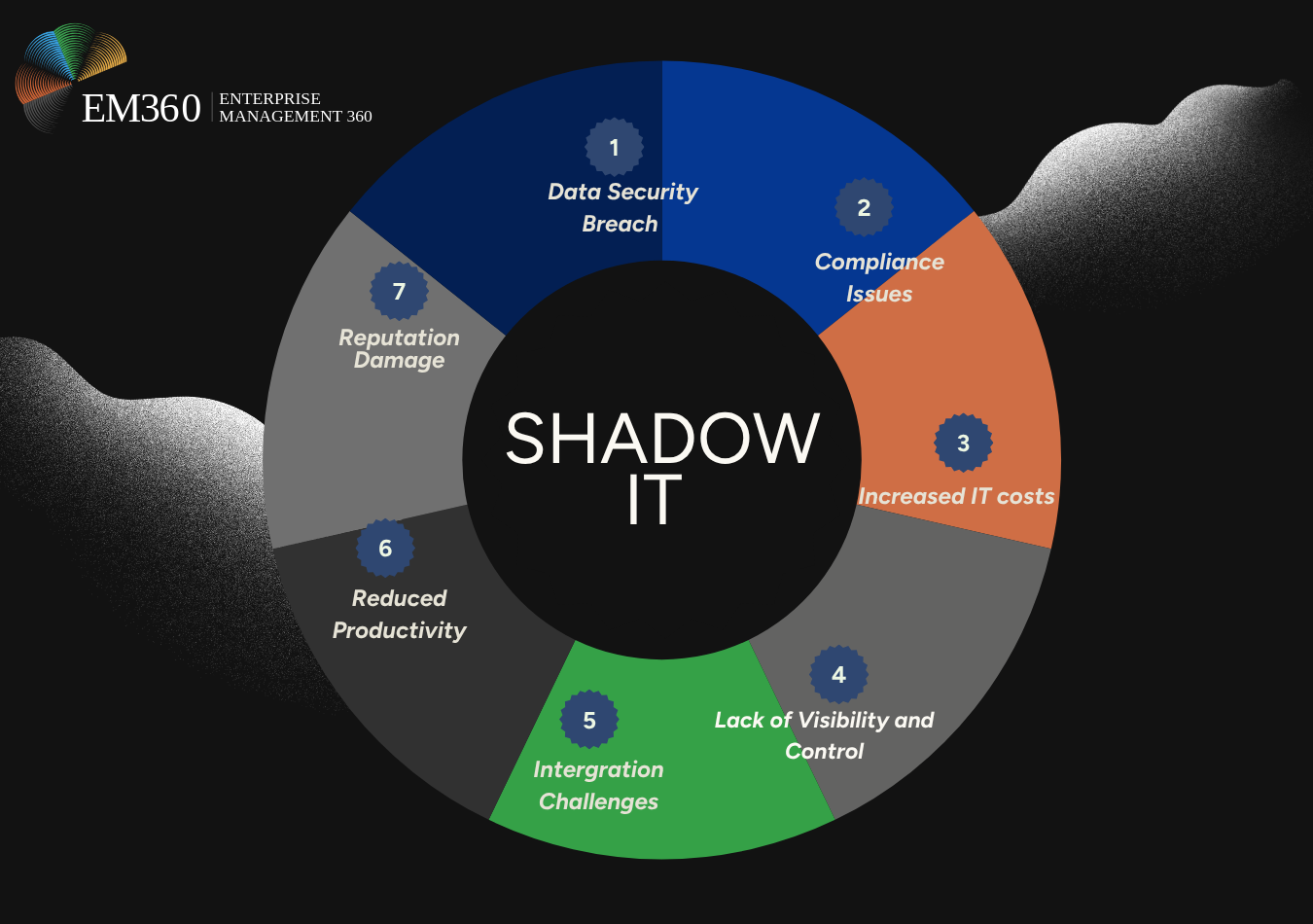
The IBM video you watched earlier elaborates on these points effectively.
Let's revisit the IBM video to get a more detailed breakdown of the risks.
Watch the section that covers the risks and challenges of shadow IT. The speaker details four key areas: increased exposure, data insecurity, compliance issues, and business inefficiencies.
These risks are real and substantial. Unvetted applications can introduce security vulnerabilities, sensitive data can be stored in non-compliant locations (violating regulations like GDPR or HIPAA), and siloed systems can lead to data inconsistency and costly integration problems down the line.
The Rewards
If shadow IT is so risky, why not just ban it? Because doing so would be like turning off your organization's smoke detectors. Shadow IT, while risky, provides invaluable feedback and is often a source of genuine business value.
The podcast "Shadow IT and Internal Audit" makes a compelling case for the benefits.
Shadow IT and Internal Audit | The IIA Podcast
This part of the podcast is crucial for understanding why we should manage shadow IT, not just eliminate it.
Read the section where the host asks about the benefits, starting from the discussion on intrapreneurs. Bill Bensing shares a personal story of saving a program $1 million with a tool he built as "shadow IT." He frames the value proposition in two key ways: Validated Learning: It's a low-cost way to "validate assumptions" and test hypotheses about better ways of working. Economies of Scale: It addresses smaller-scale problems with tailored solutions that central IT, focused on large projects, cannot economically justify.
From an architect's perspective, shadow IT is a source of requirements. It's user research happening organically. Every instance of shadow IT is a data point telling you: "The official way of doing this is broken, and here is a potential alternative."
Conclusion
In this lesson, we have defined shadow IT not as a simple act of defiance, but as a complex sociotechnical phenomenon driven by legitimate business needs. It is a direct consequence of the organizational conditions in which it appears.
Key Takeaways:
- Shadow IT is a Symptom: It is the use of unsanctioned technology to solve business problems, and it serves as a clear signal of friction, unmet needs, or a speed mismatch within the organization.
- It's Caused by Push and Pull: Employees are pushed away from official channels by high cognitive load and slow processes, and simultaneously pulled toward modern, accessible, and user-friendly external tools.
- It's a Double-Edged Sword: While it introduces significant security, compliance, and integration risks, it is also a vital source of innovation, efficiency, and validated learning.
- The Goal is Management, Not Elimination: A blanket ban on shadow IT is counterproductive. The goal is to understand the needs driving it and create pathways to bring valuable innovations out of the shadows and into a governed, supported environment.
Preview of the Next Lesson:
Now that you can identify shadow IT and its root causes, the next logical step is to formulate a response. In our next lesson, we will focus on proposing strategies to increase platform adoption through collaboration and incentives rather than mandates. We will build directly on today's insights, exploring how a platform team can use the signals from shadow IT to improve its product, foster collaboration, and create an ecosystem where developers choose the paved road because it's genuinely the best path available. We'll even explore a structured model for moving a successful shadow IT project from exploration to a fully operational and supported service.