Welcome to the fourth lesson in our exploration of human cognition. In our last session, we examined how schemas act as mental blueprints, organizing our knowledge and guiding our interpretation of the world. We concluded that these frameworks, while essential for efficiency, are also the architects of bias. This brings us to a fundamental question: what information gets selected to be processed by these schemas in the first place?
This lesson directly addresses that question, fulfilling the learning outcome: Describe how attention selectively filters information and creates your subjective reality. We will investigate the mechanisms of attention, treating it as the mind's gatekeeper. You will learn not only how this selective process works but also how its limitations create profound gaps in our perception—gaps that we are often completely unaware of. Understanding this filtering process is the first step toward a more accurate analysis of any situation, a core skill in both management and interpersonal dynamics.
The Selective Spotlight
Think of your awareness as a spotlight in a vast, dark warehouse filled with sensory information. You can't illuminate the entire warehouse at once; you have a limited beam. Attention is that beam. It's the cognitive process of selectively concentrating on one aspect of the environment while ignoring others.
A classic illustration of this is the "cocktail party effect": your ability to focus on a single conversation in a noisy room, filtering out all other chatter. But what happens to the information you filter out? And where, in the process of perception, does this filtering occur? Cognitive scientists have debated this for decades.
The following video provides a concise overview of the three main theories of selective attention. It uses an experimental setup called a "shadowing task" to explain the different models.
Theories of selective attention | Processing the Environment | MCAT | Khan Academy
This Khan Academy video, "Theories of selective attention," explains the foundational models of how our brains filter auditory information. As you watch, focus on the core difference between the three theories.
Please watch the entire video. Pay close attention to the explanation of Broadbent's Early Selection Theory, the problems with it as demonstrated by the cocktail party effect, and how the Late Selection and Attenuation theories attempt to solve this problem.
As the video illustrates, the debate centers on whether we filter information before or after we process its meaning.
- Broadbent's Early Selection Theory proposed a hard filter based on physical characteristics (like pitch or volume).
- Deutsch & Deutsch's Late Selection Theory argued we process everything for meaning first, then filter for what enters our conscious awareness.
- Treisman's Attenuation Theory offered a compromise, suggesting the filter is more like a dimmer switch (an "attenuator") that turns down, rather than blocks, unattended information.
While the exact mechanism is still debated, the key principle is that attention involves not just focusing, but actively suppressing irrelevant information. This active suppression is known as cognitive inhibition.
The Role of Attention in Cognitive Development: How We Focus and Ignore • Psychology Town
To solidify our definitions, let's turn to a short reading from Psychology Town. This will formally define selective attention and cognitive inhibition.
First, read the section What is attention? to get a clear definition. Then, skip down to the section "Types of attention" and read the paragraph on Selective attention. Finally, read the first two paragraphs under the heading Cognitive inhibition to understand the importance of actively ignoring stimuli.
Cognitive inhibition is the unsung hero of focus. Without it, your mind would be a constant storm of distractions, making any purposeful thought or action impossible. But this powerful filtering system comes with a startling consequence.
The Invisible Gorilla: When the Spotlight Fails
If attention determines what we perceive, what happens to the things that fall outside the spotlight's beam? The answer is unsettling: they often cease to exist for us. This phenomenon is known as inattentional blindness.
The most famous demonstration of this was a study where participants were asked to count basketball passes and failed to notice a person in a gorilla suit walking through the middle of the scene. In the following TEDx talk, co-author of that study, Christopher Chabris, discusses the deeper implications of this research, starting with a gripping real-world case.
Inattentional Blindness: Chris Chabris at TEDxAlbany 2011
This talk, "Inattentional Blindness," goes beyond the famous gorilla experiment to show how our focused attention can make us blind to shocking events happening right in front of us.
Watch from the beginning to understand the case of Officer Connley (the setup). Then, pay close attention as Chabris explains the core finding: looking is not seeing, and we all suffer from an "illusion of attention." Finally, listen to his discussion on the power of expectations and how it connects to what we perceive. You can stop after he mentions radiology.
Chabris’s talk delivers several critical insights:
- Looking is not seeing. Your eyes can be pointed directly at an object, but if your attention is not engaged, you will not consciously perceive it.
- The Illusion of Attention. The most dangerous part of this phenomenon is that we are unaware of our own blindness. We have a powerful, and false, intuition that we perceive the world as it is, in its entirety.
- Expectations Drive Perception. This links directly back to our previous lesson on schemas. Our schemas create expectations, and we are far more likely to notice things that conform to those expectations. Unexpected events, even dramatic ones, can be filtered out.
The case of Officer Connley, who ran past a brutal assault without seeing it, is a stark illustration of how two people can experience the same objective event and construct completely different subjective realities based on where their attention was focused.
The Ladder of Inference
This process—moving from a world of infinite data to a single, subjective belief—can be visualized with a powerful mental model used in business and organizational psychology: The Ladder of Inference.

The ladder illustrates the thinking journey that we all take, usually in an instant:
- Observable Data & Reality: At the bottom is the entire world of information available to our senses.
- I Select "Data" from what I observe: This is the crucial first step where selective attention comes into play. We cannot process everything, so we unconsciously choose what to notice based on our goals, interests, and schemas. This is where Officer Connley selected the data point "fleeing suspect" and filtered out the data point "beating victim."
- I Create Meanings: We interpret the data we’ve selected.
- I Make Assumptions: We use our existing schemas to make assumptions based on the meanings we’ve created.
- I Reach Conclusions: We draw conclusions from our assumptions.
- I Build Beliefs: Over time, these conclusions solidify into our beliefs about the world.
- I Take Actions: Our actions are based on these beliefs, which seem to us like self-evident truths.
The Ladder of Inference reveals that our final actions are based on beliefs that are several steps removed from objective reality. The most critical, and often unnoticed, filter is the very first one: the data we select with our attention.
The Art of Misdirection: Hacking the Spotlight
Since attention is a directed, limited resource, it can be deliberately manipulated. Magicians have mastered this for centuries, calling it "misdirection." Psychologists who study this art have developed frameworks for understanding exactly how attention is hijacked.
This is not just about "looking over there." It's a systematic exploitation of the cognitive mechanisms you've just learned about. The academic paper "A psychologically-based taxonomy of misdirection" provides a detailed framework.
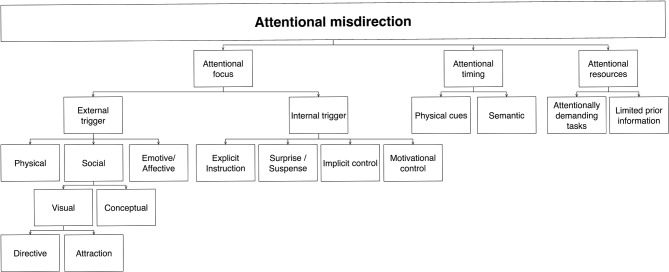
A psychologically-based taxonomy of misdirection
This research paper deconstructs the art of stage magic to create a scientific framework for how attention is manipulated. It provides a powerful analytical tool for recognizing influence attempts.
Start by reading the section What is misdirection? for a clear definition. Then, navigate to the section "Attentional misdirection" and read the introduction to the three main aspects that can be manipulated: attentional focus, timing, and resources. Finally, skim the descriptions for each to understand the core idea: Control of attentional focus: Read the first paragraph of this subsection to see how focus is controlled by external (e.g., a bright flash) and internal (e.g., your own goals) triggers. Control of attentional timing: Read the first paragraph of this subsection to learn about manipulating when people pay attention, such as during moments of tension and relaxation. Control of attentional resources: Read the first paragraph of this subsection to understand how overloading attention (e.g., with a demanding task) prevents people from noticing other things.
This framework gives you a way to deconstruct influence. When observing a negotiation, a marketing pitch, or a political speech, you can ask:
- Focus: What are they trying to make me look at (physically or conceptually)? What are they trying to make me ignore?
- Timing: Are they creating moments of high tension or humor to perform actions during "off-beat" moments?
- Resources: Are they overwhelming me with complex information or a secondary task to reduce my capacity to scrutinize their main action?
Conclusion
Today we've seen that attention is not a passive recording device but an active and aggressive filter. It constructs our reality by selecting a tiny fraction of the available information and discarding the rest.
Here are the key takeaways from our lesson:
- Attention is a selective filter. It operates as a limited-capacity spotlight, allowing us to focus our cognitive resources while actively inhibiting distractions.
- We suffer from an "illusion of attention." Our subjective experience is that we see the world as it is, but inattentional blindness demonstrates that we routinely miss significant, unexpected events happening right in front of us.
- Subjective reality is built on selected data. The Ladder of Inference model shows that our beliefs and actions are based on a small slice of reality that passes through our attentional filter, a process heavily guided by our pre-existing schemas and expectations.
- Attention can be manipulated. The principles of misdirection, used by magicians, provide a framework for understanding how attentional focus, timing, and resources can be deliberately controlled to guide perception.
In our last lesson, we saw how schemas shape interpretation. Today, we saw how attention shapes perception. The next logical step is to examine what happens to the information that makes it through this double-layered filter. In our next lesson, we will explore the fallible and constructive nature of memory, revealing how even our recollections of past events are not perfect records but are actively re-built and distorted every time we access them.