Welcome to our third lesson. In our previous session, we explored the dual-process theory, contrasting the fast, intuitive System 1 with the slow, analytical System 2. We established that System 1 handles the vast majority of our mental operations by using efficient shortcuts. Now, we will investigate the very architecture of those shortcuts.
This lesson addresses the learning outcome: Define schemas and explain how they create mental models to interpret new information and people. We will dissect the concept of schemas—the mental frameworks that organize all our knowledge. You will learn what they are, the different types we use, and how they are formed and modified. Most importantly, we will examine their dual role: as indispensable tools for making sense of the world, and as sources of significant bias and distortion. Understanding schemas is fundamental to analyzing both your own thinking and the behavior of others.
The Mind's Filing System: What is a Schema?
Imagine trying to navigate your day if every single object and situation was brand new. You'd have to figure out what a "door" is and how it works every time you entered a room. The cognitive load would be paralyzing. Our minds avoid this by using schemas: mental structures that act like blueprints or templates for everything we know.
The video below from the channel Practical Psychology offers a great introduction to this idea, using the helpful analogy of a mental filing cabinet. It also provides some historical context, crediting psychologist Jean Piaget for popularizing the term.
What is Schema Theory in Psychology?
Please watch the first part of the video to get a clear definition of schemas and how they develop.
Watch from the beginning up to the birthday party example. Focus on the "filing cabinet" and "index card" analogies as a way to visualize how schemas organize information.
As the video explains, schemas are frameworks built from our past experiences. They help us categorize new information and make sense of it quickly. To solidify this definition and see how schemas are modified, let's turn to a short reading.
What Is a Schema in Psychology? - Verywell Mind
This article from Verywell Mind provides a concise, formal definition and a classic example of how schemas are updated.
Please read the first two sections. Start with the initial overview, then continue to the section "Schema Examples" and read about the child and the animals.
The example of the child encountering a cow and then a miniature horse perfectly illustrates the two processes by which schemas change:
- Assimilation: This is when we incorporate new information into an existing schema. The child initially calling the cow a "horse" is assimilation—the new animal was forced into the existing "four-legged farm animal" schema.
- Accommodation: This is when we alter an existing schema or create a new one because the new information doesn't fit. When the child learns the difference and creates a new "cow" schema, that's accommodation. Similarly, seeing a miniature horse forces an accommodation to the "horse" schema to include a wider range of sizes.
This constant process of assimilation and accommodation is how we build and refine our mental models of the world.
The Blueprints of Our Social World: Types of Schemas
Schemas don't just apply to objects; they are crucial for navigating our social lives. We have schemas for people, social roles, common situations, and even for ourselves. These schemas form our expectations and guide our interactions.
The image below illustrates the four primary types of schemas that are central to social cognition.

To understand these categories in more detail, let's explore them through a couple of focused readings.
What Is a Schema in Psychology? - Verywell Mind
First, let's return to the Verywell Mind article to get clear definitions for the four types shown in the image.
Find the section titled "Types of Schemas" and read the descriptions for all four types.
Now, let's get a more nuanced view, particularly on how these apply in social contexts. The following reading from Psychology Town is slightly more academic and connects these ideas to concepts like stereotypes, which is highly relevant to your goals.
Schemas in Social Cognition: How We Frame Our Social World • Psychology Town
This reading expands on the types of schemas and introduces the critical concept of "role schemas" and their connection to stereotypes.
In the article, please read the section on social schemas. Pay close attention to the distinction between person schemas (for specific individuals) and role schemas (for social positions like 'doctor' or 'leader'), and how the latter can become stereotypes.
The key types to remember are:
- Person Schemas: Your mental file on a specific individual (e.g., your boss, your partner).
- Social/Role Schemas: Your expectations about people in certain roles (a "CEO," a "police officer," a "software engineer"). These are powerful but can harden into stereotypes.
- Self-Schemas: Your own self-concept—your beliefs about your personality, abilities, and future.
- Event Schemas (or Scripts): Your blueprint for how a situation should unfold (e.g., a "business meeting," a "first date," a "job interview").
The Double-Edged Sword: Efficiency vs. Error
Schemas are the engine of System 1 thinking. Their primary benefit is cognitive efficiency—they allow us to process vast amounts of information automatically. However, this speed comes at a cost. Schemas achieve efficiency by filtering information, filling in gaps, and guiding our attention and memory. This process is not neutral; it is biased toward confirming what we already believe.
A Demonstration of Schema-Driven Memory
The following video includes a classic psychology experiment that brilliantly demonstrates how schemas can create false memories. Please follow the instructions in the video carefully.
Schemas (Learn Social Psychology Fundamentals)
This clip from the Opinion Science channel will walk you through a word recall test. It's a powerful way to experience how your own mind uses schemas to reconstruct memory.
Please watch the segment starting with the list of words. Listen to the words, take the quiz, and pay close attention to the explanation of why you likely "remembered" a word that wasn't there.
As the video demonstrates, you probably remembered the word "sleep" with high confidence. This is because all the words on the list activated your "sleep" schema. When asked to recall the list, your brain didn't replay a perfect recording; it reconstructed the memory based on the gist, and the word "sleep" fit the schema perfectly. This shows how schemas don't just organize information; they actively shape our recollection of it.
A Demonstration of Schema-Driven Judgment
Now let's look at how schemas can bias our judgments about people. A role schema can be so powerful it can make an obvious solution to a problem invisible.
What is Schema Theory in Psychology?
Let's return to the Practical Psychology video for a famous riddle that stumps most people precisely because of a strong role schema.
Watch the section that presents and solves the doctor riddle.
The difficulty in solving this riddle comes from a deeply ingrained role schema for "surgeon" that, for many people, is predominantly male. The schema acts as a mental block, making it difficult to consider the possibility that the doctor is the boy's mother. This is a clear example of how schemas can lead to errors by limiting the possibilities we consider.
From Schemas to Mental Models
So, how do all these pieces fit together to create our view of the world? Schemas are the individual building blocks. A mental model is the functioning structure you build out of those blocks to represent how something in the world works.
For instance, your mental model of a corporate negotiation is a complex assembly of schemas:
- Event Schema: Your script for how a negotiation typically proceeds.
- Person Schemas: Your knowledge of the specific people at the table.
- Role Schemas: Your expectations for how a "CFO" or "sales director" will behave.
- Self-Schema: Your beliefs about your own strengths and weaknesses as a negotiator.
This entire assembly is your mental model. It generates your predictions and guides your decisions. The diagram below illustrates how these models are in a constant feedback loop with reality.
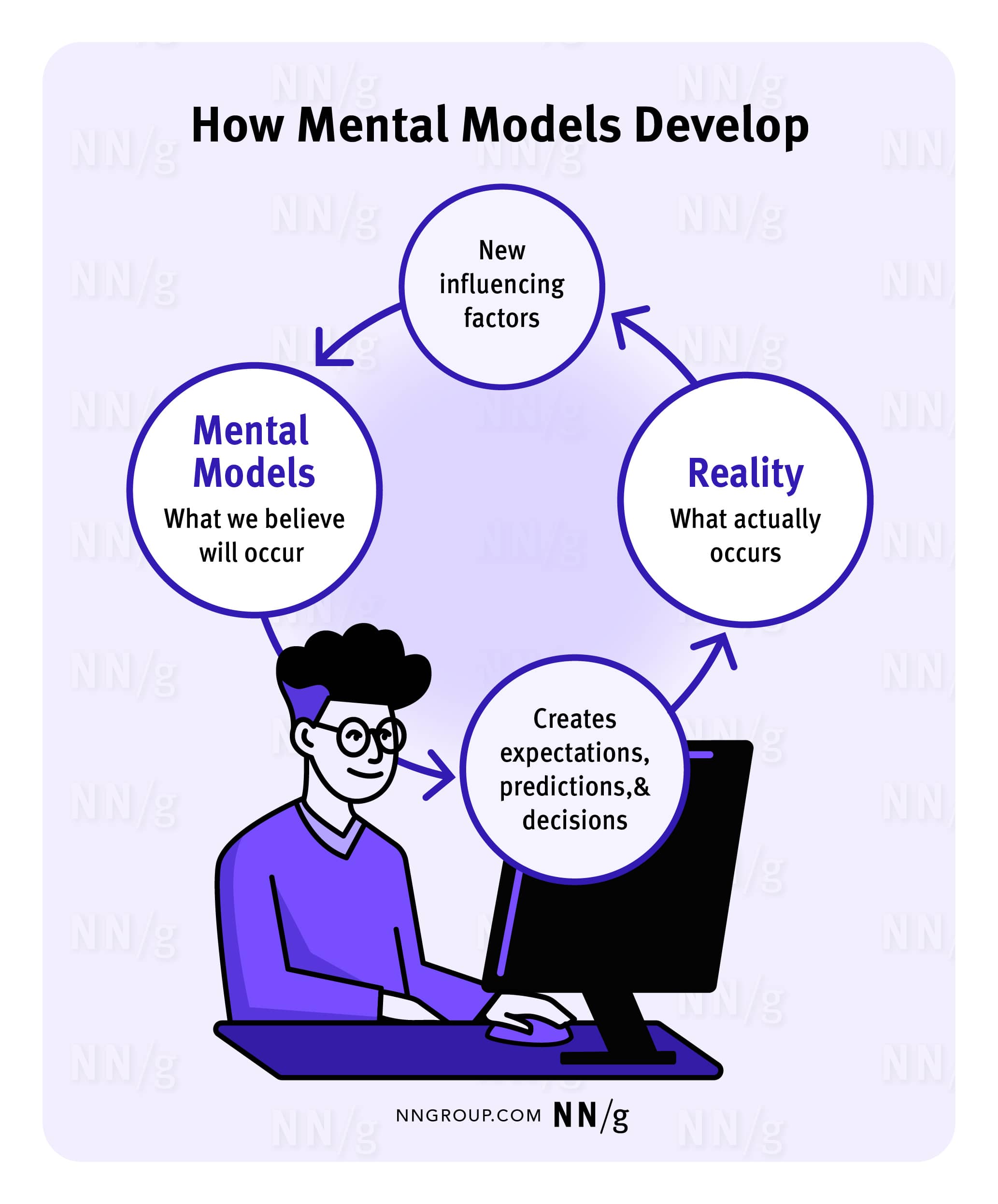
When we encounter new information, we first try to assimilate it into our existing mental model. If the feedback from reality consistently clashes with our model, we are forced to accommodate—to change the underlying schemas and thus update the model itself. However, because accommodation requires significant cognitive effort (a System 2 task), we have a strong tendency to stick with assimilation, which leads directly to confirmation bias.
For your work in management, understanding this is critical. A successful strategy often depends on understanding the mental models of your customers, competitors, and employees. Effective marketing, for example, rarely tries to build a new schema from scratch; instead, it skillfully activates and aligns with the schemas a customer already has. When you analyze a person or situation, a key skill is to first identify the likely schemas they are using to interpret events.
Conclusion
In this lesson, we have moved from the "what" of System 1 to the "how." We've seen that the mind's rapid processing is made possible by a vast network of schemas.
Here are the key takeaways:
- Schemas are mental frameworks or blueprints that organize our knowledge, allowing for efficient processing of information.
- They are formed and updated through assimilation (fitting new information into existing schemas) and accommodation (changing schemas to fit new information).
- We use various types, including person, social/role, self, and event schemas, to navigate the social world.
- Schemas are a double-edged sword: they are essential for cognitive efficiency but also systematically distort our attention, memory, and judgment, leading to biases and stereotyping.
- Schemas are the building blocks of our mental models—the internal representations we use to understand and predict how the world works.
You now have a foundational understanding of how our minds build a model of reality. This process begins with what we choose to notice. In the next lesson, we will focus on this first crucial step: attention. We will explore how it selectively filters information from our environment to construct our subjective experience, a process heavily guided by the schemas we hold.