In our previous lesson, we established the fundamental division between the fast, automatic unconscious mind and the slow, deliberate conscious mind. We saw that the unconscious is not a bit player but the main engine of our daily lives, with consciousness acting as a strategic navigator. Now, we will formalize this concept using the most influential framework in modern cognitive psychology: the dual-process theory of thinking.
This lesson unpacks the famous "System 1" and "System 2" model, which you may remember from your exposure to Daniel Kahneman's work. We will go beyond the simple labels to understand their distinct characteristics, their typical working relationship, and, most importantly, how this internal dynamic is the primary architect of your everyday judgments and decisions. Mastering this concept is essential, as it forms the basis for understanding the cognitive biases we will explore in the next module.
Meet the Two Characters: System 1 and System 2
The dual-process theory proposes that our thinking is the product of two fundamentally different modes of processing. The Nobel laureate Daniel Kahneman, who popularized this model, provides the clearest introduction.
Daniel Kahneman: Thinking Fast vs. Thinking Slow | Inc. Magazine
Watch this short clip from an interview with Daniel Kahneman himself. He will lay out the core distinction between the two systems.
Pay close attention as he explains the defining characteristics of each system from the start of his explanation. Note which system is voluntary and which is automatic.
As Kahneman explains, System 1 is the hero of the story—fast, intuitive, and always on. System 2 is the supporting character—analytical, deliberate, but requires effort to be called to the stage.
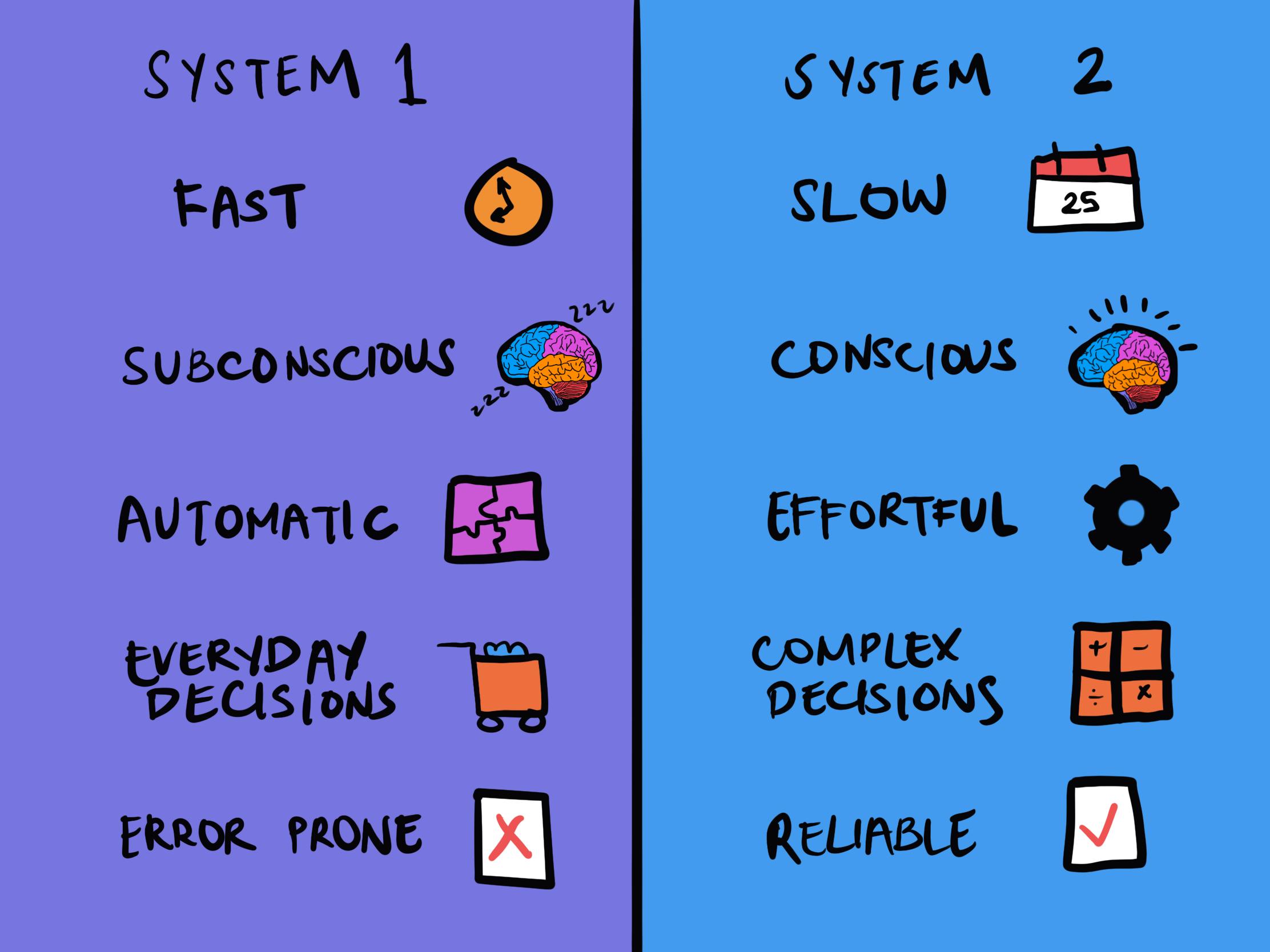
This illustration provides a clear visual summary of the contrasting features of System 1 and System 2 thinking.
To formalize these ideas, let's turn to a detailed article that breaks down the theory and its implications.
Dual Process Theory: System 1 vs System 2 (What Holds Up)
This article provides an excellent overview of Dual Process Theory. We'll start with the introduction to solidify our understanding of the two systems.
Read the first section, What is Dual Process Theory. Focus on the descriptions of what each system does and the classic bat-and-ball problem as a simple but powerful illustration of their interaction.
The key takeaway is that System 1 generates suggestions for System 2: impressions, intuitions, intentions, and feelings. If endorsed by System 2, these impressions and intuitions turn into beliefs, and impulses turn into voluntary actions. Most of the time, this works beautifully. System 1 is generally very good at what it does: creating a coherent and plausible interpretation of the world around you with minimal effort. The problem arises because System 1 has biases, systematic errors that it is prone to make in specific circumstances. Furthermore, System 2 is often lazy and will endorse System 1's intuitive—and sometimes incorrect—conclusions without much scrutiny.
This "lazy controller" aspect of System 2 is a central theme in understanding human judgment. The bat-and-ball problem is a perfect example. System 1 quickly pattern-matches "$1.10" and "$1.00" and offers the intuitive answer "10 cents." To arrive at the correct answer of 5 cents, System 2 must be actively engaged to check the math: if the ball is and the bat is , then , which simplifies to , and thus . For most people, System 2 doesn't bother. It accepts System 1's plausible-sounding answer.
How We Jump to Conclusions: The Ladder of Inference
So, how exactly does System 1 construct our reality so quickly? A very useful model, particularly in a business and management context, is the "Ladder of Inference." It breaks down the rapid, unconscious process by which we turn objective data into beliefs and actions. This entire process is a prime example of System 1 at work.

This flowchart shows how a range of inputs are processed through our cognitive heuristics (System 1) and critical thinking (System 2) to arrive at a judgment or decision.
The following reading from a Harvard Business publication explains this model and explicitly connects it to the System 1/System 2 framework.
Building Self-Awareness to Be A Better Human-Centered Leader - Harvard Business Impact
This article presents a practical tool for understanding how our minds construct reality from raw data. It's a powerful way to visualize System 1's judgment-making process.
Start by reading the introduction to the Ladder of Inference. Then, carefully study the breakdown of the process, from selecting data to adopting beliefs.
The Ladder of Inference shows the "mental path" of System 1:
- Select Data: We are bombarded with information and unconsciously filter it.
- Add Meanings: We interpret that selected data based on our culture and personal experiences.
- Make Assumptions: We fill in the gaps in the story.
- Draw Conclusions: We form a judgment based on our assumptions.
- Adopt Beliefs: These conclusions harden into beliefs about the world.
- Take Actions: Our beliefs drive our actions.
This all happens in an instant, and as Kahneman would say, "what you see is all there is." System 1 presents the conclusion to you as a fact, without showing you the rungs it climbed to get there. The very act of learning this model and using it to "climb down the ladder"—to re-examine the data you selected and the assumptions you made—is an act of engaging System 2. It’s a core skill for improving self-awareness and making more robust decisions, a key part of your overall goal.
Real-World Consequences: Finance, Marketing, and You
The interplay between System 1 and System 2 isn't just a theoretical curiosity; it has profound, measurable effects on professional fields, especially those you're interested in like finance and marketing.
Dual Process Theory: System 1 vs System 2 (What Holds Up)
Let's return to the article on Dual Process Theory to see how this framework is applied in the real world.
Read the section on applications, focusing specifically on the sub-sections about Marketing and UX and Finance and Investing.
As the article highlights:
-
In Marketing: Most advertising is a direct appeal to System 1. It uses emotion, smooth visuals, and simple stories, bypassing the analytical System 2. A car ad doesn't show you a spreadsheet of its fuel efficiency versus competitors; it shows you the car driving on an open road, evoking feelings of freedom and status. This is because marketers know that System 1, which runs on feeling, is in charge most of the time.
-
In Finance: The field of behavioral finance is largely the study of how System 1's biases lead to costly investment errors. When the market drops, System 1 screams "Danger! Sell!". It takes an effortful, System 2 override to stick to a long-term strategy. Tools like dollar-cost averaging are essentially pre-commitments made by your "planner" System 2 to prevent your impulsive "doer" System 1 from making panicked decisions based on short-term noise.
Understanding this dynamic is critical. When you are negotiating, marketing a product, or assessing an investment, you are not just dealing with the other person's rational, analytical mind. You are primarily dealing with their fast, intuitive, and emotional mind.
Important Nuances and Critiques
To truly grasp the model, it's vital to understand its limitations. A simplistic "System 1 bad, System 2 good" view is inaccurate and will lead to poor analysis.
Dual Process Theory: System 1 vs System 2 (What Holds Up)
Finally, let's explore some of the critical nuances of this theory. This will give you a more sophisticated and accurate understanding than the typical pop-psychology summary.
Read the sections Critique 1 and Critique 2. Then, skim the section on the brain to get a sense of the underlying neurology.
Let's summarize the two most important critiques:
-
It's a Metaphor, Not a Mechanism: System 1 and System 2 are not two little agents in your head or distinct physical parts of your brain. They are useful labels for two modes of processing that involve overlapping brain networks. The amygdala, for instance, is crucial for System 1's fast emotional tagging, while the prefrontal cortex is central to System 2's deliberate control. The labels are a helpful simplification, but it's important not to forget the complexity underneath.
-
System 2 Isn't Always "Better": The popular version of this theory often implies that the goal is to use System 2 all the time. This is wrong. System 1 is not just faster; in many situations, it's more accurate. As Kahneman notes, the intuition of a master chess player is a System 1 process, but it's highly reliable because it has been trained over thousands of hours. Similarly, the work of researcher Gary Klein on naturalistic decision-making shows that expert firefighters or military commanders often make better life-or-death decisions with their trained intuition than by following a slow, analytical checklist.
The real question isn't "Which system is better?" but rather, "For this specific task, which system is more likely to be right?" For a novice in an unfamiliar domain, System 2 is the better bet. For an expert in a familiar domain with lots of reliable feedback, System 1 intuition can be superior.
Conclusion
In this lesson, we have put a formal structure on the idea of the two minds. We've dissected the dual-process theory of thinking and its key players, System 1 and System 2.
Here are the key takeaways:
- System 1 is the fast, automatic, intuitive, and emotional mode of thinking. It's the default and does most of the cognitive work.
- System 2 is the slow, effortful, analytical, and deliberate mode. It acts as a monitor for System 1, but it is "lazy" and often doesn't intervene.
- Judgment as a Story: Our judgments are often the product of System 1 rapidly and unconsciously climbing a "Ladder of Inference" to create a coherent story from incomplete data.
- A Powerful but Flawed Partnership: This division of labor is incredibly efficient, but it leaves us vulnerable to systematic errors or biases, especially in fields like finance and marketing that are designed to appeal to System 1's shortcuts.
- Context is Key: Neither system is inherently "better." The goal is not to eliminate System 1 but to understand its strengths and weaknesses, and to know when to engage the effortful System 2.
You now have the core theoretical framework for understanding the mechanics of judgment. The next logical question is: what are the "patterns" and "shortcuts" that System 1 uses to operate so quickly? In our next lesson, we will answer that by exploring schemas, the mental models we use to organize our knowledge and interpret the world.