Introduction
Welcome to our new lesson. Last time, we built a comprehensive toolkit for handling jealousy, framing it not as an enemy to be defeated but as a signal to be understood. We concluded with the 5-step roadmap: Notice, Name, Narrate, Navigate Needs, and Nurture Compersion.
Today, we delve into that final step. Our learning goal is to define compersion and describe the psychological mindsets and relational conditions that facilitate its experience. This emotion is often described as the "opposite" of jealousy, but as we'll see, the reality is more nuanced and interesting. Instead of a replacement for jealousy, think of compersion as a separate emotional muscle that can be identified, understood, and strengthened.
What is Compersion?
Compersion is the experience of finding joy in a partner's joy, particularly when that joy comes from their connection with another person. It's a form of sympathetic joy, specific to the context of romantic and sexual relationships.
To get a feel for this concept, let's start with a short, insightful talk by Dr. Joli Hamilton, a research psychologist who specializes in this area.
Compersion–the Opposite of Jealousy | Joli Hamilton | TEDxEasthamptonWomen
In this TEDx talk, Dr. Hamilton introduces compersion not as a way to destroy jealousy, but as a positive emotional state to move toward. She also offers a clear distinction between compersion and compassion.
Please watch from 05:26 to 06:05 for an introduction to the concept, and then from 12:51 to 14:21 for a formal definition and a contrast with compassion. Pay close attention to the idea that compersion is about feeling joy for another's joy, even if it doesn't involve you.
As Dr. Hamilton explains, while compassion is feeling for someone's suffering, compersion is feeling for their happiness. This distinction is critical. The concept itself was first named by the Kerista community in San Francisco in the 1990s, but the idea of sympathetic joy has ancient roots, such as the Buddhist concept of muditā.
The Dance of Jealousy and Compersion
A common misconception is that you must eliminate jealousy to feel compersion. This is not the case. They are not two ends of a single spectrum; they are separate emotions that can, and often do, coexist.
Exploring Polyamory: How to find Security in Non-Monogamy - with Jessica Fern | Awakened Love EP 25
Therapist Jessica Fern, author of Polysecure, offers some important nuances on this topic. In this clip, she discusses the coexistence of jealousy and compersion and warns against a common pitfall.
Please watch from 13:46 to 15:01. Notice her example of feeling both happy for a partner's new experience and simultaneously hurt by it. Also, take note of her warning against 'weaponizing' compersion—using it as a standard to judge how 'good' someone is at polyamory.
This is a key insight: acknowledging the validity of your jealous feelings is often the first step toward creating space for compersion to arise. Forcing or faking compersion is counterproductive. The goal is to hold space for both emotions at once.
A Framework for Cultivating Compersion
Research has identified a consistent set of factors that make compersion more likely to occur. We can visualize these factors using the following conceptual model.
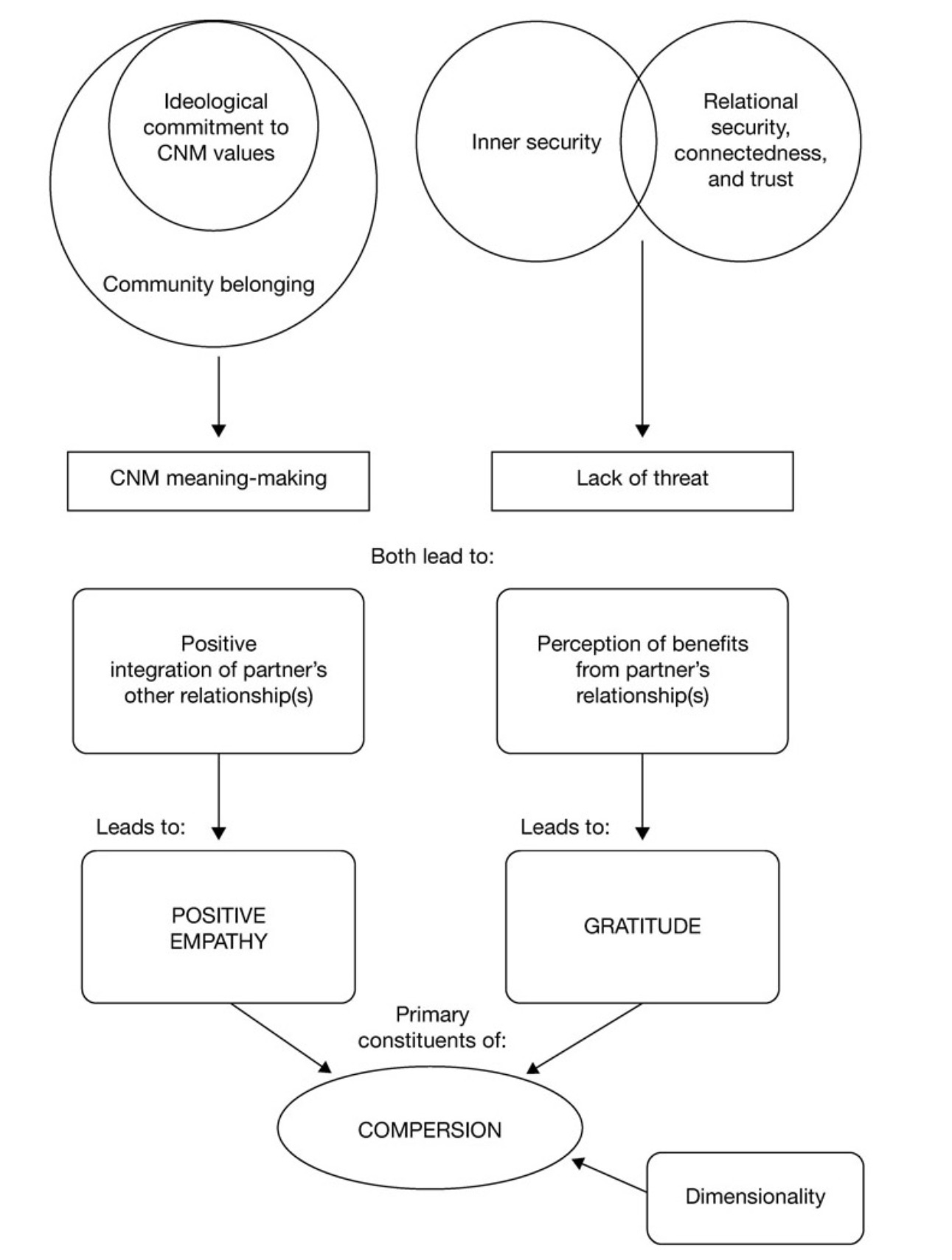
As the model shows, compersion isn't random. It grows from two solid foundations:
- A lack of perceived threat, which stems from security within yourself and your relationship.
- Positive meaning-making, which comes from your personal values and the benefits you see in your chosen relationship style.
We will now explore the specific psychological mindsets (individual factors) and relational conditions that build these foundations.
To go deeper on this topic, the following article provides an excellent summary of the research. We will refer to it throughout the next sections.
When You Feel Jealous, Think About Cultivating “Compersion”
The article 'When You Feel Jealous, Think About Cultivating “Compersion”' by Marie Thouin for UC Berkeley's Greater Good Science Center provides a clear, evidence-based overview of the factors that promote compersion.
Please read the entire article. It will take about 10 minutes. As you read, notice how the author organizes the factors into those related to having a 'strong self' (individual factors) and those related to having 'strong relationships' (relational factors).
Pillar 1: Psychological Mindsets (Intrapersonal Factors)
This is the internal work—the mindsets and personal attributes that create the "inner security" mentioned in the flowchart. As the Greater Good article notes, a "strong self" is a precursor to compersion.
Key mindsets include:
- Abundance Mentality: This is the belief that love, joy, and connection are not finite resources. Dr. Hamilton touches on this in her TEDx talk when she speaks of love "multiplying rather than dividing." This mindset directly counters the scarcity-based fear that underlies much of jealousy.
- Internal Security & Self-Worth: When you feel confident in your own value and have a life that is fulfilling independent of your partner (strong friendships, engaging work, hobbies), you are less likely to perceive a partner's other connections as a threat. You feel your own "plate is full."
- Personal Autonomy: This involves respecting your own agency and, by extension, your partner's. It's an ideological commitment to the idea that your partner is a sovereign individual, not a possession. This reframes their other relationships as an expression of their autonomy, not a betrayal of you.
- Mindfulness & Emotional Responsibility: This is the ability to observe your feelings (like jealousy) without being consumed by them, and to take responsibility for managing your own emotional state rather than making it your partner's job to prevent you from feeling jealous.
Pillar 2: Relational Conditions
This is the external work—the conditions within your relationships that create the "relational security" and "positive integration" shown in the flowchart.
Key conditions include:
- Trust and Communication: This is the bedrock. Compersion thrives in an environment of transparency and honesty. Feeling that your partner is open with you about their feelings and experiences—and includes you in their joy—is crucial. Secretiveness breeds suspicion, which is poison to compersion.
- Relational Security: You need to feel securely attached, loved, and valued by your partner. This means knowing your needs for time, attention, and reassurance are being met within your relationship. When you feel neglected, it is nearly impossible to feel happy about the attention your partner is giving to someone else.
- Positive Regard for the Metamour: A metamour is your partner's partner. It is far easier to feel compersion when you genuinely like, respect, and trust your metamour. Knowing they are a good person who treats your shared partner well contributes significantly to feelings of joy.
- Perceiving Benefits: This is the "Gratitude" component in the flowchart. Compersion is easier when you see direct or indirect benefits from your partner's other relationship.
- The "Stepping Stone": A classic example is feeling relief and happiness that your partner can enjoy an activity with their other partner that you dislike (e.g., going dancing, watching horror movies).
- Shared Joy: The positive energy from a partner's new relationship (New Relationship Energy, or NRE) can "spill over," bringing excitement and novelty into your own dynamic.
- Personal Growth: Witnessing your partner's happiness can help you grow as a person, expanding your capacity for empathy and generosity.
For a very detailed look at all these factors, based directly on interviews with polyamorous people, you can explore the following academic paper.
[PDF] Factors that Facilitate and Hinder the Experience of Compersion ...
This research paper, 'Factors that Facilitate and Hinder the Experience of Compersion...', is the basis for much of our modern understanding of the topic. It provides a rich, qualitative look at what works in practice.
You don't need to read the whole paper. Skim the 'Results' section, specifically the three sub-sections: 'Individual/Intrapersonal Factors', 'Experiences in and Characteristics of the Relationship with One’s Partner', and 'Feelings/Judgments About Their Metamour'. This will give you direct insight into the lived experiences that underpin the principles we've discussed. Focus on the illustrative quotes.
Conclusion
Today we have moved beyond jealousy to explore its much-discussed counterpart, compersion. We have defined it as sympathetic joy and, crucially, understood that it can and does coexist with feelings of jealousy.
Key Takeaways:
- Compersion is the positive feeling of joy one experiences in response to a partner's happiness with another person.
- It is not the absence of jealousy. The two emotions can be felt simultaneously, and learning to hold space for both is a key skill.
- Cultivating compersion relies on two pillars:
- Individual Mindsets: Building inner security, self-worth, and an abundance mentality.
- Relational Conditions: Fostering high levels of trust, communication, and mutual care within the relationship network.
- Compersion is often seen as a benefit of non-monogamy, but it is not a requirement or a measure of success. Forcing it is counterproductive.
Preview of the Next Lesson
In discussing the conditions for compersion, we touched on the concept of a partner's energy from a new connection spilling over into the existing relationship. This phenomenon is known as New Relationship Energy (NRE). In our next lesson, we will begin a new module by focusing squarely on this topic. Our goal will be to explain new relationship energy (NRE) as a distinct neurobiological and psychological phenomenon and its impact on existing relationships.