Introduction
Welcome to our new module, "Models of Consensual Non-Monogamy." In our last lesson, we concluded our exploration of core emotional dynamics by defining compersion. We noted that one of the perceived benefits of non-monogamy is when the positive energy from a partner's new connection, sometimes called "spill-over," enriches an existing relationship.
Today, we will dive deep into that "spill-over" effect. The formal term for it is New Relationship Energy (NRE). Our learning outcome for this lesson is to explain new relationship energy (NRE) as a distinct neurobiological and psychological phenomenon and its impact on existing relationships. We will explore what NRE feels like, what's happening in the brain to cause it, and how this intense state can be both a challenge and an opportunity within established partnerships.
What is New Relationship Energy?
At its core, New Relationship Energy is the intense, often euphoric, state of excitement, infatuation, and emotional intensity that characterizes the beginning of a new romantic or sexual connection. It's often referred to as the "honeymoon period."
To start, let's get a clear, practical definition of NRE and see how it manifests.
This short video from Conor and Brittany, titled 'What is NRE in Polyamory?', provides an excellent introduction. It defines NRE and connects it to the more familiar 'honeymoon period,' immediately highlighting why it's a key topic in polyamory.
Please watch the first two and a half minutes (00:00 - 02:55). Pay attention to how they describe NRE as a hormonal 'high' and distinguish it from the more stable, long-term feeling of being in love.
As the video explains, NRE is a powerful force. This intense focus on a new partner, driven by a cocktail of brain chemicals, feels exhilarating. However, it's crucial to distinguish this state from other intense feelings, particularly limerence.
- NRE is based on a mutual, growing attachment. It's the excitement about a promising future with someone who reciprocates your feelings. The joy deepens as you get to know the person and the connection becomes more certain.
- Limerence, a term coined by psychologist Dorothy Tennov, is an obsessive state of infatuation often fueled by uncertainty and unreciprocated feelings. It's characterized by intrusive thoughts, a desperate desire for reciprocity, and mood swings between euphoria (when given a sign of hope) and despair (when ignored). Limerence thrives on the unknown, whereas NRE thrives on mutual discovery.
The following video offers a detailed exploration of this important distinction.
What is New Relationship Energy? Understanding NRE, Limerence and Frenzy
In this segment from her video 'What is New Relationship Energy? Understanding NRE, Limerence and Frenzy', Evie Lupine provides a clear and detailed comparison between NRE and limerence.
Please watch from 13:35 to 19:19. Focus on the core differences she outlines: NRE is based on mutual, growing attachment, while limerence is based on uncertainty and unfulfilled desire. Notice the role of 'intermittent reinforcement' in fueling limerence.
Understanding this difference is vital. While both are temporary states, NRE typically evolves into a stable, bonded attachment, whereas limerence often ends abruptly when the uncertainty is resolved (either through reciprocation, which can transition it to NRE, or through final rejection).
The Neurobiology of NRE: Your Brain in Love
The intense feelings of NRE aren't just a psychological whim; they are the direct result of significant, measurable changes in your brain chemistry. Your brain's reward pathway is activated, flooding your system with a powerful cocktail of neurochemicals.
To understand this process, let's look at a concise article from Psychology Today.
The Rise and Inevitable Fall of New Relationship Energy
This article, 'The Rise and Inevitable Fall of New Relationship Energy' by Dr. Nan Wise, breaks down the specific neurochemicals at play during NRE and explains why the feeling is temporary.
Please read the first two sections of the article, down to the heading 'Coming Down from Record-High Desire'. As you read, identify the roles of the key chemicals mentioned: dopamine, oxytocin, vasopressin, cortisol, serotonin, and NGF.
Let's summarize the key players from the article and other research:
- Dopamine: This is the primary driver. It's the neurochemical of motivation, wanting, and seeking. It’s not about the pleasure of having, but the pleasure of anticipation. This is what creates the obsessive focus and the craving to spend more time with the new person.
- Oxytocin & Vasopressin: Often called the "bonding hormones," these are released through physical touch and emotional intimacy. They promote feelings of attachment and connection.
- Cortisol: This is a stress hormone. Falling in love, with all its insecurities and excitement, is a form of "good stress" (eustress) that elevates cortisol levels, contributing to the feeling of high alertness and energy.
- Serotonin: Levels of this mood-regulating chemical actually decrease during the initial phase of romantic love. Lower serotonin is linked to the obsessive, ruminating thoughts characteristic of NRE (and is also a feature of OCD).
- Nerve Growth Factor (NGF): Levels of this protein, crucial for neuron development, also spike, correlating with the intensity of passionate feelings.

In essence, NRE is a temporary, altered neurobiological state designed to facilitate intense bonding.
The Impact of NRE on Existing Relationships
The powerful, all-consuming nature of NRE inevitably has a significant impact on any pre-existing relationships. This impact can be a source of either disruption or renewal, depending entirely on how it is managed.
The Potential Challenges:
- Perceived Neglect: The person experiencing NRE may unconsciously redirect time, attention, and emotional energy away from their existing partner(s), leading the latter to feel neglected, de-prioritized, and insecure.
- Unfavorable Comparisons: The intense high of NRE can make a stable, comfortable long-term relationship seem dull or lacking by comparison. This can create dissatisfaction where none previously existed.
- Threat to Security: For the existing partner, seeing their loved one so intensely focused on someone else can trigger feelings of jealousy, insecurity, and fear of being replaced. This is the "mate guarding" instinct we discussed in a previous lesson.
The Potential Benefits:
- Energy Infusion: A person energized by NRE can bring that excitement, joy, and vitality back into their existing relationships. Their happiness can be contagious, leading to a more vibrant dynamic for everyone.
- Renewed Appreciation: The process of developing a new connection can sometimes highlight the unique strengths and comforts of a long-term bond, leading to a renewed sense of gratitude for the existing partner.
- Facilitating Compersion: As we discussed last lesson, seeing a partner blissful and happy can be a profound source of joy (compersion), provided one's own sense of security is intact.
The key to navigating this is understanding that NRE is a temporary peak. The intense "high" does not last.
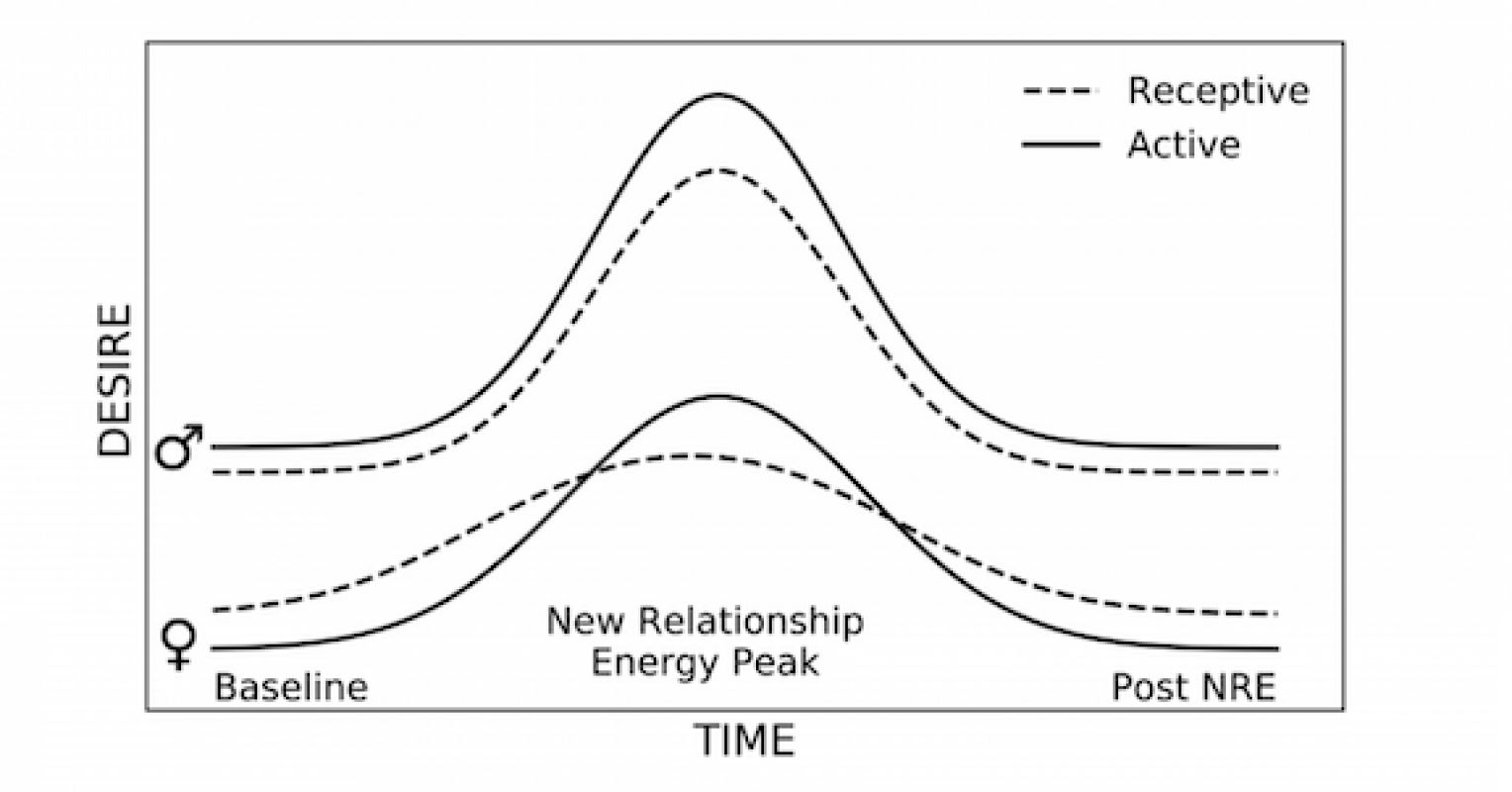
Recognizing that NRE will naturally fade helps manage expectations. It reassures the existing partner that the intense focus on the "new shiny" is not the new permanent reality, and it reminds the person in NRE not to make rash, life-altering decisions based on a temporary emotional state.
Conscious management is key. This involves openly acknowledging the NRE, reassuring the existing partner of their importance, deliberately scheduling quality time together, and maintaining open communication about everyone's feelings—both the joy and the insecurity.
Conclusion
In this lesson, we have dissected the powerful phenomenon of New Relationship Energy. We've seen that it is far more than just a "crush"; it's a distinct psychological and neurobiological state with profound effects.
Key Takeaways:
- NRE is an intense, temporary state of euphoria and focus at the beginning of a relationship, driven by a neurochemical cocktail led by dopamine.
- It is distinct from limerence, which thrives on uncertainty and unreciprocated feelings, whereas NRE is based on mutual, growing attachment.
- The impact of NRE on existing relationships is dual-edged: it can lead to neglect and insecurity if unmanaged, or it can infuse the system with new energy and joy if handled with awareness and care.
- Understanding that NRE is a temporary "peak" is crucial for managing expectations and maintaining stability in long-term partnerships.
Preview of the Next Lesson
The way a couple or group chooses to manage the impact of NRE often reflects their underlying relationship structure. Do they have agreements that prioritize the existing relationship, or do they aim to treat all connections with equal importance? This brings us directly to our next topic. We will compare and contrast hierarchical and non-hierarchical polyamory, focusing on the concepts of primary and secondary partners.