Introduction
Welcome back. In our previous lesson, we explored New Relationship Energy (NRE), a powerful psychological and neurobiological state that can both energize and challenge existing relationships. We concluded by noting that managing the effects of NRE requires clear communication and often depends on the established structure of the relationships.
Today, we will examine those structures directly. Our learning outcome is to compare and contrast hierarchical and non-hierarchical polyamory, focusing on the concepts of primary and secondary partners. This is a fundamental distinction in the world of polyamory. We will define these models, explore their practical implications and psychological dynamics, and analyze the common challenges associated with each.
Defining the Structures: Hierarchy vs. Non-Hierarchy
At the most basic level, the distinction comes down to one question: are some relationships intentionally given priority over others?
- Hierarchical Polyamory answers "yes." It involves a ranking system where some partners (primaries) are prioritized over others (secondaries).
- Non-Hierarchical Polyamory answers "no." It seeks to avoid such rankings, affording all relationships the opportunity to develop without predetermined constraints.
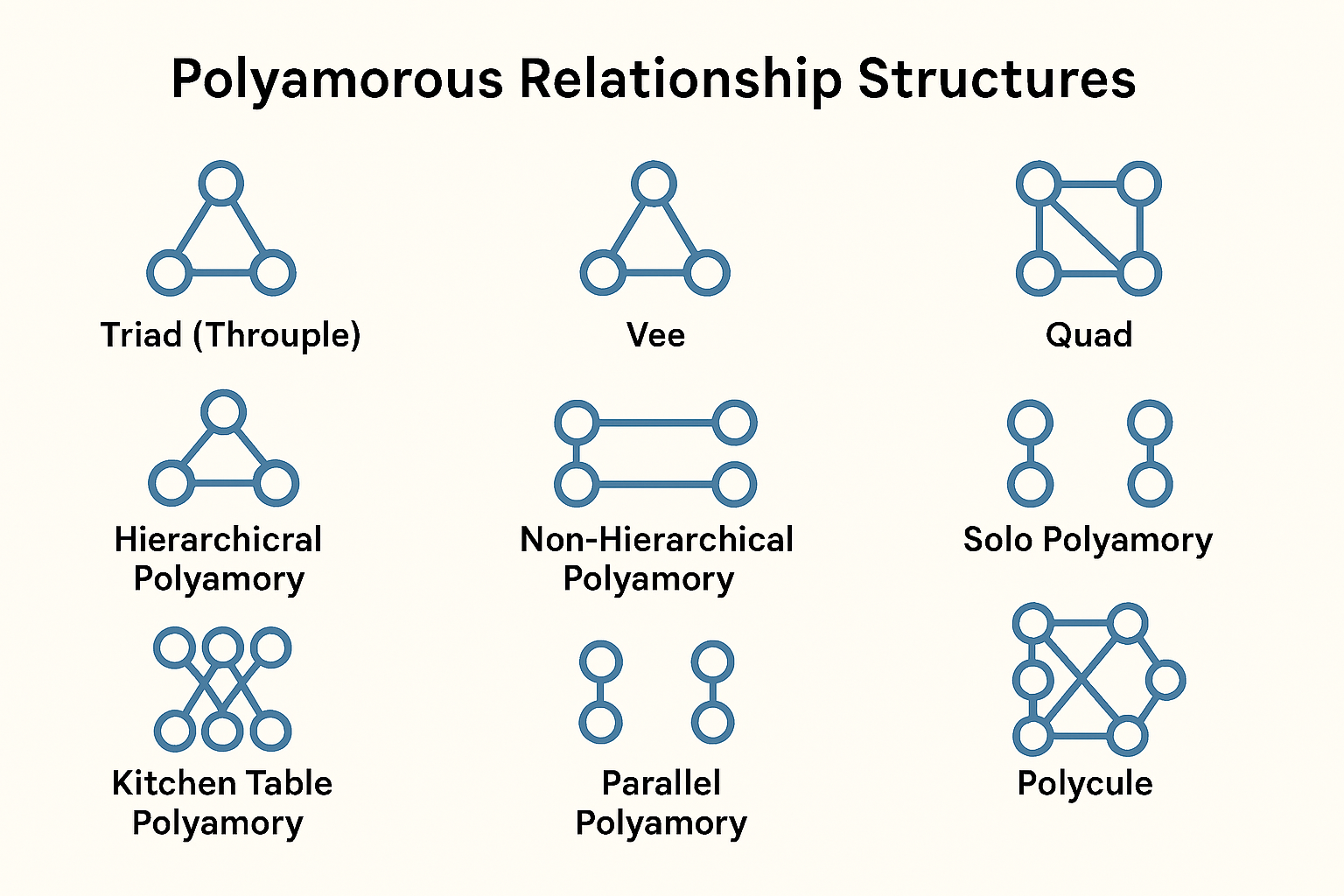
The image below shows simple diagrams representing these and other polyamorous configurations. Notice the visual difference between the 'Hierarchical' and 'Non-Hierarchical' models.
To get a pair of concise, clear definitions, let's watch two short clips.
The Difference Between Relationship Anarchy and Non-Hierarchical Polyamory
This video, from the Relationship Anarchy channel, provides very brief and direct definitions of both hierarchical and non-hierarchical polyamory. It's a great starting point for our discussion.
Please watch from the beginning until 01:36. The first part defines hierarchical polyamory, and the second defines the non-hierarchical approach. Pay close attention to the term 'veto power'.
As the video explains, the core concepts are:
- Primary Partner(s): Often a cohabiting, married, or long-term partner with whom life is deeply entangled (e.g., shared finances, home, or children).
- Secondary Partner(s): Partners who are not part of the primary unit. The relationship may be intentionally limited in terms of time, commitment, or entanglement.
- Veto Power: A rule that allows a primary partner to unilaterally end their partner's secondary relationship. This is a hallmark of prescriptive hierarchy and is widely seen as ethically contentious because it treats the secondary partner as disposable.
Hierarchical Polyamory: The Dynamics of Priority
Many people who transition from monogamy initially adopt a hierarchical model because it feels safer. It seems to protect the pre-existing relationship by placing it in a privileged position. This creates what is often called "couple's privilege," where the needs and security of the primary couple are systematically placed above the needs of anyone else.
Let's explore how this plays out in practice and the crucial distinction between prescriptive and descriptive hierarchy.
How Do You Get Started in Polyamory? | Therapist Explains Polyamory 101
Therapist Mickey Atkins gives a detailed explanation of hierarchical polyamory in this video. She clearly outlines the ethical concerns around couple's privilege and veto power and provides an excellent personal example to distinguish prescriptive from descriptive hierarchy.
Please watch the segment from 18:35 to 24:49. Focus on the distinction she makes between a hierarchy that is prescriptive (imposing rules and power) versus one that is descriptive (acknowledging existing life entanglements).
As Mickey Atkins explains, the key difference is:
-
Prescriptive Hierarchy: This is about power and control. The primary partners create rules that limit secondary relationships. Examples include veto power, restrictions on activities (e.g., "no overnights," "no 'I love yous'"), or rules that a secondary relationship can never escalate to a certain level of commitment. The goal is to protect the primacy of the core relationship.
-
Descriptive Hierarchy: This is about acknowledging logistics. It simply describes the reality of current entanglements without necessarily imposing rules on feelings or future possibilities. For example, a partner you live with and share finances with (a nesting partner) will naturally have a different type of involvement in your life than a partner you see twice a month. This is a descriptive reality, not a prescriptive rule limiting the emotional potential of the other relationship. Some people use the term "anchor partner" to describe this kind of highly-entangled partner without using the loaded term "primary."
While prescriptive hierarchy is often criticized, some individuals find comfort in the clarity of a well-defined structure. In the article "Guest Post: Is There a Problem with Hierarchy?", the author notes that being a secondary partner can have benefits, such as clear boundaries, fewer logistical burdens, and the freedom to enjoy a connection without the pressures of a primary partnership.
Common Challenges and the Limits of Frameworks
No relationship model is a magic bullet that prevents difficult feelings or conflict. Both hierarchical and non-hierarchical structures have their own common failure points, which usually stem from mismatched expectations and poor communication rather than the framework itself.
The following reading details some classic psychological traps that can emerge within hierarchical structures.
Guest Post: Is There a Problem with Hierarchy?
The article we just mentioned, 'Is There a Problem with Hierarchy?', provides an excellent breakdown of specific scenarios where hierarchical relationships can become problematic.
Please read the section titled 'Where Hierarchies Go Wrong'. Pay attention to the three scenarios described: 'automatic promotion of a secondary,' 'secondary escalation,' and 'primary-secondary mismatch.'
As the article illustrates, problems often arise during times of change:
- A primary relationship ends, and a secondary is implicitly "promoted" without a clear agreement, changing the nature of that relationship.
- A secondary relationship deepens naturally ("secondary escalation"), creating resentment or insecurity in the primary relationship because the original labels no longer fit the reality.
- A new partner desires a primary-level commitment, but the established couple is only offering a secondary role, leading to a fundamental mismatch in expectations.
It's important to note that non-hierarchical polyamory is not immune to these issues. A couple might claim to be non-hierarchical but practice an unstated or "sneaky" hierarchy, leading to confusion and hurt. Ultimately, the success of any polyamorous configuration depends less on the chosen label and more on honest communication about desires, boundaries, and capacity.
Conclusion
In this lesson, we have compared the foundational models of hierarchical and non-hierarchical polyamory. We've moved beyond simple definitions to analyze the psychological dynamics and practical challenges of each.
Key Takeaways:
- Hierarchical Polyamory (HP) explicitly ranks relationships, creating primary and secondary partners. This is often done to provide security for an established couple.
- Non-Hierarchical Polyamory (NHP) rejects formal ranking, aiming to allow each relationship to develop on its own terms.
- Prescriptive hierarchy involves rules and power imbalances (like veto power), while descriptive hierarchy simply acknowledges existing life entanglements (like co-parenting or shared finances).
- Neither model is inherently "right" or "wrong," and neither prevents relationship problems. Common pitfalls in both structures often trace back to mismatched expectations, a lack of clear communication, and unexamined power dynamics.
Preview of the Next Lesson
Non-hierarchical polyamory itself is a broad category encompassing several distinct philosophies. In our next lesson, we will explore two approaches that take the idea of autonomy to its fullest expression. We will describe solo polyamory and relationship anarchy, contrasting their approaches to autonomy and relationship categorization.