Welcome back! In our previous lesson, we established a clear definition of e-commerce and contrasted it with traditional, brick-and-mortar commerce. We saw that moving transactions online fundamentally changes everything from market reach to customer interaction.
Today, we will build on that foundation by exploring the different ways these online interactions are structured. The world of e-commerce isn't monolithic; it's a diverse ecosystem of different transaction types. Our goal is to classify the main models based on who is selling and who is buying. By the end of this lesson, you will be able to identify and provide real-world examples for the four primary types of e-commerce: Business-to-Consumer (B2C), Business-to-Business (B2B), Consumer-to-Consumer (C2C), and Direct-to-Consumer (D2C).
A Framework for Classification
The simplest way to categorize e-commerce is by identifying the participants in a transaction. Is a business selling to an individual? Is one business selling to another? Or are individuals trading amongst themselves? Answering these questions allows us to map the entire e-commerce landscape. Let's start with the model you're likely most familiar with.
Business-to-Consumer (B2C)
Business-to-Consumer (B2C) e-commerce is what most people think of when they hear "online shopping." It involves businesses selling products or services directly to individual consumers for their personal use. Think of any time you've bought a book from an online retailer, ordered takeout through an app, or subscribed to a streaming service.
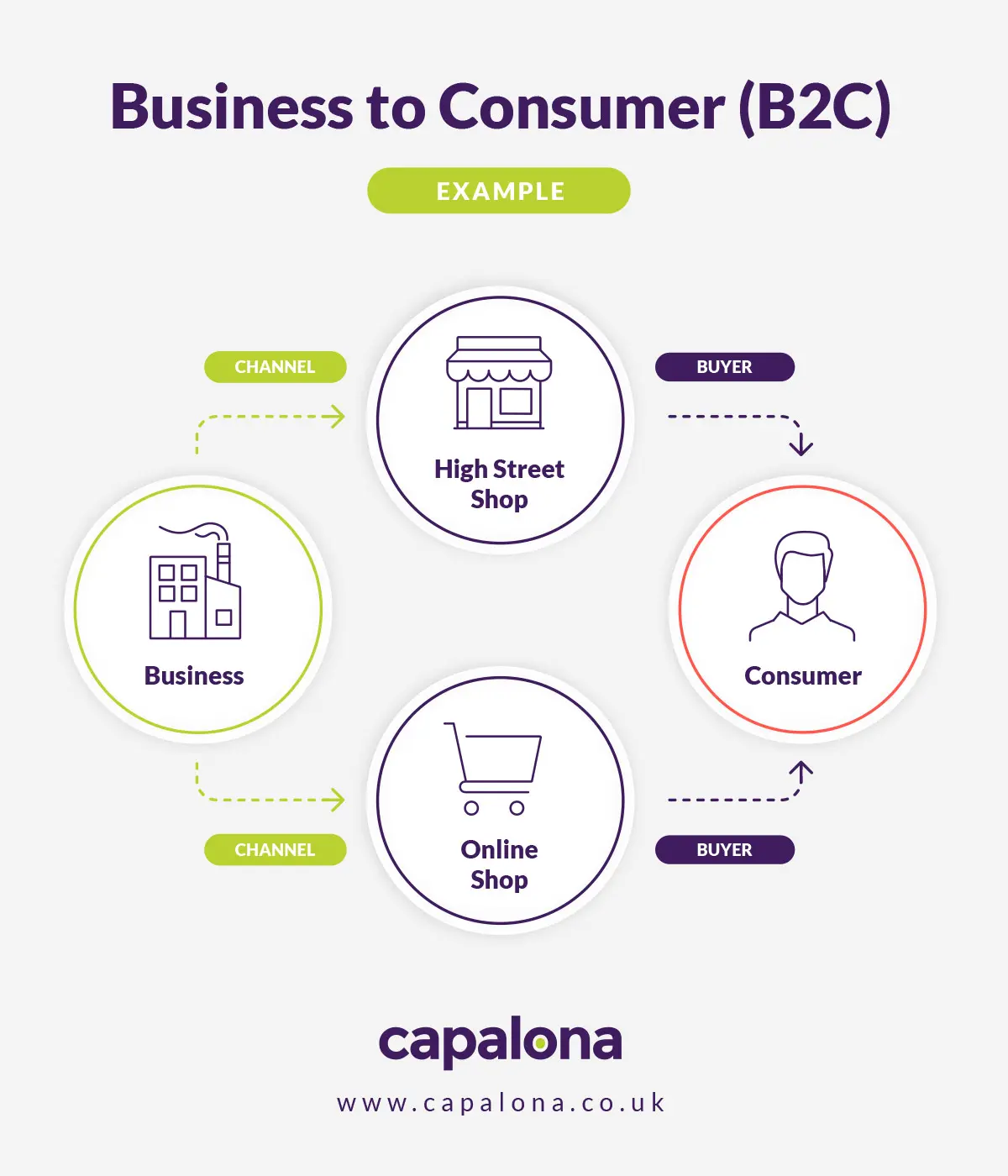
To see this in context, let's watch a short introductory video that defines the main e-commerce types.
This clip from the video "What is eCommerce?" by Simply Coding provides clear, concise definitions for the primary e-commerce models.
Watch the segment from B2C, B2B, and C2C. Pay attention to the simple examples provided for each type, as we will be building on them.
As the video highlighted, B2C is characterized by a high volume of transactions, but with a relatively low value for each individual sale. The sales process is often quick and can be driven by emotional decisions or immediate needs. For a deeper look into its characteristics and real-world applications, please read the following section.
Different Types of E-commerce Models: A Complete Guide
This article from Sea Media Academy provides a thorough breakdown of the B2C model, including its key characteristics, advantages, and challenges.
Please read the entire section on B2C e-commerce. Focus on understanding the concepts of shorter sales cycles and consumer-focused marketing.
Business-to-Business (B2B)
Next, we have Business-to-Business (B2B) e-commerce, where transactions occur between two companies. This could be a manufacturer selling components to an assembler, a firm selling software to other companies, or a wholesaler selling in bulk to a retailer.
Unlike B2C, B2B transactions typically involve:
- Higher order values: Orders are often in bulk and represent significant investment.
- Longer sales cycles: The decision-making process is more complex, involving multiple stakeholders, quotes, and negotiations.
- Relationship-driven focus: Building long-term, trusting relationships is crucial for repeat business.
For a detailed explanation of the B2B model, let's turn to the following resource.
Types of E-Commerce Websites Explained: B2B, B2C, and More
This section from ICO Web Solutions explains the unique features of B2B e-commerce, such as bulk ordering and the importance of order management systems.
Read the section titled B2B E-Commerce. Pay attention to the key features that distinguish B2B platforms from the B2C sites you might be more familiar with.
Examples like Alibaba (connecting manufacturers with businesses globally) or Salesforce (providing customer relationship management software to companies) perfectly illustrate this model in action.
Consumer-to-Consumer (C2C)
Consumer-to-Consumer (C2C) e-commerce facilitates trade between individuals. In this model, a company provides a platform (or marketplace) where consumers can buy and sell goods and services from one another. The platform itself doesn't own the inventory; it makes money by charging listing fees or taking a commission on each transaction.
The most famous example is eBay, where individuals can auction off second-hand items. Other examples include Etsy, which focuses on handmade and vintage goods, and Facebook Marketplace.
Different Types of E-commerce Models: A Complete Guide
This resource explains how C2C platforms operate as intermediaries and the importance of trust and safety systems.
Read the full section on C2C e-commerce. Focus on the platform's role and the challenges associated with quality control and trust.
Direct-to-Consumer (D2C): A Special Case of B2C
This brings us to our final, and perhaps most modern, classification: Direct-to-Consumer (D2C). The D2C model can sometimes be confused with B2C, but there's a critical difference. While all D2C is a form of B2C, not all B2C is D2C.
Here's the distinction:
- Traditional B2C often involves a supply chain with intermediaries. A manufacturer sells to a wholesaler, who sells to a retailer, who finally sells to the consumer. When you buy a product from a major online retailer like Amazon or Walmart, you are often participating in this multi-step chain.
- D2C occurs when the brand or manufacturer sells directly to the end consumer, bypassing all intermediaries.
This diagram clearly shows the difference in the value chain.
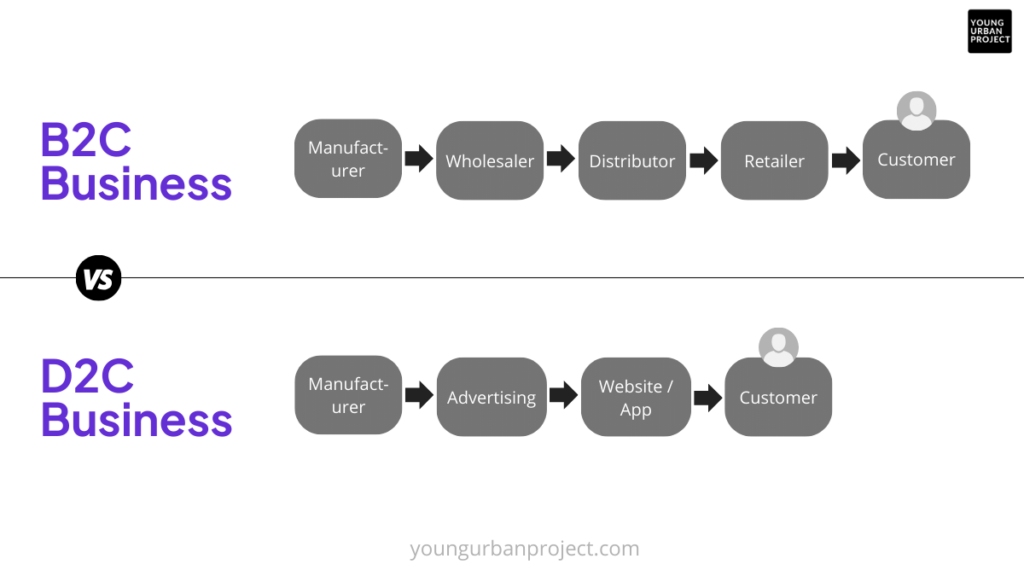
Brands adopt the D2C model to gain more control over their brand image, customer experience, and pricing, while also capturing the profit margin that would otherwise go to retailers.
Different Types of E-commerce Models: A Complete Guide
This article details the D2C model, highlighting its benefits like higher profit margins and direct access to customer data.
Read the section on D2C. Note the examples like Warby Parker and Dollar Shave Club, which are classic case studies of disrupting traditional industries by going direct.
Summary of E-Commerce Types
To help consolidate these concepts, here is a summary table:
| Model | Who Sells to Whom | Key Characteristics | Examples |
|---|---|---|---|
| B2C | Business → Consumer | Short sales cycle, emotional buying, large market | Amazon, Walmart, Netflix |
| B2B | Business → Business | Long sales cycle, logic-based buying, high order value | Alibaba, Salesforce, Slack |
| C2C | Consumer → Consumer | Platform as intermediary, trust systems are key | eBay, Etsy, Facebook Marketplace |
| D2C | Brand/Mfr. → Consumer | Bypasses intermediaries, brand control, data ownership | Warby Parker, Casper, Allbirds |
You may also encounter other classifications, such as Consumer-to-Business (C2B), where individuals sell services to companies (e.g., a freelance graphic designer on Upwork), or models involving government agencies (B2G, C2G). However, the four we've covered today represent the core of the modern e-commerce landscape.
Conclusion
In this lesson, we have dissected the e-commerce world into its primary classifications. By understanding who is transacting with whom, we can better analyze the strategies and challenges inherent in each model.
Here are the key takeaways:
- E-commerce models are primarily defined by the participants: Business (B) and Consumer (C).
- B2C is the most common model, where businesses sell to individuals.
- B2B involves transactions between two businesses, characterized by larger orders and longer decision times.
- C2C empowers individuals to trade with each other through an intermediary platform.
- D2C is a powerful B2C strategy where brands sell directly to their customers, cutting out traditional retailers.
Now that we've classified who is involved in e-commerce, our next lesson will examine how these businesses operate. We will compare common e-commerce business models, such as using online marketplaces, the dropshipping model, and subscription services.