Welcome to the first lesson of your course on e-commerce. Our goal today is to build a solid foundation by exploring exactly what e-commerce is and how it differs from the traditional commerce we experience in our daily lives. By the end of this lesson, you will be able to define both concepts and clearly distinguish between their core characteristics. This understanding is the essential first step before we delve into more specific models and strategies in the e-commerce landscape.
What is Commerce?
Before we can discuss "e-commerce," let's start with the root word: commerce. At its heart, commerce is simply the act of buying and selling goods or services. This fundamental human activity has evolved over millennia, from early barter systems to the use of currency and modern banking.
To get a quick overview of this evolution and set the stage for our main topic, let's watch a short video.
This clip from the "What is eCommerce?" video by Simply Coding provides a concise definition of both commerce and its traditional form.
Please watch the first part of the video, from the beginning until 00:49. Pay attention to the definition of commerce and the description of how traditional commerce operates, focusing on its key limitations. What is commerce? Traditional commerce
As the video explains, traditional commerce is what we experience in person. It's characterized by:
- Face-to-face interaction in a physical location like a store or market.
- Geographical limitation, typically serving a local or regional customer base.
- Immediate gratification, where you receive the goods as soon as you pay for them.
- Limited operating hours, usually confined to standard business days and times.
Defining E-commerce
With the advent of the internet, a new way of conducting business emerged: electronic commerce, or e-commerce. This refers to the buying and selling of goods and services conducted over an electronic medium, primarily the internet.
To get a formal definition, please read the following brief sections from the article "E-commerce vs. Traditional Business" from D&V Philippines.
E-commerce vs. Traditional Business: What's the Difference?
This reading will provide you with clear, side-by-side definitions of e-commerce and traditional business.
Please read the two short sections under the heading "Defining the terms". Focus on the core components mentioned in each definition, such as the role of the internet for e-commerce and physical locations for traditional business.
As you've just read, e-commerce transactions take place on digital platforms, such as online marketplaces like Amazon or dedicated websites built with tools like Shopify. This fundamental difference—physical versus digital—is the source of all the other distinctions between the two models.
Distinguishing E-commerce from Traditional Commerce
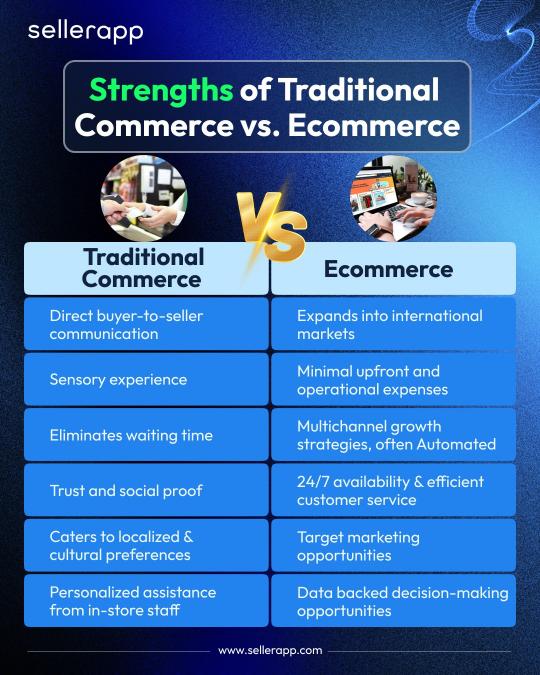
Now let's break down the key differences in more detail. The following infographic provides a great at-a-glance comparison of the strengths of each model.
To explore these distinctions more deeply, let's return to the D&V Philippines article. It provides an excellent, structured comparison across several key business aspects.
E-commerce vs. Traditional Business: What's the Difference?
This reading expands on the infographic by providing detailed explanations for each point of comparison.
Please read the section titled "6 key differences". Pay close attention to how each aspect—from market reach to customer interaction—manifests differently in an e-commerce context versus a traditional one. You can skip the final subsection on "Accounting."
Based on your reading and the infographic, we can summarize the main points of contrast:
- Reach & Accessibility: Traditional commerce is local and operates during fixed hours. E-commerce is global and accessible 24/7.
- Customer Interaction: Traditional commerce is face-to-face and personal. E-commerce interactions are screen-to-face, mediated by technology like chat, email, and reviews.
- Product Experience: In a physical store, you can touch, see, and try products. Online, the experience is based on images, descriptions, and videos. This is often referred to as the lack of "tangibility" in e-commerce.
- Operations & Costs: Traditional businesses have high overheads like rent and in-store staff. E-commerce businesses often have lower operational costs but face expenses related to digital marketing, platform fees, and shipping.
- Delivery: Traditional commerce provides instant possession of goods. E-commerce involves a delay for shipping and fulfillment.
Advantages and Disadvantages
These differences naturally lead to distinct advantages and disadvantages for each model. The next video offers a clear summary of the pros and cons of operating an e-commerce business, which implicitly highlights the corresponding strengths of its traditional counterpart.
This video from Marketing91 details the unique benefits and drawbacks of e-commerce.
Please watch the segments on the advantages and disadvantages of e-commerce. Advantages of e-commerce Disadvantages of e-commerce
As you can see, the lack of geographic boundaries and 24/7 availability are powerful advantages for e-commerce. However, this comes with challenges like intense competition, security concerns, and the inability for customers to physically inspect goods before buying—a key strength of the traditional model.
Conclusion
In this lesson, we established the foundational concepts of commerce. We defined traditional commerce as the familiar, in-person model of business and contrasted it with e-commerce, which is the buying and selling of goods and services over the internet.
Here are the key takeaways:
- Traditional commerce is defined by its physical presence, personal interaction, local reach, and limited operating hours.
- E-commerce is defined by its digital nature, global reach, 24/7 accessibility, and screen-based customer interactions.
- The choice between the two models involves trade-offs between factors like operational costs, customer experience, market potential, and fulfillment speed.
Now that you have a clear understanding of what e-commerce is, our next lesson will explore the different ways these online interactions take place. We will classify the main types of e-commerce, such as Business-to-Business (B2B), Business-to-Consumer (B2C), and others, using real-world examples you'll surely recognize.