Welcome back! In our previous lesson, we established a framework for classifying e-commerce based on the participants in a transaction—B2C, B2B, C2C, and D2C. Now that you can identify who is buying and selling, we'll turn our attention to how these online businesses are structured to generate revenue.
Today, we will delve into the operational blueprints, or business models, that underpin e-commerce ventures. We will define, analyze, and compare several of the most common approaches: dropshipping, wholesale, marketplace, and subscription services. By the end of this lesson, you will be able to compare these models based on their distinct advantages, challenges, and strategic trade-offs, enabling you to understand the fundamental choices an entrepreneur makes when starting an online business.
A Landscape of E-Commerce Business Models
While the B2C/B2B classification tells us about the transaction type, the business model defines the mechanics of value delivery and profit generation. It answers questions like: Do I hold my own inventory? Do I create a platform for others? Do I charge customers once or on a recurring basis?
This infographic provides a helpful visual overview of some of the models we will be exploring today.
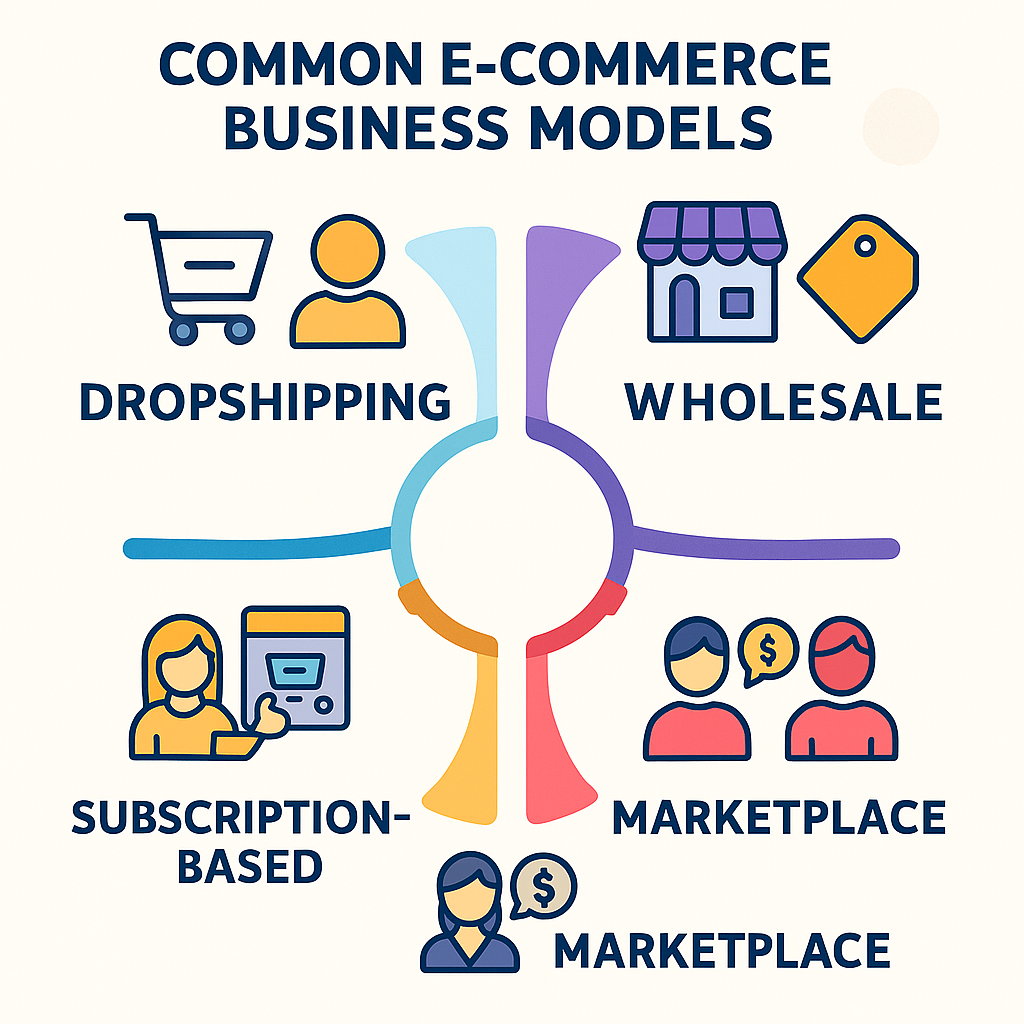
Let's begin by contrasting two of the most fundamental approaches to handling products: dropshipping and the traditional wholesale/retail model.
Model 1: The "Hands-Off" Inventory Approach – Dropshipping
Dropshipping is a retail fulfillment method where a store doesn't keep the products it sells in stock. When a store sells a product, it purchases the item from a third party—a manufacturer or wholesaler—and has it shipped directly to the customer. As a result, the merchant never sees or handles the product.
This visual provides a clear contrast between traditional e-commerce fulfillment and the dropshipping model.

The appeal of dropshipping lies in its low barrier to entry. However, this ease comes with significant trade-offs regarding profit margins, quality control, and competition. To get a realistic, in-depth look at this model, let's watch a detailed analysis.
Every Ecommerce Business Model Ranked - Only 2 Make Real Money
The video "Every Ecommerce Business Model Ranked" from the MyWifeQuitHerJob Ecommerce Channel provides a critical, real-world evaluation of various models. This first segment breaks down the pros and cons of dropshipping.
Please watch the section on dropshipping on your own website. As you watch, focus on the speaker's rating criteria: ease of launch, profit velocity, sustainability/risk, and competition. Note his points about thin margins and lack of control over the customer experience.
As the video explains, the primary strengths of dropshipping are its low startup costs and simplicity. However, its greatest weakness is also its greatest strength: because it's so easy to start, the market becomes incredibly saturated, driving down prices and profits. You are also completely reliant on your supplier for product quality and shipping times, which can damage your brand if issues arise.
A popular variation of dropshipping is Print on Demand (POD), where you sell custom-designed items (like t-shirts or mugs) that are printed and shipped by a third party only after an order is placed. It shares the same "no inventory" benefit as dropshipping but faces similar challenges with tight margins and intense competition.
Model 2: The "Hands-On" Inventory Approach – Wholesale/Retail
The more traditional counterpart to dropshipping is the wholesale or retail model. Here, you purchase products in bulk from a manufacturer or distributor at a discounted price, hold the inventory yourself (or in a third-party warehouse), and then sell them to consumers at a markup. This is likely what comes to mind when you picture a classic retail business.
This model gives you significantly more control over the customer experience, from product quality to packaging and shipping speed. Margins are also typically healthier than in dropshipping. However, it requires a larger upfront investment in inventory and carries the risk of not being able to sell the stock you've purchased.
Let's return to the same video to see how this model compares.
Every Ecommerce Business Model Ranked - Only 2 Make Real Money
This segment of the video examines the traditional wholesale model, where you sell other brands' products on your own website.
Watch the review of buying wholesale. Pay attention to the discussion of 50% margins and owning the customer relationship, but also the major challenge: competition and the need for differentiation.
In essence, the wholesale model trades the low financial risk of dropshipping for greater control and higher potential profit. Success in this model often depends on your ability to add value beyond simply listing a product, such as through expert content, excellent customer service, or building a strong brand identity.
Model 3: The Platform Approach – The Marketplace
Instead of selling products yourself, you can create a platform that connects buyers with multiple sellers. This is the marketplace model. Think of Amazon, eBay, or Etsy. The marketplace owner does not own the inventory; instead, they facilitate transactions and typically earn revenue through commissions, listing fees, or advertising services.
Building a marketplace is a complex undertaking, but selling on an existing one is a very common strategy for e-commerce entrepreneurs.
To understand the core mechanics of the marketplace model from the platform owner's perspective, please read the following section.
E-commerce Revenue Models: Subscription, Marketplace & More
This article from Elsner Technologies provides a concise overview of how marketplace models work.
Read the section under the heading Marketplace E-commerce Model. Focus on understanding the "network effect" and the different revenue streams available to a platform owner.
For sellers, marketplaces offer a huge advantage: immediate access to a large base of customers. However, this comes at the cost of intense competition (often on the same product page), less control over branding, and significant platform fees that eat into profits. As the video "Every Ecommerce Business Model Ranked" discusses in its analysis of selling on Amazon, you are essentially "building on rented land."
Model 4: The Recurring Revenue Approach – Subscription Services
The subscription model focuses on customer retention over one-time sales. In this model, customers pay a recurring fee—typically monthly or yearly—to receive a product or service on a regular basis. Examples range from streaming services like Netflix to curated "subscription boxes" for items like coffee, beauty products, or pet food.
This approach offers the powerful advantage of predictable, recurring revenue, making financial forecasting much more stable. However, it requires a constant effort to provide value to prevent customers from canceling their subscriptions (an issue known as "churn").
Let's explore the details of this model.
E-commerce Revenue Models: Subscription, Marketplace & More
This resource offers a great breakdown of the subscription model, covering its benefits, challenges, and ideal use cases.
Please read the section titled Subscription Model. Pay close attention to the concepts of predictable revenue and customer lifetime value (CLV), as well as the primary challenge of managing churn.
Comparing the Models: A Summary of Trade-Offs
Each business model presents a unique set of trade-offs. There is no single "best" model; the right choice depends on your capital, risk tolerance, skills, and business goals.
The following table summarizes the key characteristics of the models we've discussed.
| Feature / Model | Dropshipping | Wholesale/Retail | Selling on a Marketplace | Subscription |
|---|---|---|---|---|
| Upfront Investment | Very Low | High | Low to Medium | Medium |
| Inventory Risk | None | High | Medium | Medium |
| Profit Margins | Low | Medium to High | Low to Medium | Medium to High |
| Control over Brand | Low | High | Very Low | High |
| Revenue Predictability | Low | Low to Medium | Medium | High |
| Key Challenge | Supplier reliance, competition | Inventory management, traffic | Fees, competition, no control | Customer retention (churn) |
To guide your thinking on how to select a model, the following resource provides a simple but effective framework.
E-commerce Revenue Models: Subscription, Marketplace & More
This final excerpt gives practical advice on matching a business model to your personal circumstances.
Read the short section on choosing a model. This connects the concepts we've learned to a practical decision-making process.
Conclusion
In this lesson, we moved beyond the types of e-commerce transactions to explore the operational business models that power online stores. We've seen that each model represents a distinct strategy with its own balance of risks and rewards.
Here are your key takeaways:
- Business models define how an e-commerce company operates and makes money.
- Dropshipping offers a low-cost, low-risk entry point but suffers from thin margins and a lack of control.
- The Wholesale/Retail model provides higher margins and brand control but requires significant upfront investment in inventory.
- Marketplaces offer instant access to traffic but at the cost of high fees, intense competition, and dependence on the platform's rules.
- The Subscription model creates predictable, recurring revenue but requires a relentless focus on delivering value to retain customers.
Understanding these fundamental trade-offs is the first step in formulating a sound e-commerce strategy. Now that we have covered the types of e-commerce and the primary business models, our next lesson will look at the day-to-day reality of running an online business. We will outline the essential components of e-commerce operations, from presenting a product online to getting it into the customer's hands.