Welcome to your third lesson.
In our last session, we mapped out the project life cycle, understanding the four key phases: defining, planning, executing, and closing. This gave us the "what" and "when" of a project's journey.
Today's Goal
Today, we'll focus on the "who" that drives this journey. Our learning outcome is to identify the key roles and responsibilities of a project manager. We will explore the multifaceted nature of this role, which sits at the intersection of planning, leadership, communication, and problem-solving. Understanding these responsibilities is fundamental to applying project management principles in your upcoming case study and for your exam.
1. The Core Balancing Act: The Project Management Triangle
At the heart of a project manager's responsibility is a constant balancing act. Every project is constrained by three key factors: scope (what we are creating), time (the schedule), and cost (the budget). These three form the "project management triangle." The project manager's primary job is to manage these competing constraints while ensuring the final deliverable meets a certain standard of quality.
What a Project Manager Does - Roles, Skills & Responsibilities
Let's start by understanding this fundamental framework. This article from Cora Systems clearly explains the project management triangle and its importance.
Please read the section titled 'Project Manager Roles and Key Responsibilities'. Focus on how it describes the relationship between scope, time, cost, and quality.
A change in one constraint almost always impacts the others. For example:
- If a client wants to increase the scope (add features), the project manager must explain that this will likely require more time and/or cost.
- If the deadline is moved up (reducing time), the project manager might need to negotiate a reduction in scope or an increase in cost (e.g., by hiring more people).
This triangle is the lens through which a project manager makes many of their daily decisions.
2. A Breakdown of Key Responsibilities
Now that we have the core framework, let's break down the specific duties a project manager performs to navigate a project from start to finish.
Project Manager Job Description
This article from Purdue University provides a clear and concise list of the primary duties of a project manager. It serves as an excellent high-level overview.
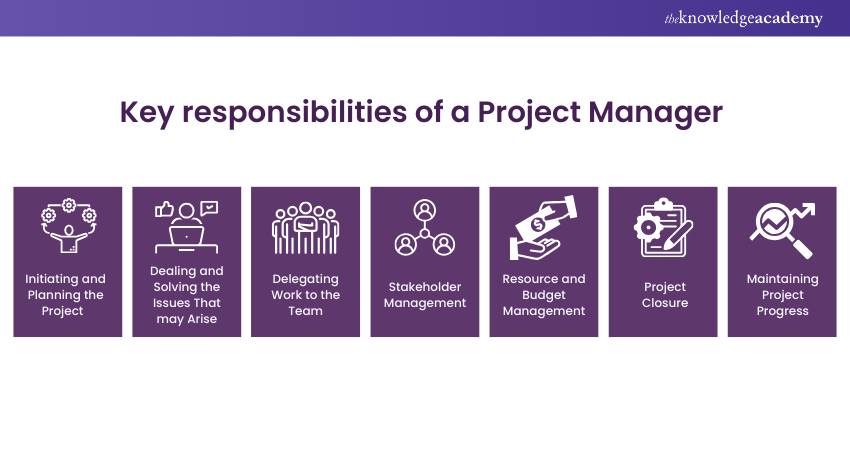
Please read the section 'What Are the Roles and Responsibilities of a Project Manager?'. Pay attention to the seven responsibilities listed, from planning the scope to evaluating performance.
As you read, you can see how these responsibilities map directly to the project life cycle we discussed in the last lesson. Let's visualize this with a simple infographic.
3. The Project Manager in Action: Myths vs. Reality
Lists and diagrams are helpful, but understanding the role also means appreciating the nuances of how these responsibilities are carried out in practice. A common misconception is that a project manager simply creates a plan and then tells people what to do. The reality is far more dynamic and people-focused.
This video offers practical insights into what a project manager really does, contrasting common myths with the reality of the job.
What Does a Project Manager Do? Myths vs. Reality | Roles and Responsibilities of a Project Manager
This video from 'PMPwithRay' provides a realistic look at the project manager's role. We will watch it in segments that align with the responsibilities we've just read about.
Start by watching the introduction and the first core area, 'Project Planning and Initiation' (0:00 - 05:09). Note the distinction he makes between a project and business-as-usual operations, reinforcing our first lesson.
Planning, Risk Management, and Communication
As the video highlighted, planning isn't just about creating a schedule. It's about defining what the project is (and isn't), setting realistic expectations, and establishing the rules of engagement through a governance framework.
Now, let's explore three other critical areas: leading the team, managing risks, and acting as the communication hub.
What Does a Project Manager Do? Myths vs. Reality | Roles and Responsibilities of a Project Manager
Let's continue with the next three core areas discussed in the video.
Please watch the segments on 'Team Leadership and Coordination' (05:09 - 08:02), 'Risk and Issue Management' (08:02 - 10:39), and 'Stakeholder Communication and Reporting' (10:39 - 12:55).
Notice the key themes from those segments:
- Team Leadership: The project manager often leads a team of people who do not report directly to them. This requires influencing without authority. Your HR background gives you insight into functional reporting lines, and this concept is central to navigating them effectively.
- Risk vs. Issues: A PM proactively plans for risks (potential problems) and reactively solves issues (problems that have already occurred).
- Communication Hub: The PM isn't expected to be the expert on everything. A key skill is knowing who the right experts are and facilitating communication between them and the stakeholders.
4. The Dual Role: Manager vs. Leader
The concept of "influencing without authority" brings us to a crucial distinction: the difference between managing a project and leading a project team.
- Management is about handling complexity. It involves planning, budgeting, organizing, and problem-solving. It's about ensuring the project is on time and on budget.
- Leadership is about coping with change and motivating people. It involves setting a vision, aligning people towards that vision, and inspiring them to overcome obstacles.
A successful project manager must be both a good manager and a good leader.
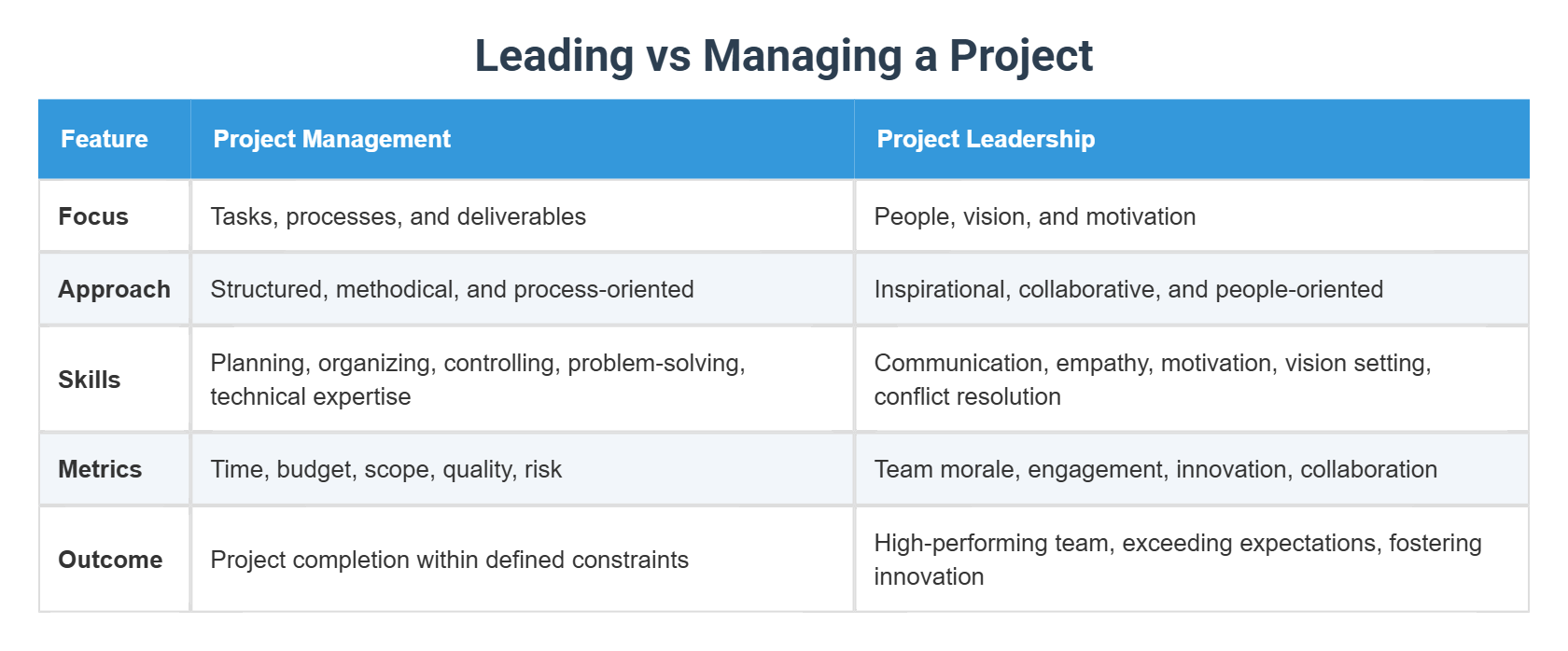
As you can see from the table, management focuses on the "what" and "how" (the plan, the schedule, the budget), while leadership focuses on the "who" and "why" (the team, the vision, the motivation). Your experience in HR gives you a solid foundation for understanding the leadership aspects, such as team dynamics, motivation, and communication.
Conclusion
In this lesson, we've unpacked the complex role of the project manager. It's far more than just tracking tasks on a Gantt chart.
Key Takeaways:
- The project manager's core job is to balance the competing constraints of scope, time, and cost to deliver a quality product.
- Key responsibilities include planning, leading the team, managing the budget, overseeing risk, and communicating with stakeholders.
- A project manager is the central communication hub, connecting team members, experts, and stakeholders, but doesn't need to be the expert in every technical detail.
- The role has a crucial dual nature, requiring skills in both project management (organizing tasks) and project leadership (inspiring people).
Preview of the Next Lesson:
We've established what a project is, the path it follows, and the person who guides it. But how are projects chosen in the first place? In the next lesson, we will "Explain how organizational strategy drives project selection." We will see that projects are not chosen randomly; they are initiated to help an organization achieve its strategic goals.