Welcome to your fourth lesson in the Principles of Project Management course.
In our last session, we defined the roles and responsibilities of a project manager, establishing them as the central figure who guides a project to completion. We saw that their job involves a constant balancing act and requires both management and leadership skills.
But this raises a fundamental question: how does a project get approved in the first place? Projects don't appear out of thin air. They are carefully chosen investments.
Today's Goal
This lesson directly addresses that question. Our learning outcome is to explain how organizational strategy drives project selection. We will explore the vital link between a company's long-term goals and the specific projects it decides to undertake. Understanding this connection is the first step in justifying any project, a skill you will need for your upcoming case study and for the exam.
We'll cover:
- The concept of Project Portfolio Management (PPM) as the bridge between strategy and execution.
- The problems that arise when projects are not aligned with strategy.
- The models and criteria organizations use to select the right projects.
Let's begin by looking at where project selection fits into the big picture.

1. From Strategy to Projects: The Role of Portfolio Management
An organization’s strategy is its long-term plan for achieving its mission and vision. Projects are the primary vehicles used to execute that strategy. The process of selecting, prioritizing, and managing all of an organization's projects and programs as a unified collection is called Project Portfolio Management (PPM).
Think of it this way:
- Strategy is the destination (e.g., "Become the market leader in sustainable technology").
- The Portfolio is the GPS-optimized route plan that considers all possible roads.
- Projects are the individual legs of the journey (e.g., "Develop a new recyclable battery," "Build a solar-powered factory").
This first video introduces the concept of PPM and why it's a more effective approach than just relying on intuition or a simple map.
Project Portfolio Management - Simplified
Let's watch this overview from Acuity PPM. It clearly defines portfolio management and uses a great analogy to explain its role in executing strategy.
Please watch the first two parts of the video (0:00 - 08:02). Focus on: The distinction between a project, a program, and a portfolio. The paradigm shift of viewing projects as strategic investments. The 'GPS' analogy for how a portfolio optimizes the path to strategic goals.
As the video explains, PPM provides answers to critical business questions like "Are we working on the right projects?" and "Where are we investing our money and our people?". Without a formal system to align projects with strategy, significant problems can arise.
2. The Dangers of Misalignment
When project selection is not driven by a clear strategy, organizations often suffer from three key problems:
- The Implementation Gap: A disconnect between high-level strategy formulated by executives and the projects executed by functional managers.
- Organizational Politics: Projects are chosen based on the power and persuasiveness of individuals rather than strategic merit. These are often called "pet projects."
- Inefficient Resource Use: Too many projects are started without clear priorities, leading to multitasking and delays as teams are spread too thin.
The next video explains these issues in more detail.
Project Management 04: Project Selection
This video from Yong Wang explains the consequences of not having a strong project priority system.
Please watch the first segment (0:03 - 04:44). As you watch, think about how your experience as a Network Engineer or in HR has shown you examples of resource conflicts or competing departmental priorities.
To avoid these problems, organizations need a structured process for selecting projects.
3. The Project Selection Process
Project selection is fundamentally a filtering process. Many ideas are proposed, but only a few are selected and funded.
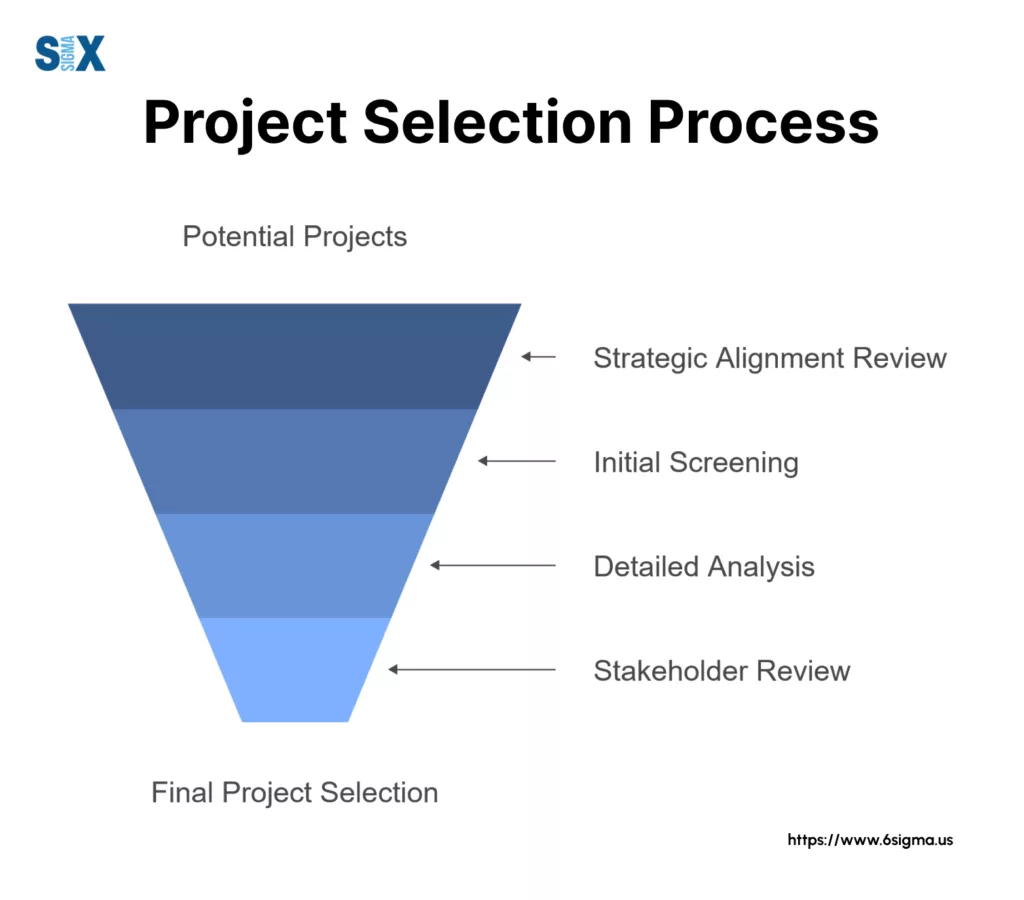
This process relies on a combination of financial and non-financial criteria to evaluate which projects offer the most value and best align with the company's strategic objectives.
Project Organization and Selection
To understand the factors that go into this selection funnel, let's read a short piece from an open-source textbook.
Please read the introduction and the first main section of the text, down to the heading 'Financial and Non-Financial Criteria'. Focus on the three types of projects mentioned: compliance, operational, and strategic.
As the reading highlights, organizations must evaluate projects against a set of criteria. Let's look at the two main categories of models used for this.
Non-Financial Selection Models
While financial return is important, it's not the only factor. A project might be selected for other strategic reasons, such as increasing market share, developing new technology, or meeting regulatory requirements (a compliance project).
Two common non-financial models are:
- Checklist Model: A simple set of questions (e.g., "Does this project align with our strategy?", "Do we have the resources?"). It's a good first-pass filter but is highly subjective and doesn't allow for easy comparison between projects.
- Multi-Weighted Scoring Model: A more robust method. Here, selection criteria are identified, assigned a weight based on their strategic importance, and each project is scored against them. The weighted scores are then summed to give a total score for comparison.
This video provides a great walkthrough of these models, including a clear example of a multi-weighted scoring model in action.
Project Management 04: Project Selection
Let's return to the 'Project Management 04' video to see how non-financial models work.
Please watch from 11:29 to 16:40. Pay close attention to the example of the multi-weighted scoring model. Notice how the criteria (e.g., 'Enhance Core Competencies,' 'Align with Strategy') are directly tied to strategic goals.
The scoring model provides a disciplined, objective way to ensure the projects with the highest strategic value are prioritized.
Financial Selection Models (A Preview)
The other side of the coin is financial viability. You mentioned you want to learn more about financial calculations, and we will dedicate future lessons to that. For now, it's important to recognize their role in project selection. They help answer the question: "Is this project a good financial investment?"
Project Selection Methods: A Primer for the Project Manager
This article gives a brief, non-mathematical introduction to two of the most common financial models you'll need to know for your exam.
Please read just the introductory paragraphs for the sections 'B. Payback Period' and 'D. Net Present Value (NPV)'. We will cover the calculations in detail in Module 2.
- Payback Period: Measures how long it will take to earn back the initial investment. A shorter payback period is generally preferred.
- Net Present Value (NPV): Calculates the total expected profit of a project, taking into account the time value of money (i.e., a dollar today is worth more than a dollar tomorrow). A positive NPV indicates a financially viable project.
4. Creating a Balanced Portfolio
Finally, it's not about just picking the single project with the highest score. Organizations strive for a balanced portfolio of projects, much like a financial investor diversifies their stocks. This involves balancing risk, timeline, and project type.
A useful way to classify projects in a portfolio is by their risk and potential value:
- Bread-and-butter: Easy, low-risk projects that provide modest value (e.g., software updates). They are essential for keeping the business running.
- Pearls: Low-risk, high-value projects. These are clear winners.
- Oysters: High-risk, potentially high-value projects (e.g., breakthrough R&D). They are gambles that could lead to a 'pearl'.
- White Elephants: Projects that once had promise but are no longer viable. These should be identified and cancelled.
This final video clip explains this concept of portfolio balancing.
Project Management 04: Project Selection
Let's watch the final segment of the video to understand how senior management balances the project portfolio.
Please watch from 17:55 to 22:07. Focus on the four project types and the role of senior management and the Project Management Office (PMO) in maintaining this balance.
Conclusion
Today, we have connected the dots between an organization's highest-level strategy and the individual projects it undertakes. Projects are not chosen at random; they are the result of a deliberate selection process designed to move the organization toward its goals.
Key Takeaways:
- Projects are the primary means by which an organization executes its strategy.
- Project Portfolio Management (PPM) is the discipline of managing projects as a collective to ensure they align with strategic objectives.
- Without strategic alignment, organizations face problems like political project selection and inefficient use of resources.
- Project selection uses both non-financial models (like the multi-weighted scoring model) and financial models (like Payback Period and NPV) to evaluate proposals.
- The goal is to create a balanced portfolio of projects that includes a mix of low-risk operational work and high-risk strategic initiatives.
Preview of the Next Lesson:
Now that we understand why a project is chosen, we need to consider the environment in which it will be executed. In our next lesson, we will compare functional, matrix, and projectized organizational structures and their impact on projects. This will explore how a company's structure can help or hinder a project manager's ability to get things done.