Hello! Welcome to your fifth lesson in the Principles of Project Management course.
In our last session, we established the crucial link between an organization's strategy and the projects it chooses to pursue. We saw that projects are selected through a careful process to ensure they align with long-term goals.
But once a project is approved, what kind of environment will it be executed in? A project manager's ability to lead, secure resources, and communicate effectively is heavily influenced by the company's organizational structure.
Today's Goal
This lesson addresses the learning outcome: Compare functional, matrix, and projectized organizational structures and their impact on projects. We will explore how a company is organized and how that setup directly impacts a project manager's authority, access to resources, and the overall dynamics of a project. Understanding this is fundamental to navigating the political and logistical landscape of any project.
Given your background in HR and as a Network Engineer, you've likely experienced how reporting lines and departmental divisions shape daily work. Today, we'll put a formal project management framework on those experiences.
We will cover:
- The definitions and characteristics of functional, projectized, and matrix organizations.
- The advantages and disadvantages of each structure from a project perspective.
- How each structure impacts a project manager's authority, budget control, and resource availability.
Let's start with a clear overview of these three core structures.
1. The Three Basic Structures
All organizations need a structure to function, but not all structures are equally suited for managing projects. In project management, we typically classify them into three main types: Functional, Projectized, and Matrix.
To get a solid introduction to these concepts, please watch the following video.
Project Management Organizational Structure: Types, Team Structure & Strategy | AIMS Education
This video from AIMS Education provides a concise introduction to the three main organizational structures and the different flavors of the matrix structure. It sets the stage for our entire lesson.
Please watch the first part of the video (0:00 - 01:22). Focus on the basic definitions of functional, projectized, and matrix structures, and note how the project manager's authority shifts between them.
As the video highlighted, the core difference between these structures is the level of authority granted to the project manager versus the functional manager (e.g., the Head of Engineering or Director of HR). Let's now examine each structure in more detail.
2. A Spectrum of Structures: From Functional to Projectized
Think of the organizational structures as a spectrum. On one end, you have the traditional functional structure, and on the other, the fully project-focused projectized structure. The matrix structure sits in the middle, attempting to blend the two.
To explore the details, advantages, and disadvantages of each, we'll turn to a resource based on your course textbook, Project Management – The Managerial Process by Gray and Larson.
[PDF] Project Management 3e. - Gray and Larson
These slides, based on an earlier edition of your textbook, provide a detailed breakdown of each organizational structure. Reading this will give you the core theoretical foundation.
Please read the sections describing the three main organizational structures. You can find them by looking for these headings: Start at 'Organizing Projects: Functional organization' and read through the advantages and disadvantages. Next, find 'Organizing Projects: Dedicated Teams' (this is another term for a projectized structure) and read through its pros and cons. Finally, locate 'Organizing Projects: Matrix Structure' and read about its different forms (Functional/Weak, Balance, Strong) and its own set of advantages and disadvantages.
Let's summarize the key points from your reading:
- Functional Structure: This is the classic hierarchical organization. The company is grouped by specialty (e.g., engineering, marketing, finance). Projects are typically siloed within a single department. The project manager has very little formal authority.
- Pros: Deep expertise, clear career path for team members.
- Cons: Poor cross-functional communication, slow decision-making for projects, and a weak sense of project ownership.
- Projectized Structure: The organization is structured around projects. The project manager has full authority over the project and its resources. Team members from different functions are brought together for the project and report directly to the PM.
- Pros: Clear line of authority, fast decision-making, strong team cohesion.
- Cons: Can be expensive (duplication of resources), and creates uncertainty for team members about their next assignment after the project ends.
- Matrix Structure: A hybrid model where employees report to both a functional manager and a project manager. It’s an attempt to gain the benefits of both functional and projectized structures. The key variable is the balance of power, which leads to three subtypes:
- Weak Matrix: The functional manager retains most of the power. The PM acts more as a coordinator or expediter.
- Balanced Matrix: Power is shared between the PM and the functional manager. This can be a source of conflict.
- Strong Matrix: The project manager has the majority of the power and authority, closely resembling a projectized structure.
3. Comparing the Impact on Project Management
Now for the most critical part of this lesson: how do these structures directly affect a project manager's job? The choice of structure determines the answers to key questions: How much authority do I have? Who controls the money? Are resources dedicated to my project?
This table provides an excellent summary of these impacts.
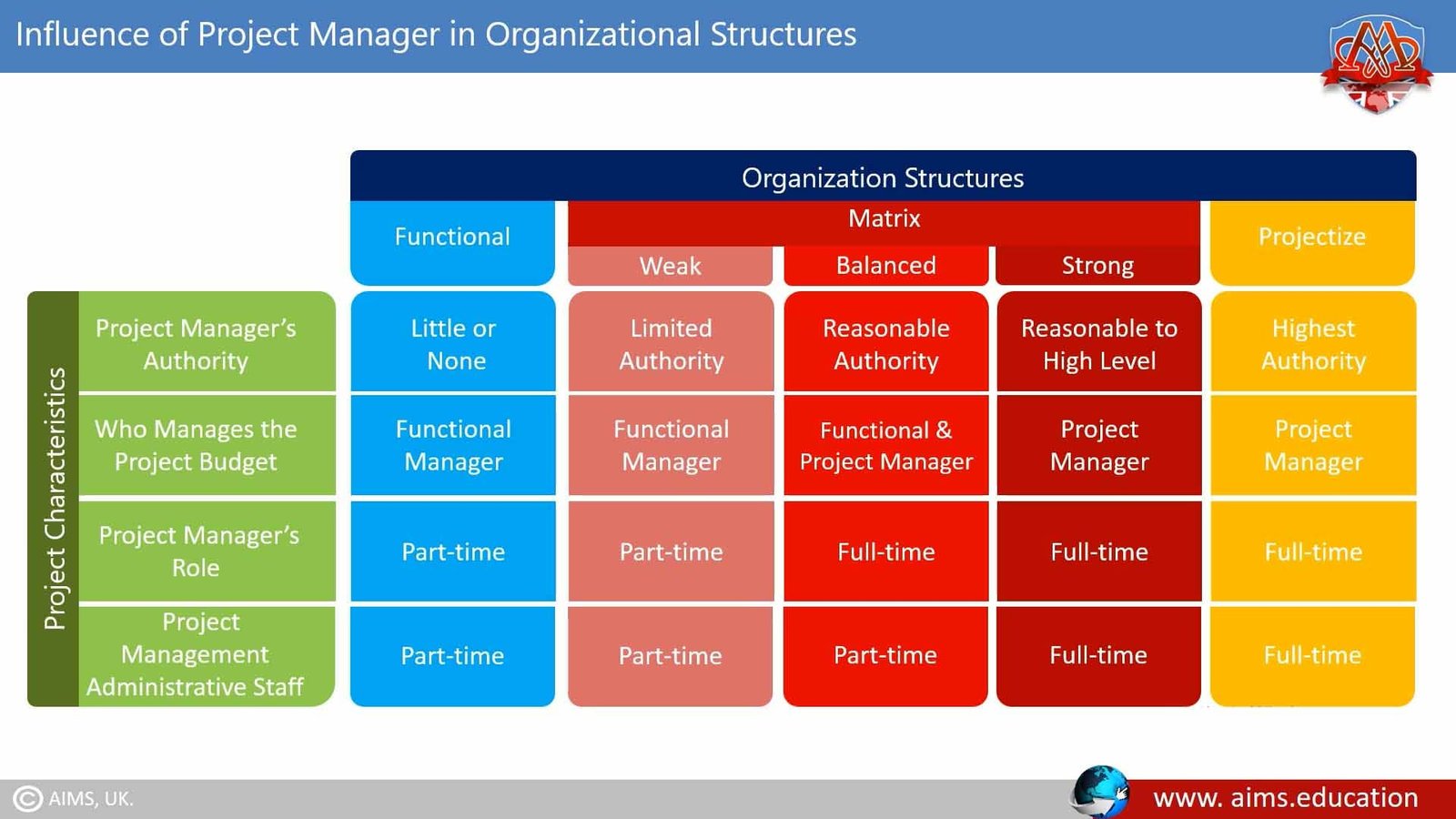
Let's analyze this table. You can see a clear progression: as you move from left (Functional) to right (Projectized), the project manager's power and control increase significantly across every category.
The following article explains these impacts in more narrative detail.
The Impact of Organizational Structure on Project Management
This article from the Project Management Academy does a great job of explaining how a company's structure directly influences critical project elements.
Please read the section titled 'Impact of Organizational Structure on Project Management'. Focus on how each point (Communication, Resource Allocation, Decision-Making) would play out differently in a functional versus a projectized structure.
As the article and table show, your effectiveness as a PM is not just about your personal skills; it's heavily constrained or enabled by the system you work in.
- In a functional structure, a PM must be skilled at negotiation and influence, as they have no formal power over team members from other departments.
- In a strong matrix or projectized structure, a PM can focus more on direct leadership and execution, as they have clear authority over the team and budget.
4. Choosing the Right Structure
No single structure is inherently "best." The optimal choice depends on the nature of the organization and the projects it runs. For example, a company focused on manufacturing might thrive with a functional structure, while a construction or consulting firm would be better served by a projectized one.
The research from Gray and Larson's book shows this clearly.

This graph illustrates that for complex, unique work like new product development, a more project-focused structure (Strong Matrix or Projectized) is significantly more effective. The functional structure, in this context, is rated as very ineffective.
So, when is each structure most appropriate?
- Functional Structure is best when:
- The work is primarily operational and projects are secondary.
- Specialized expertise and efficiency are more important than project speed.
- Projectized Structure is best when:
- The organization's main business is delivering large, complex projects.
- Projects require dedicated, focused teams and fast decision-making (e.g., in consulting or IT).
- Matrix Structure is best when:
- The organization needs to be flexible and share skilled resources across multiple projects.
- There's a need to balance deep functional expertise with a project focus.
Conclusion
Today, we've dissected the three primary organizational structures and analyzed their profound impact on managing projects. This isn't just abstract theory; it dictates the day-to-day reality for a project manager and is a critical concept for your exam and case study.
Key Takeaways:
- The three main structures are Functional, Projectized, and Matrix (which includes Weak, Balanced, and Strong subtypes).
- These structures exist on a spectrum defined by the balance of power between the functional manager and the project manager.
- In a functional structure, the PM has little authority, and projects are secondary to departmental work.
- In a projectized structure, the PM has high authority, and the entire organization is geared toward executing projects.
- In a matrix structure, authority and resources are shared, which offers flexibility but can lead to conflict.
- The most appropriate structure depends on the organization's strategy and the nature of its projects.
Preview of the Next Lesson:
With this foundational knowledge of project selection and organizational context complete, we are ready to move into the first phase of the project life cycle: Project Initiation. In our next lesson, we will begin Module 2 by returning to the financial models we previewed earlier. We will learn how to calculate and use the Payback Period and Net Present Value (NPV) to help select projects from competing proposals, giving you the practical calculation skills you've been looking for.