Welcome to your second lesson.
In our first session, we established a clear understanding of what a project is—a temporary and unique endeavor. This distinction is crucial because it tells us when to apply the principles of project management.
Today's Goal
Today, we'll answer the next logical question: If a project has a beginning and an end, what happens in between? We will explore this by focusing on the phases of the project life cycle. This framework provides the high-level roadmap that guides a project from its initial idea to its final completion. Understanding this structure is essential for your case study, as it will help you organize your analysis and recommendations logically.
1. The Project Life Cycle Framework
Every project, regardless of its size or complexity, follows a general path from start to finish. This path is known as the project life cycle. It organizes the project into a series of distinct phases, each with its own set of goals and deliverables.
Let's begin with a formal definition.
This article, which references your course textbook authors (Larson & Gray), provides a concise definition of the project life cycle and its stages.
Please read the section titled 'The Project Life Cycle'. Focus on how it defines the life cycle as a sequence of stages and names the four basic stages.
As the reading states, the four basic stages are defining, planning, executing, and closing.
A key concept of the project life cycle is that the level of effort and resources consumed is not constant. It changes as the project moves from one phase to the next. The following graph, based on your textbook's model, illustrates this concept.
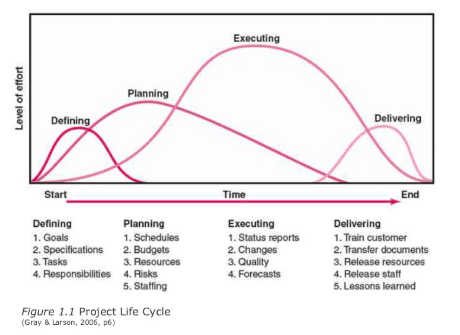
Notice how the phases overlap slightly, indicating that a project doesn't always move from one phase to the next with a hard stop. For instance, some planning might continue even as execution begins. The bulk of the work, however, clearly occurs during the "Executing" phase.
2. Exploring the Four Standard Phases
Now, let's dive into the specifics of what happens in each of the four standard phases. We'll use a comprehensive video that walks through the purpose and key activities of each stage.
4 Stages to MASTER Your Project Life Cycle
This video, titled '4 Stages to MASTER Your Project Life Cycle', provides a detailed breakdown of the standard project life cycle. We will watch it in sections, focusing on one phase at a time.
We will break down the video by phase. You can start by watching the introduction from 0:00 to 0:27 for a quick overview of all four stages.
Phase 1: Initiation (or Defining)
This is the starting point. The goal of this phase is to define the project at a broad level and determine if it's feasible and worth pursuing. If approved, this phase culminates in the formal authorization of the project.
4 Stages to MASTER Your Project Life Cycle
Let's examine the Initiation phase.
Please watch the segment from 00:27 to 01:25. Pay close attention to the key outputs of this phase, such as the business case and the identification of stakeholders.
Key activities in the Initiation phase include:
- Identifying a business need, problem, or opportunity.
- Defining the project's objective and high-level scope.
- Conducting a feasibility study.
- Identifying key stakeholders.
- Developing a business case to justify the project.
- Creating a project charter (a topic we will cover in detail later), which formally authorizes the project.
Phase 2: Planning
Once the project is approved, you enter the planning phase. This is arguably the most critical phase for a project manager, as it involves creating the detailed roadmap that the team will follow. Thorough planning is the foundation for a successful project.
Your concerns about scheduling calculations (FS, LS) and budgeting fall squarely within this phase.
4 Stages to MASTER Your Project Life Cycle
Next, let's look at the Planning phase.
Now watch the segment from 01:25 to 02:37. Notice the variety of plans created, from the schedule and budget to risk management.
Key activities in the Planning phase include:
- Developing a detailed project scope statement.
- Creating a Work Breakdown Structure (WBS) to break the project into manageable tasks.
- Developing a project schedule (including activity dependencies).
- Estimating costs and creating a budget.
- Planning for resources, quality, and communications.
- Identifying and analyzing risks.
Phase 3: Execution
This is where the plan is put into action. The project team does the work to create the project's deliverables. The project manager's role shifts from planning to coordinating, directing, and managing the team and resources.
4 Stages to MASTER Your Project Life Cycle
Now we move to the Execution phase, where the work gets done.
Watch the segment from 02:37 to 03:42. Focus on the project manager's role in this phase: monitoring, communicating, and managing.
Key activities in the Execution phase include:
- Directing and managing project work.
- Monitoring progress against the plan (schedule, budget, etc.).
- Communicating with stakeholders and providing status updates.
- Managing the project team.
- Implementing approved changes and corrective actions.
- Assuring quality standards are met.
Phase 4: Closure (or Delivering)
The final phase involves formally completing the project. It’s not just about finishing the work; it’s about a structured process to hand over deliverables, release the team, and document the project's performance for future benefit.
4 Stages to MASTER Your Project Life Cycle
Finally, let's examine the Closure phase.
Watch the final segment from 03:42 to 04:27. Note that closure involves both administrative tasks and reflection, such as documenting lessons learned.
Key activities in the Closure phase include:
- Delivering the final product or service to the customer.
- Obtaining formal sign-off and acceptance.
- Releasing project resources (team, equipment).
- Closing out contracts with suppliers.
- Archiving project documents.
- Conducting a post-mortem or lessons learned session to capture knowledge for future projects.
3. Life Cycles in Different Industries
While the four-phase model (Defining, Planning, Executing, Closing) is a standard, the specific names and number of phases can vary depending on the industry or type of project. For example, a software development project might have phases like "Requirements," "Design," "Code," "Test," and "Deploy," which still map to the general four-phase framework.
This brief video provides a few examples to illustrate this point.
Project Life Cycle vs Phase vs Process Groups in Project Management | PMBOK Guide | PMP | CAPM
To see how life cycles can vary, this video gives examples from different industries.
Please watch the segment from 03:00 to 03:59. It shows how the generic phases can have specific names in construction, software, and machine development projects.
Thinking about your background, a network upgrade project would follow this same structure:
- Defining: Identifying the security risks or performance issues that necessitate an upgrade; getting budget approval.
- Planning: Scheduling the rollout, planning for downtime, ordering hardware, writing configuration scripts.
- Executing: Installing the new hardware, deploying software patches, migrating users.
- Closing: Training users on new features, updating network diagrams, and formally handing over the new system to the IT operations team for ongoing maintenance.
Conclusion
In this lesson, we have mapped out the entire journey of a project from start to finish.
Key Takeaways:
- The project life cycle provides a structured, phased approach to managing a project.
- The four standard phases are Defining (Initiation), Planning, Execution, and Closing.
- Each phase has distinct objectives and key activities that build upon the previous phase.
- The level of effort and focus changes throughout the life cycle, typically peaking during the execution phase.
- While the four-phase model is a universal guide, the specific names and details of the phases can be adapted to fit different industries and projects.
Preview of the Next Lesson:
We've now covered what a project is and the path it follows. The next logical question is who guides the project along this path? In our next lesson, we will focus on the central figure in any project: the project manager. We will identify the key roles and responsibilities of a project manager in navigating the team through the project life cycle.