Welcome back to your course on developing an on-premise CRM. In our first lesson, we explored the fundamental "why" behind this project, focusing on how a unified CRM addresses the business challenges of data fragmentation in a multi-entity financial group—what we called the "whole elephant" problem.
Today, we transition from the why to the what. Our goal is to identify the key functional modules of an enterprise CRM system: sales, service, marketing, and analytics. Deconstructing the CRM into these core components is crucial for your role. It will enable you to define the project's scope, understand the specific needs of each business unit—from banking to payments—and have productive conversations with your development team about priorities and implementation.
The Building Blocks of a Customer-Centric System
At its core, an enterprise CRM system is designed to manage the entire lifecycle of your customer relationships. To do this effectively, it relies on a set of integrated modules, often thought of as the four pillars of CRM. A short video provides an excellent high-level introduction to enterprise systems and situates CRM within this context.
Enterprise Wide Systems - CRM, ERP and SCM (Business Information Systems)
This video, from the channel Our Kaleidoscope Journey, offers a clear and concise explanation of enterprise systems. Watching this segment will help frame our discussion of CRM's core functions.
Please watch the section that defines Customer Relationship Management, as it explains how CRM automates and integrates sales, marketing, and customer service. Then, watch the brief explanation of the two main types of CRM: operational and analytical.
As the video explains, a CRM integrates customer-facing functions. This integration happens through distinct but interconnected modules. Let's examine each of the four primary modules in detail.
1. The Sales Module: Automating the Pipeline
The Sales module, often called Sales Force Automation (SFA), is the engine for your revenue-generating teams. Its primary purpose is to streamline the entire sales process, provide visibility into the sales pipeline, and improve the productivity of your sales representatives.
For your financial group, this module helps answer critical questions like:
- Which leads are most promising for a new corporate banking product?
- What is the total value of potential loans currently in our pipeline?
- How long does it typically take to close a deal for a payment gateway integration?
The Creatio article on Finance CRMs provides a good overview of how sales teams use these tools.
10 Best Finance CRM's in 2026 | Creatio
This article details how different departments in a financial business use CRM.
Read the section on Sales, which describes how a CRM centralizes client data for sales teams. Then, review the feature descriptions for Pipeline & opportunity management and Onboarding and account opening.
The core functionalities you would expect to scope for your Sales module include:
- Lead Management: Capturing, tracking, and qualifying potential customers (leads) from various sources, such as website forms, marketing campaigns, or referrals.
- Opportunity Management: Converting qualified leads into opportunities (i.e., potential deals) and managing them through a structured sales process or pipeline (e.g., Qualification, Proposal, Negotiation, Closed-Won/Lost).
- Account and Contact Management: Storing comprehensive information about the businesses (Accounts) and individuals (Contacts) you interact with. In your multi-entity context, this is where you would link a single individual to their personal bank account, their role in a business that uses your payment services, and any other relationships across the group.
- Sales Forecasting: Using historical data and current pipeline information to predict future sales revenue.
2. The Service Module: Engineering Customer Satisfaction
The Service module is the heart of your customer support operations. Its goal is to enable your teams to resolve customer issues efficiently, track all service interactions, and deliver a consistent, high-quality experience across all channels. Your experience in banking technology has likely shown you how critical swift and effective issue resolution is to customer retention.
The central concept in a service module is the case or ticket—a single record that tracks a customer's question, complaint, or request from initiation to resolution.
Key functionalities of the Service module are:
- Case Management: Creating, assigning, escalating, and resolving customer support tickets. This provides a full audit trail of every interaction.
- Knowledge Base: A centralized repository of articles, FAQs, and troubleshooting guides that both agents and customers can use to find answers quickly.
- Multi-channel Communication: Integrating with various communication channels like phone (via Computer-Telephony Integration), email, SMS, and chat, so that all conversations are logged in one place.
- Service Level Agreement (SLA) Management: Defining and tracking response and resolution time targets to ensure service standards are met.
This diagram illustrates how a Banking CRM serves as the central hub, receiving customer calls and integrating with core systems to provide agents with the necessary information.
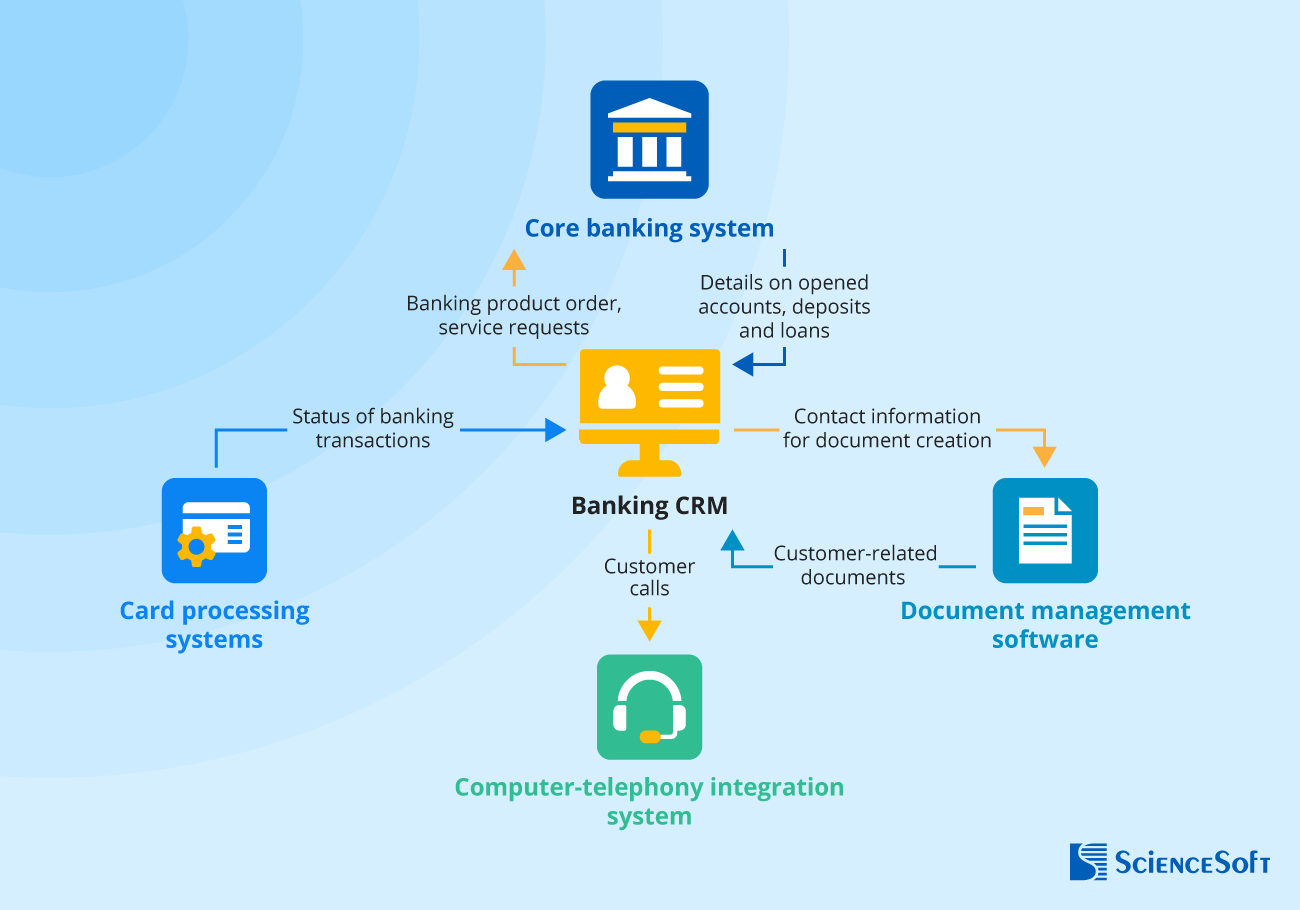
3. The Marketing Module: Personalizing Engagement at Scale
The Marketing module, which often incorporates marketing automation, is about communicating with the right customers, with the right message, at the right time. Given your background in marketing automation software, you'll recognize its core functions. Within a unified CRM, its power is amplified by having access to sales and service data.
The module enables your marketing teams to move from generic "batch and blast" campaigns to highly personalized, data-driven engagement.
10 Best Finance CRM's in 2026 | Creatio
Let's revisit the Creatio article to see how the marketing function fits in.
Focus on the section about Marketing, which explains how a financial CRM enables precise targeting and campaign management.
Essential functionalities of the Marketing module include:
- Customer Segmentation: Grouping customers based on shared attributes, behaviors, or transaction history. For example, segmenting bank customers who have recently taken out a mortgage to offer them home insurance.
- Campaign Management: Designing, executing, and monitoring multi-stage, multi-channel marketing campaigns.
- Email Marketing & Lead Nurturing: Automating communication to guide potential customers through the sales funnel, providing them with relevant information at each stage.
- Marketing Analytics: Measuring the performance and return on investment (ROI) of marketing activities.
The integration with sales and service data is key. For instance, the marketing team can exclude customers with open high-priority service tickets from a new sales campaign to avoid appearing tone-deaf.
4. The Analytics Module: Transforming Data into Insight
If the Sales, Service, and Marketing modules are where data is collected, the Analytics module is where that data is transformed into intelligence. This is the component that fulfills the promise of the 360-degree customer view, providing the insights needed for strategic decision-making at all levels of the organization, including your own.
This module is what distinguishes a modern CRM from a simple database. It addresses the analytical aspect of CRM that the video mentioned earlier.
Core functionalities of the Analytics module are:
- Dashboards: Visual, at-a-glance summaries of key performance indicators (KPIs) for different roles (e.g., a sales leader's dashboard would show pipeline health, while a service manager's would show ticket resolution times).
- Reporting: The ability to create detailed, customizable reports on any data within the CRM. For example, a report showing cross-sell opportunities between the banking and payments entities.
- Predictive Analytics: Using historical data and machine learning to forecast trends, predict customer churn, or identify the "next best action" for a sales or service agent to take.
For your role, this module is your primary tool for measuring the success of the CRM project and demonstrating its value to stakeholders.
Beyond the Core: Specialized Financial Modules
While Sales, Service, Marketing, and Analytics form the universal foundation of CRM, a system for a financial group like yours often requires specialized modules tailored to specific banking and regulatory processes.
The "Key Features of a Modern Finance CRM" section in the Creatio article describes several of these. For instance, a Loan Origination module can manage the entire lending lifecycle, while a KYC/AML & Compliance module helps automate identity verification and transaction monitoring to meet Uzbekistan's strict regulatory requirements. As you plan your CRM, identifying the need for such specialized modules will be a critical part of your requirements gathering.
Conclusion
In this lesson, we have dissected the enterprise CRM into its four primary functional modules. Understanding these components is the first step toward building a comprehensive project plan.
Key Takeaways:
- An enterprise CRM is typically built on four pillars: the Sales, Service, Marketing, and Analytics modules.
- The Sales Module automates the sales pipeline, from lead to closure, to increase revenue and efficiency.
- The Service Module manages customer support interactions to improve satisfaction and retention.
- The Marketing Module enables personalized, targeted communication and campaign management.
- The Analytics Module transforms data from all other modules into actionable insights for strategic decision-making.
- The true power of a CRM lies in the seamless integration of these modules, allowing them to share data and create a cohesive customer experience.
Preview of the Next Lesson:
Now that we understand the functional building blocks of the CRM, our next step is to connect them directly to the customer's journey. In the next lesson, we will map customer lifecycle stages to these CRM modules using examples from banking and payments services. This will help you articulate to your team not just what the system should do, but how it should support the customer at every step of their relationship with your group.