Hello and welcome to the first lesson of your course on developing an on-premise CRM for your financial group. Our goal over the next several weeks is to equip you with the strategic and technical knowledge needed to lead this complex project successfully.
Today, we begin by establishing the foundational "why" behind this initiative. The learning outcome for this lesson is to analyze how a CRM system addresses core business challenges in a multi-entity financial group. We will examine the inherent difficulties that arise when separate entities—like your bank, payments company, and tech ventures—try to understand and serve the same customer. Understanding these core challenges is the essential first step before defining requirements, evaluating architecture, or leading your development team.
The "Not Seeing the Whole Elephant" Problem
A financial group like yours often faces a challenge best described by the old parable of the blind men and an elephant. Each man touches a different part—the leg, the trunk, the tail—and comes to a completely different conclusion about the nature of the beast. Similarly, your banking entity sees a customer's loan history, your payments company sees their daily transaction patterns, and your tech entity might see their engagement with a digital service. Each holds a valuable piece of the puzzle, but no single entity sees the whole customer.
This fragmentation is the central business challenge that a unified CRM system is designed to solve. The World Economic Forum's paper on data sharing in financial services provides an excellent introduction to this fundamental tension.
[PDF] The Next Generation of Data Sharing in Financial Services
This paper from the World Economic Forum introduces the core tension between the value of sharing data and the risks involved. It provides a strong conceptual foundation for why collaboration is both difficult and necessary in the financial sector.
Please read the Foreword and the Introduction (pages 4-5) to understand the "whole elephant" analogy. Then, review the section titled Chapter 1: Privacy in the financial sector (pages 6-7), focusing on the competing objectives and the benefits versus drawbacks of data sharing for institutions, regulators, and customers.
As the reading highlights, this inability to see the "whole elephant" creates several critical business challenges:
- Incomplete Customer Insight: Without a unified view, you cannot accurately assess a customer's total value or risk to the group. A high-value customer in the bank might be treated as a new, unknown user by the payments company.
- Inconsistent Customer Experience: The customer interacts with a single brand group but receives disjointed service. This erodes trust and can lead to frustration, for example, when they have to provide the same identification documents to multiple entities within the same group.
- Missed Commercial Opportunities: You cannot effectively cross-sell or up-sell services. For instance, data from the payments company could signal a customer's need for a small business loan from the bank, but if the systems and processes are siloed, that opportunity is lost.
- Operational Inefficiency: Teams across the group waste time and resources on redundant data collection and manual reconciliation. This also increases the risk of data entry errors, compromising data quality.
- Increased Regulatory and Security Risk: Managing data sharing across entities while complying with strict regulations on personal data and banking secrecy—a critical consideration in Uzbekistan—becomes exponentially more complex without a central governance framework.
This diagram neatly summarizes some of the most common pain points in the industry, several of which are magnified in a multi-entity structure.

A Framework for Collaborative CRM Challenges
To move from these high-level problems to actionable strategy, it helps to use a more structured framework. Your situation is not unique; many financial services networks face these issues. The following academic paper analyzes several real-world cases and identifies a consistent set of key challenges. This will provide you with a robust vocabulary for discussing these issues with your team and stakeholders.
[PDF] CRM collaboration in financial services networks: a multi-case ...
This research paper provides a detailed analysis of CRM collaboration within financial services networks, similar to your own. It identifies and categorizes the primary obstacles that such groups face.
First, read the Abstract for a concise summary of the key findings. Then, read the Introduction and the section on Key CRM issues (pages 591-597). As you read, consider how each of the identified issues—such as privacy constraints and systems integration—manifests within your own group of companies.
The paper systematically breaks down the problem into five areas. Let's translate them into practical questions for your project:
- Redundant Competencies: Do your banking and payments arms offer overlapping products? This can confuse customers and lead to internal competition instead of collaboration. A CRM helps clarify which entity "owns" the customer relationship for specific needs.
- Privacy Constraints: This is arguably the most significant hurdle. As the paper notes for Europe, and as is true for Uzbekistan, laws on data protection and banking secrecy are strict. You cannot freely share customer data between the bank and the payments company, even if they are part of the same group, without explicit, legally sound customer consent. A core function of your CRM's design will be to manage this consent and enforce these rules.
- CRM Process Integration: How do you create a seamless process that crosses company lines? For example, if a customer makes a large international transaction via the payments platform, can this automatically trigger a follow-up call from a wealth management advisor at the bank? Without an integrated process backbone, which a CRM provides, such cross-entity workflows are impossible.
- Customer Information Exchange: Beyond just data in databases, how do you share the "soft" knowledge that resides with your relationship managers and service agents? A collaborative CRM provides tools to make this crucial, often unwritten, information visible across the group, preventing situations where valuable business opportunities are missed because "no one knew who to ask."
- CRM Systems Integration: This is the foundational technical challenge. Your bank has a core banking system, your payments company has a transaction processing platform, and each has its own databases. These legacy systems were not designed to communicate. A central CRM requires a deliberate integration strategy to pull data from these disparate sources.
How a CRM Architecture Addresses These Challenges
Having defined the problems, we can now see how a CRM system is architecturally designed to solve them. A modern CRM is not a monolithic application but a layered platform where each layer targets a specific set of challenges.
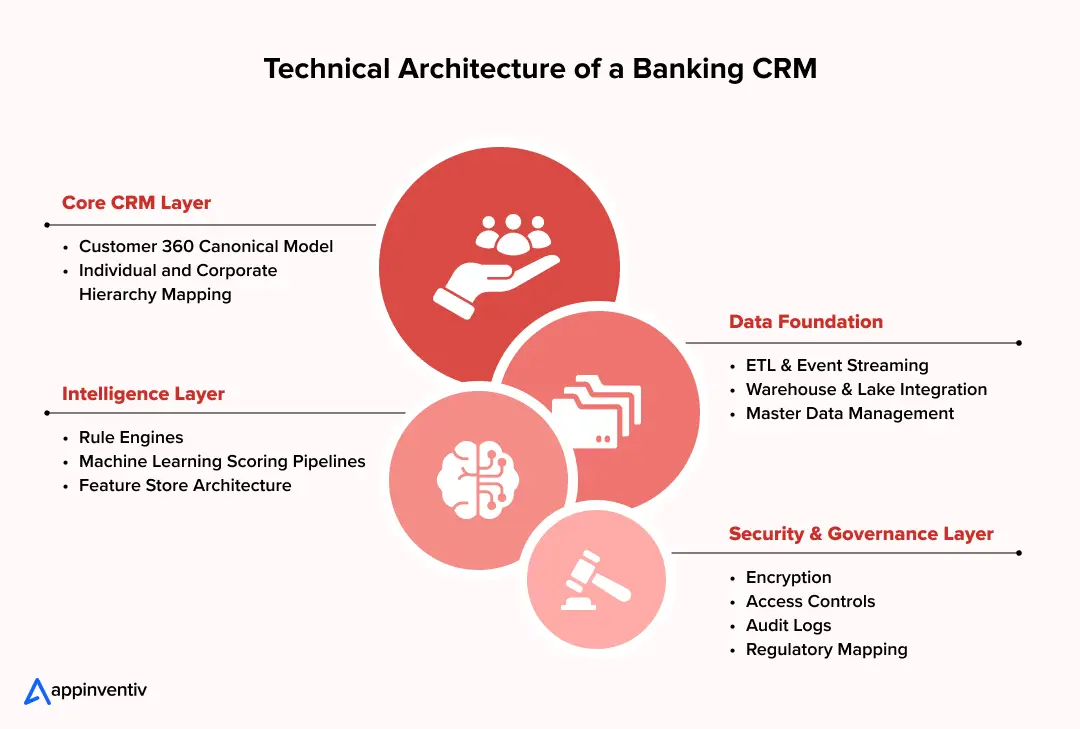
Let's look at this architecture as a direct response to the challenges we've discussed:
- Core CRM Layer (Customer 360): This is the heart of the solution to the "whole elephant" problem. It establishes the Customer 360 Canonical Model, which is the single, authoritative, and complete profile of a customer across all entities. It maps relationships, such as connecting an individual's personal bank account to their corporate payment account.
- Data Foundation: This layer tackles the Systems Integration and Information Exchange challenges head-on.
- ETL & Event Streaming: These are the technical mechanisms for extracting data from your various source systems (like the core banking and payments platforms) and feeding it into the CRM in real-time or in batches.
- Warehouse & Lake Integration: This is where the consolidated data is stored for analysis.
- Master Data Management (MDM): This is a critical discipline (which we'll cover in Module 2) for ensuring you have a single, clean customer record. It involves processes and tools to merge duplicate records and create that one "golden record" for each customer.
- Intelligence Layer: This layer is where you generate value from the unified data. It includes Rule Engines and Machine Learning Pipelines that can analyze behavior across the entire group to detect fraud, predict churn, or identify cross-sell opportunities. This turns the CRM from a passive data repository into an active business driver.
- Security & Governance Layer: This layer directly addresses the challenge of Privacy Constraints. It is where you implement the technical controls to comply with Uzbekistan's data laws. This includes:
- Encryption: Protecting data both when it's stored (at rest) and when it's moving between systems (in transit).
- Access Controls: Enforcing strict rules about who can see what data. For example, a marketing user from the payments company should not be able to see a customer's sensitive banking loan details. This is where you'll implement your Role-Based Access Control (RBAC) model.
- Audit Logs: Creating an immutable record of who accessed or changed data, which is essential for regulatory compliance.
By understanding this layered approach, you can see that a CRM is purpose-built to foster collaboration and create a unified business front, while respecting the technical and regulatory boundaries between your different companies.
Conclusion
In this introductory lesson, we've established the fundamental business case for a unified CRM in a multi-entity financial group.
Key Takeaways:
- The primary challenge for a financial group is data and process fragmentation, which prevents you from having a complete, 360-degree view of your customer—the "whole elephant" problem.
- This fragmentation leads to specific business pains: inconsistent customer experience, missed commercial opportunities, operational inefficiencies, and significant compliance risks.
- We can categorize these challenges into five key areas: redundant competencies, privacy constraints, process integration, information exchange, and systems integration.
- A well-designed CRM directly addresses these issues through a layered architecture that creates a unified customer model, integrates disparate data sources, enables cross-entity intelligence, and enforces security and governance.
Preview of the Next Lesson:
Now that we have a firm grasp of why your group needs a CRM, we will move on to the what. In the next lesson, we will identify the key functional modules of an enterprise CRM—Sales, Service, Marketing, and Analytics—and explore the specific capabilities each module provides to your business users.