Welcome to the third lesson in our course on building an enterprise CRM. In our previous sessions, we first established the strategic "why" for a unified CRM in your financial group and then deconstructed it into its four essential functional modules: Sales, Service, Marketing, and Analytics. We have the building blocks.
Today, we will bring those blocks to life. Our objective is to map the customer lifecycle stages to these CRM modules using examples from banking and payments services. This is a critical step that transforms the CRM from a collection of features into a system that actively supports and guides a customer's relationship with your company. For your role, this mapping exercise is the foundation for defining functional requirements and ensuring the system your team builds aligns directly with business outcomes at every stage of the customer journey.
Understanding the Customer Lifecycle
Before we can map our CRM modules, we must first understand the journey the customer takes. This journey, often called the customer lifecycle, describes the path from when a person first becomes aware of your brand to the point where they are a loyal, long-term client. While many models exist, a common and effective framework breaks the journey into four key stages: Awareness, Consideration, Decision, and Loyalty.
This diagram provides an excellent visualization of this journey from a customer-centric banking perspective. It outlines what the customer is feeling, doing, and demanding at each step.
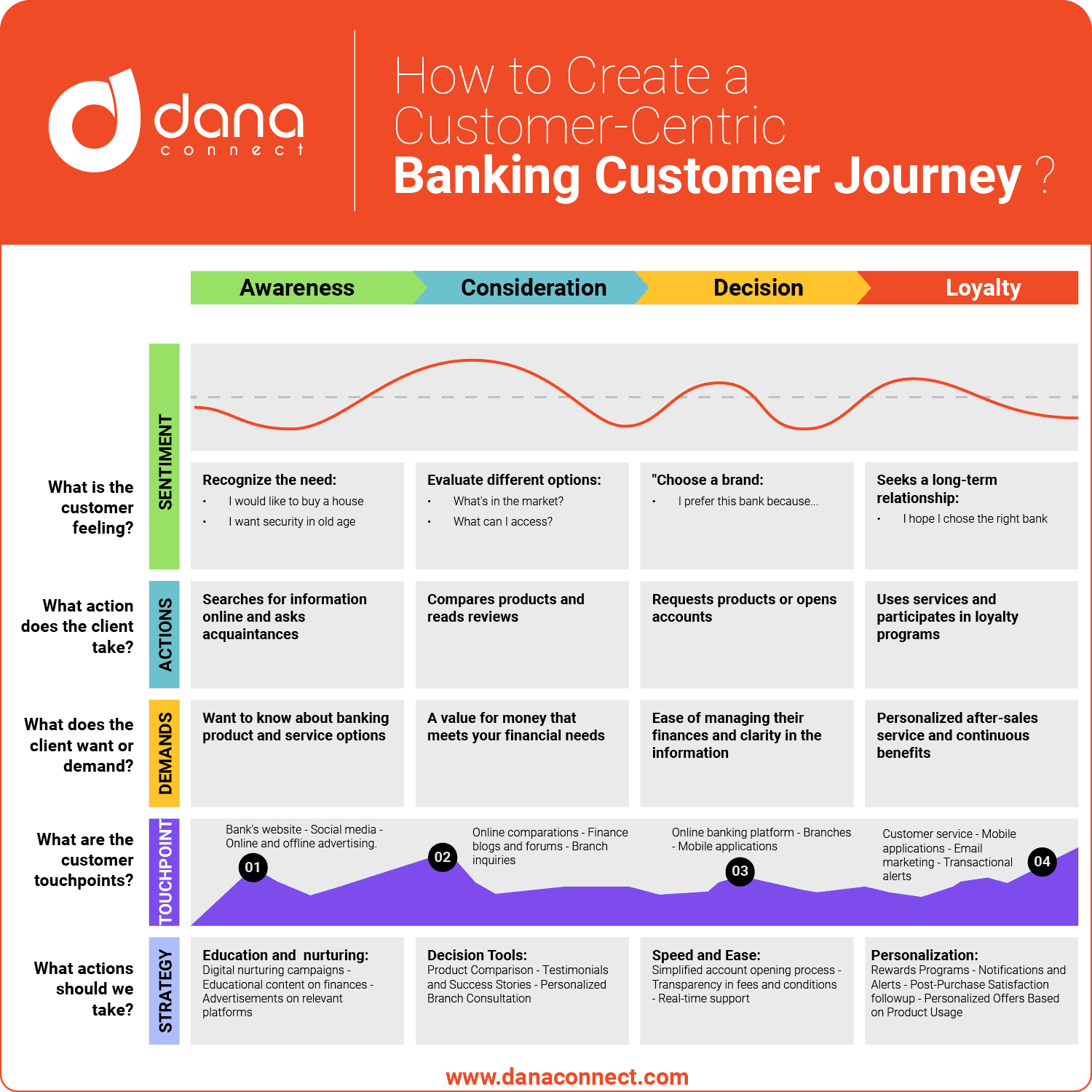
We will use these four stages as our guide to see how the different CRM modules you've learned about come into play.
Stage 1: Awareness — Attracting Prospects
At this initial stage, the prospect recognizes a need—"I would like to buy a house" or "My business needs to accept credit card payments online"—and begins searching for information. The primary goal for your business is to be discoverable and to attract their attention.
- Primary CRM Module: Marketing
- How it Works: The Marketing module is the engine of the Awareness stage. It uses customer segmentation and campaign management tools to reach potential customers with relevant messages. Your experience with marketing automation software is directly applicable here; the CRM integrates this capability with a broader customer view. The system can track interactions with marketing materials, such as website visits, ad clicks, or content downloads, creating an initial profile of the prospect.
- Banking Example: A user in Tashkent searches online for "best mortgage terms." They click on a targeted ad from your bank that leads to a landing page with a mortgage calculator. They enter some details but don't complete a full application. The CRM's Marketing module captures this interaction, potentially adding the user to a "mortgage interest" segment for a gentle email nurturing campaign with educational content about the home-buying process.
- Key Question for your Team: "How will our CRM capture interactions from our various marketing channels (website, social media, ads) to build an initial profile of a prospect before they have formally identified themselves?"
The article "A Brief Guide to Supercharging a Bank CRM Solution" explains how these activities are part of a broader strategy.
A Brief Guide to Supercharging a Bank CRM Solution | CSI
This article from CSI details how various CRM modules are used in a banking context.
Please read the section titled Manage Dynamic Marketing Campaigns. Focus on how it describes segmenting a customer base and tailoring campaigns, which are the core activities of the Awareness stage.
Stage 2: Consideration & Decision — Converting Leads into Customers
As prospects move into the Consideration and Decision stages, they are actively evaluating their options and choosing a provider. They compare products, read reviews, and eventually decide to apply for a product or open an account. This is the critical handoff from marketing to sales.
- Primary CRM Modules: Sales and Marketing
- How it Works: A prospect who shows strong interest (e.g., by requesting a quote or a demo) becomes a Lead in the CRM. The Marketing module might use lead scoring to rank these prospects based on their activity. The hottest leads are then passed to the Sales module, where they become Opportunities. The sales team uses the CRM to manage their pipeline, track all communications (calls, emails, meetings), send proposals, and oversee the onboarding process until the deal is "Closed-Won."
- Payments Example: The owner of a growing e-commerce business in Uzbekistan, after engaging with your fintech entity's marketing content, requests a demo of your payment gateway. A lead is automatically created in the CRM from the web form and assigned to a sales representative. The sales rep uses the Sales module to track the opportunity, log the demo call, generate a quote, and manage the contract negotiation process.
- Key Question for your Team: "What are the specific criteria that will convert a marketing lead into a sales opportunity in our system? How will the CRM automate this handoff to ensure no leads are dropped?"
The following resource provides more detail on managing this part of the lifecycle.
A Brief Guide to Supercharging a Bank CRM Solution | CSI
Let's return to the CSI article.
Read the section on relationship management, which discusses converting prospects. Then, review the section on sales tracking, which details how opportunities are managed in the sales pipeline.
Stage 3: Service & Engagement — Supporting the Active Customer
Once the customer is onboarded, the focus shifts from acquisition to service and engagement. The customer is now using your products—their bank account, their payment gateway—and will inevitably have questions, issues, or requests. This stage is where customer satisfaction is won or lost.
- Primary CRM Modules: Service and Analytics
- How it Works: The Service module is the star of this stage. Every customer inquiry, regardless of the channel (phone, email, chat, app), is logged as a Case or Ticket. This creates a complete history of all service interactions. The module helps manage workflow by routing cases to the correct team (e.g., tech support, fraud department), escalating urgent issues, and ensuring Service Level Agreements (SLAs) are met. The Analytics module provides dashboards to monitor case volume, resolution times, and customer satisfaction scores.
- Banking Example: A customer notices a suspicious charge on their account and reports it through the bank's mobile app. A high-priority case is automatically created in the CRM and assigned to the fraud investigation team. All communication with the customer is logged in the case, and the system tracks it until the issue is resolved and the funds are returned.
- Key Question for your Team: "How will our CRM integrate with all our customer communication channels (call center, SMS, in-app chat) to create a single, unified case history for every service request?"
This diagram illustrates a more granular view of the post-acquisition lifecycle, covering setup, engagement, and support activities. Note the various touchpoints involved, all of which should be logged in the CRM.

Stage 4: Loyalty & Advocacy — Retaining and Growing Value
The final stage is about nurturing a long-term, profitable relationship. The goal is to retain the customer, increase their value through cross-selling and up-selling, and ultimately turn them into an advocate for your brand. This is where the 360-degree customer view becomes most powerful.
- Primary CRM Modules: Analytics, Marketing, and Sales
- How it Works: The Analytics module is critical here. It analyzes data from across the CRM—transaction history, product usage, service interactions—to identify patterns. It can predict which customers are at risk of leaving (churn risk) or which are prime candidates for other products. The Marketing module uses these insights to run highly targeted campaigns (e.g., offering a small business loan to a payments customer whose transaction volume is rapidly growing). New cross-sell or up-sell deals are then managed as Opportunities in the Sales module.
- Multi-Entity Example: The CRM's Analytics module identifies a customer who has a high-balance personal savings account with the bank and also receives large, regular payments into that account from an employer who is not using your group's payment processing services. The system flags this as a valuable cross-entity lead. It creates a task in the Sales module for a B2B sales rep to contact the employer about switching to your payment platform, armed with the knowledge of their payment patterns.
- Key Question for your Team: "What data points do we need to capture across our banking and payments systems to build an effective predictive model for identifying cross-sell opportunities and churn risk?"
From Theory to Practice
This mapping of CRM modules to the customer lifecycle is not just a theoretical exercise. It forms the core of your system's functional specification. The fintech CRM guide below emphasizes that a key early step in any CRM project is to "Map your customer lifecycle stages."
This article by Vantage Point provides a practical roadmap for implementing a fintech CRM.
Review the section titled Phase 1: Foundation. Notice that one of the very first recommended actions is to "Map your customer lifecycle stages." This underscores how fundamental this process is to building a successful CRM.
As the technical leader, one of your most valuable first steps will be to lead a workshop with stakeholders from sales, marketing, and service for both the bank and the payments company. Your goal: to map out their specific customer journeys for key products, just as we have done here. This will provide your development team with a clear, business-driven blueprint for what to build.
Conclusion
Today we've connected the functional CRM modules to the dynamic journey of the customer. By mapping the Sales, Service, Marketing, and Analytics modules to the stages of Awareness, Consideration, Decision, and Loyalty, you can ensure that your CRM project is laser-focused on delivering the right functionality at the right time.
Key Takeaways:
- The customer lifecycle provides a narrative framework for CRM functionality.
- Awareness is driven primarily by the Marketing module through segmentation and campaigns.
- Consideration & Decision are managed by the Sales module, which converts leads into customers through pipeline and opportunity management.
- Service & Engagement rely on the Service module to resolve issues and track interactions via case management.
- Loyalty & Advocacy leverage the Analytics module to identify risks and opportunities, which are then acted upon by the Marketing and Sales modules for retention and growth.
- This mapping is a foundational step in defining project requirements and aligning development with business goals.
Preview of the Next Lesson:
Now that we understand what the CRM modules are and how they support the customer lifecycle, we will explore the different strategic philosophies behind a CRM's design. In our next lesson, we will compare operational, analytical, and collaborative CRM approaches and identify when each applies. This will help you define the primary strategic purpose of your CRM and make crucial architectural decisions that support it.