Hello! Welcome to your next lesson in the "Essential Grammar for Spoken Clarity" module.
In our last session, you learned how to use the Present Simple to describe your role and routines (what you do) and the Present Continuous for ongoing projects (what you are doing). This is great for talking about your current work.
Today, we will focus on the past. The learning outcome is to use the past simple tense to report on completed tasks and results. This skill is essential for your goal of giving clear and confident updates in team meetings and writing professional reports. You will learn how to talk about what you did yesterday, last week, or on a finished project.
1. Understanding the Past Simple
The Past Simple tense is used to talk about actions, events, or situations that started and finished at a specific time in the past. It's the most common way to tell stories or report on past events.
Think about a timeline. The last lesson was about "now" (Present Simple and Continuous). This lesson is about everything before now.
To get a clear introduction to this tense, let's watch the first part of a detailed video lesson.
Learn English Tenses: PAST SIMPLE
In this video, 'Learn English Tenses: PAST SIMPLE' from Learn English with Rebecca, she provides a very clear explanation of when and how to use this tense.
Watch the first part of the video from 00:00 to 02:31. Focus on: The concept of a finished action in the past. How to form the past simple for regular verbs (like 'work') by adding '-ed'. Notice that the form is the same for all subjects (I, you, he, she, etc.).
As the video explained, you can use this tense to talk about what you did yesterday or what happened long ago. The key idea is that the action is finished.
In English, there are two types of verbs, and they behave differently in the past simple:
- Regular Verbs: These follow a rule. We add -ed to form the past tense (e.g., work -> worked, install -> installed).
- Irregular Verbs: These do not follow a rule. Their past tense form changes in a unique way and must be memorized (e.g., go -> went, do -> did, write -> wrote).
We will look at both types in detail.
2. How to Form the Past Simple
Let's break down the rules for making positive statements, negative statements, and questions.
Regular Verbs
The structure for regular verbs is very consistent. This next video segment will walk you through the positive, negative, and question forms. Pay close attention to the helping verb 'did'.
Learn English Tenses: PAST SIMPLE
Let's continue with the same video. This section is crucial as it explains the full structure for regular verbs.
Watch from 06:59 to 11:32. Pay special attention to this important rule: In negative sentences (with 'didn't') and questions (with 'did'), we use the base form of the verb, not the '-ed' form.
Here is a summary of the rules from the video:
| Form | Structure | Example |
|---|---|---|
| Positive (+) | Subject + verb-ed | I installed the software. |
| Negative (-) | Subject + did not (didn't) + base verb | I didn't install the software. |
| Question (?) | Did + subject + base verb...? | Did you install the software? |
The most common mistake is forgetting to use the base verb in negative sentences and questions. Remember: the "did" shows that the sentence is in the past, so you don't need to change the main verb.
Pronunciation of '-ed'
How you say the '-ed' ending is very important for clear speech. The pronunciation changes based on the last sound of the base verb. Since your native language is Arabic, focusing on these sounds will significantly improve your clarity.
There are three possible sounds for '-ed': /t/, /d/, and /ɪd/.
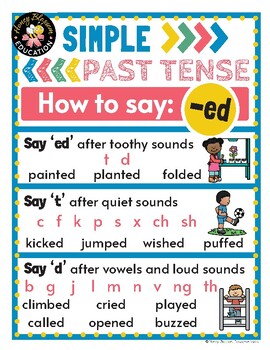
Let's break it down:
-
If the verb ends in a 't' or 'd' sound, we pronounce '-ed' as /ɪd/. This adds an extra syllable.
start->start-edneed->need-eddecide->decid-ed
-
If the verb ends in an unvoiced sound (like p, k, s, f, sh, ch - sounds made with just air, no vibration in your throat), we pronounce '-ed' as a /t/ sound.
work->work-tfix->fix-tstop->stop-twatch->watch-t
-
If the verb ends in a voiced sound (like b, g, v, z, l, m, n, r - sounds with vibration in your throat) or a vowel sound, we pronounce '-ed' as a /d/ sound.
call->call-dclean->clean-ddescribe->describe-dlog in->logged in
This takes practice, so listen carefully to native speakers and try to copy the sounds.
Irregular Verbs
Irregular verbs don't have an '-ed' ending. You need to learn their specific past tense form for positive sentences. However, the good news is that for negative sentences and questions, they follow the same rule as regular verbs: use didn't or did + the base form of the verb.
Some common irregular verbs in a technical or business context are:
| Base Verb | Past Simple Form | Example |
|---|---|---|
| be | was / were | The problem was complex. |
| do | did | I did the initial tests. |
| go | went | He went to the client's office. |
| write | wrote | She wrote the incident report. |
| send | sent | We sent the email yesterday. |
| meet | met | The team met in the morning. |
| build | built | They built a new server. |
| run | ran | I ran a diagnostic test. |
Test your understanding!
Complete these sentences with the correct past simple form of the verb in parentheses.
- We ________ (finish) the installation last Friday.
- The system ________ (not work) correctly, so I ________ (reboot) it.
- ________ you ________ (receive) the update file I sent?
- He ________ (write) the code, but he ________ (not test) it.
- She ________ (go) to the meeting, but I ________ (stay) in the office.
Show answer
- We finished the installation last Friday.
- The system didn't work correctly, so I rebooted it.
- Did you receive the update file I sent?
- He wrote the code, but he didn't test it.
- She went to the meeting, but I stayed in the office.
3. Reporting on Tasks and Results
Now, let's apply this grammar to your professional goal. The Past Simple is exactly what you need when giving a status update or writing a report about your work.
This article explains how the Past Simple is used in a business context.
Past Simple Tense in Business English
The article 'Past Simple Tense in Business English' from English for Success directly addresses how to use this tense in a professional setting.
Please read the section titled 'Key Uses of the Past Simple Tense in Business English'. Focus on the examples for 'Reporting Past Results and Achievements' and 'Describing Past Projects and Experience'.
As the article shows, you use the past simple to clearly state what you have completed.
Here is a perfect example. This is a project status report. Look at the "Accomplishments" section.

When you give an update in a meeting, you can use these same phrases:
- "Last week, I completed the project planning."
- "We created the new employee contracts."
- "I spoke with the client and confirmed the requirements."
- "The team tested the patch and found no critical issues."
Now, let's put this into a real-world task. Imagine you're writing a weekly report for your manager.
How to Create a Weekly Report (With Templates & ...
The article 'How to Create a Weekly Report' gives a sample of a professional update. This is a great model for you to learn from.
Read the section 'Sample of a weekly report to a manager'. Focus specifically on the bullet points under the 'Accomplishments' heading. Notice the verbs used, like 'rolled out', 'drove', 'collaborated', and 'optimized'.
Conclusion
Excellent work today. You have learned a vital tense for professional communication. You can now talk not only about what you do and what you are doing, but also about what you have already done.
Key Takeaways:
- Use the Past Simple for actions that started and finished in the past. It is essential for reporting on completed tasks.
- Remember the structure:
- Positive: verb + -ed (regular) or a special form (irregular).
- Negative/Question: did/didn't + base verb.
- Practice the three pronunciations of the -ed ending (/t/, /d/, /ɪd/) to make your speech clearer.
- In professional updates, use the Past Simple to list your accomplishments confidently (e.g., "I updated the client's system," "We fixed the bug.").
Preview of the Next Lesson
We have covered the present and the past. In our next lesson, we will complete the timeline by looking at the future. You will learn how to express future plans using 'will', 'going to', and the present continuous, which will help you talk about your next steps and upcoming projects.