Hello! Welcome to your next grammar lesson.
In our previous lessons, we covered how to talk about your current work using the present tenses (what you do and what you are doing) and how to report on finished tasks using the past simple (what you did). This gives you the language to discuss the past and the present confidently.
Today, we will complete the timeline by focusing on the future. The learning outcome for this lesson is to express future plans using 'will', 'going to', and the present continuous. This is a crucial skill for your goal of giving clear professional updates, as it allows you to talk about "what's next" in your projects and schedule.
1. Three Ways to Talk About the Future
In English, there isn't just one "future tense." We choose our words based on how certain our plan is. Let's look at the three main ways we talk about the future.
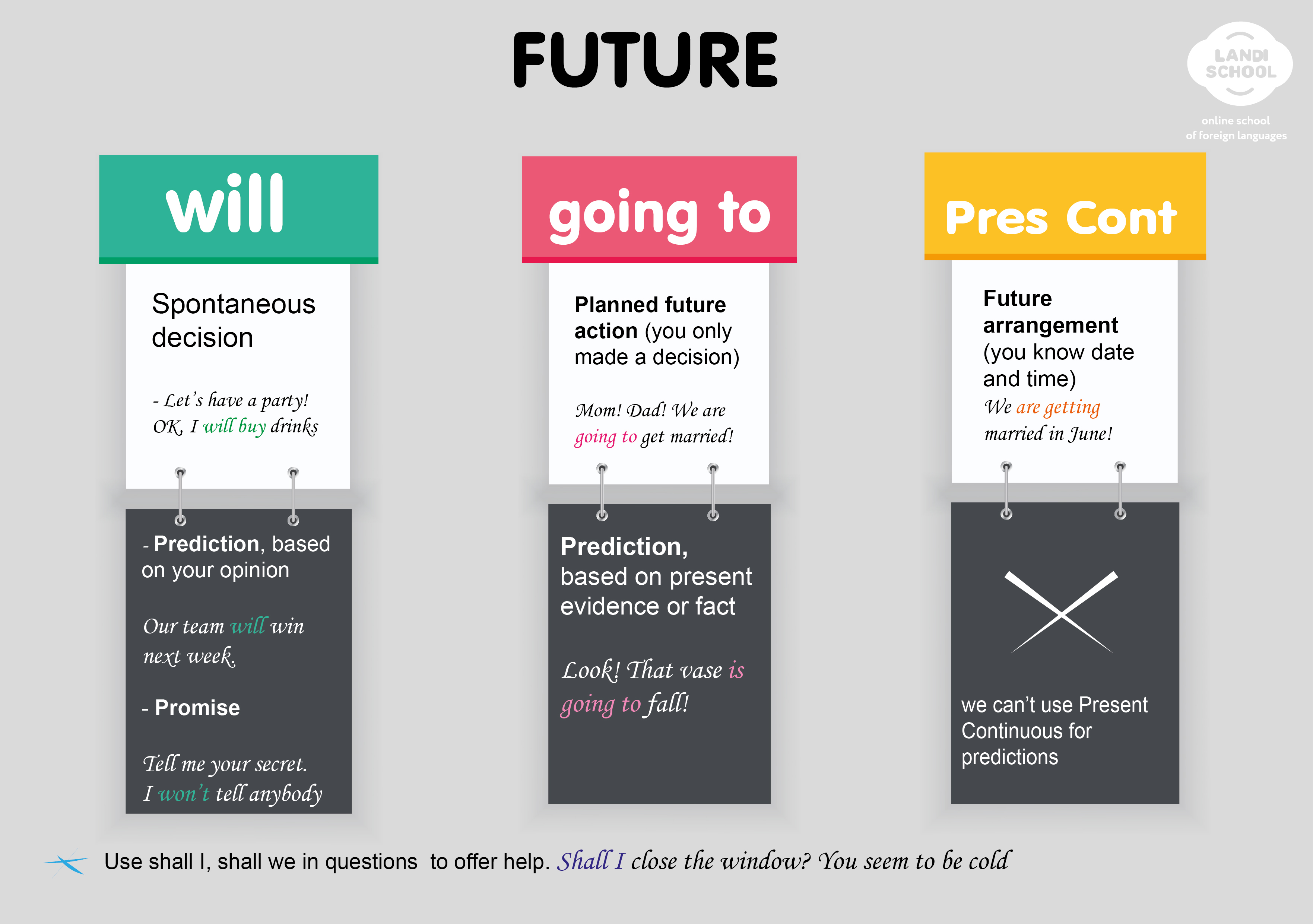
As you can see, the choice depends on whether you are making a prediction, stating an intention, or confirming a fixed arrangement. Understanding this difference will make your speaking much more precise and natural.
2. Choosing the Right Future Form: A Scale of Certainty
Think of your future plans on a scale from uncertain to very certain. This will help you choose the right structure.
- Low Certainty (or a spontaneous decision): Use 'will'.
- Medium Certainty (an intention or plan): Use 'be going to'.
- High Certainty (a fixed arrangement): Use the Present Continuous.
This video provides a very clear explanation of this concept with practical examples.
FUTURE PLANS and ARRANGEMENTS | Common mistakes in English
This video from ANGLOPOD explains the difference between these future forms very clearly. It focuses on how certain your plan is, which is a great way to remember the rule.
Watch from 01:00 to 04:16. Pay attention to the speaker's explanation of: 'Going to' for intentions (you have decided, but not arranged the details). Present Continuous for arrangements (it's in your calendar, you've spoken to someone). 'Will' for less certain plans or possibilities ('maybe I will...').
Let's summarize what you saw in the video in a table that is useful for your work as a technical consultant.
| Future Form | Use in a Professional Context | Example | Certainty |
|---|---|---|---|
| will + verb | Predictions, spontaneous decisions, promises, or uncertain plans. | "I think this update will solve the problem." | Low/Medium |
| be going to + verb | Intentions; things you have decided to do. | "I am going to test the new software this afternoon." | Medium |
| be + verb-ing | Fixed arrangements with a specific time or people involved. | "I am meeting the client at 10 AM tomorrow." | High |
Test your understanding!
Your manager asks about your plans for next week. Choose the best future form for each situation.
- You have a meeting with the support team in your calendar for Tuesday at 9 AM. You say: "I _____ (meet) the support team on Tuesday."
- You have decided you need to update the server documentation, but you haven't scheduled a time yet. You say: "I _____ (update) the server documentation soon."
- Your manager asks if the new feature will be popular. You think it will be, but you are not 100% sure. You say: "I think it _____ (be) popular."
Show answer
- am meeting (This is a fixed arrangement.)
- am going to update (This is your intention/plan.)
- will be (This is a prediction.)
3. Sounding Natural in Professional Conversations
In addition to certainty, the choice of future form also affects how formal you sound. This is very important for spoken English in meetings. In many situations, using the present continuous for future plans sounds more natural and less robotic.
Let's look at an article that explains this idea.
Avoid the Wall of Formality With This Future Grammar
This article from All Ears English discusses how these forms are used in real conversation, especially regarding formality. This is a very useful insight for your professional speaking goal.
Read the sections 'Break down the wall of formality' and 'Takeaway'. Focus on the comparison between 'I will go...' (more formal) and 'I'm going...' (more natural for arrangements).
The key idea here is that for definite plans and arrangements, especially in conversation, native speakers often prefer the present continuous.
- Slightly formal / less common in conversation: "I will meet my manager tomorrow."
- Natural / common in conversation: "I am meeting my manager tomorrow."
Using the present continuous for your scheduled tasks will help you sound more confident and fluent in team discussions.
4. Practice Speaking: Your Plans for the Week
Now it's time to practice speaking. This is the most important step to build your confidence. Think about your real work schedule for tomorrow and the rest of this week.
Try to say three sentences aloud about your plans. Use a different future form for each one.
-
An arrangement (Present Continuous): Talk about a meeting or task that is already in your calendar.
- Example: "Tomorrow morning, I'm joining the team's daily stand-up call at 9:30."
-
An intention (Going to): Talk about a task you plan to do, but maybe haven't scheduled a precise time for.
- Example: "After the call, I'm going to work on the bug report for the client."
-
A prediction or possibility (Will): Talk about something you think might happen.
- Example: "I think the client will be happy with the fix."
Try saying your three sentences now. The more you practice with your own real-life examples, the more natural it will become.
Conclusion
Great job today! You have now learned how to talk about the future with more precision, which is essential for giving clear updates and discussing plans with your colleagues.
Key Takeaways:
- Use Present Continuous (
am/is/are + verb-ing) for fixed, scheduled arrangements. This often sounds most natural in conversation. - Use 'going to' for intentions—plans you have made in your mind but haven't fully arranged.
- Use 'will' for predictions, promises, or decisions you make at the moment of speaking.
- Choosing the right form depends on how certain your plan is.
Preview of the Next Lesson
We've covered the past, present, and future. In the next lesson, we will focus on another important part of grammar for professional communication: using modal verbs (can, could, should) for polite requests, suggestions, and advice. You already got a small preview today, as 'will' is also a modal verb! This will further help you navigate team discussions effectively.