Hello! Welcome to your next lesson in our grammar module.
In our last session, we focused on expressing future plans using 'will', 'going to', and the present continuous. This allows you to clearly communicate "what's next." You might remember we mentioned that 'will' is a type of 'modal verb'. Today, we're going to explore more of these important verbs.
The learning outcome for this lesson is to use the modal verbs 'can', 'could', and 'should' for polite requests, suggestions, and advice. Mastering this is essential for effective and respectful communication in a professional environment like yours, especially during team meetings and technical discussions.
1. What are Modal Verbs?
Modal verbs are "helping" verbs that we use with a main verb to express ideas like ability, permission, advice, or possibility. They are crucial for sounding polite and professional.
Take a quick look at this chart. It gives a great overview of different modal verbs and their functions. We will focus on the ones used for permission, advice, and polite requests.
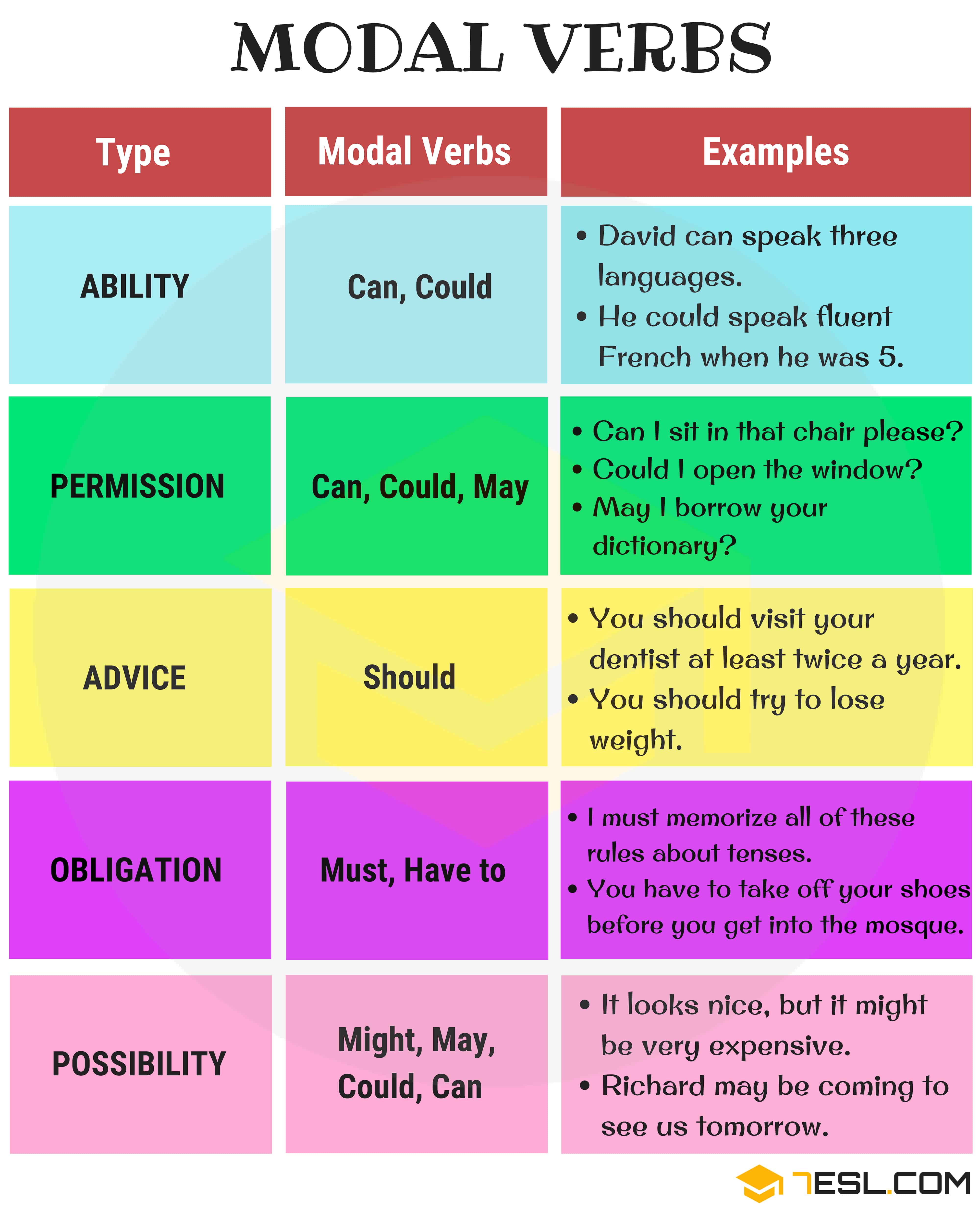
2. Making Polite Requests: Can vs. Could
In your work, you often need to ask colleagues or clients for information or action. Saying "Send me the file" is too direct and can sound rude. Using modal verbs makes your request polite.
The most common modals for requests are can and could.
Can you...?is generally used for informal or casual requests.Could you...?is more polite and is the better choice for most professional situations, whether you're speaking to a manager, a client, or a colleague you don't know well.
This video gives excellent examples and explains the difference in tone.
8 Expert Ways To Use Could In English – Starting Today
The video '8 Expert Ways To Use Could In English' clearly explains why 'could' is often a better choice than 'can' in professional settings. It will help you sound more polite and build better relationships at work.
Watch the section from 01:08 to 02:31. Notice how the speaker describes 'could' as 'softer' and 'more polite', which is ideal for your work environment.
As the video explained, adding "please" makes the request even more polite.
Structure: Could you please + [base form of verb]...?
Examples for your work:
-
Instead of: "Send me the system logs."
-
Say: "Could you please send me the system logs?"
-
Instead of: "Give me an update."
-
Say: "Could you give me an update on the project, please?"
Test your understanding!
Imagine you need your manager to approve your report. How would you ask?
Choose the most appropriate and polite option for a professional setting.
A) "Approve my report."
B) "Can you approve my report?"
C) "Could you please approve my report when you have a moment?"
Show answer
C) "Could you please approve my report when you have a moment?" is the best choice. It is polite, respectful of your manager's time, and uses the professional structure we've just discussed.
3. Giving Suggestions and Advice: Should vs. Could
As a technical consultant, you also need to provide solutions and recommendations. The way you phrase your advice can change how it is received.
-
Use
shouldfor direct advice. It implies that you believe this is the best or correct course of action. It can sound strong.- Example: "The client should restart their system. It's the standard procedure."
-
Use
couldto offer a suggestion. It's a softer, more collaborative way to introduce an idea. It sounds less like a command and more like an option to explore. This is often very effective in team discussions.- Example: "We could check the network connection first. That might be the issue."
This next video explains this important difference.
8 Expert Ways To Use Could In English – Starting Today
Let's return to the '8 Expert Ways To Use Could In English' video. This section focuses on using 'could' to offer suggestions in a way that is open and not 'pushy'.
Watch the clip from 03:53 to 04:58. Pay attention to how using 'could' instead of 'should' makes the suggestion feel more like a collaborative idea rather than a direct instruction.
Let's look at this in a technical context.
| Situation | Direct Advice with should |
Softer Suggestion with could |
|---|---|---|
| A program is not working. | "You should reinstall the software." | "You could try reinstalling the software." |
| A project is behind schedule. | "We should ask for more time." | "Perhaps we could ask for more time." |
| A client is confused. | "You should read the user manual." | "You could look at section 3 of the user manual." |
Notice how the sentences with could sound more like helpful ideas, while the sentences with should sound more like firm instructions. Both are useful, but the context determines which is better.
4. Practice Speaking: Scenarios for a Technical Consultant
Now, let's put this all into practice. It's very important to say these phrases out loud to build your speaking confidence.
Read the following scenarios. First, read the "direct" statement. Then, read the "polite" version aloud. Feel the difference in tone.
Scenario 1: You are on a call with a client who is having a technical issue.
-
Direct: "I need the error code."
-
Polite Request: "Could you tell me the error code, please?" (Say this aloud now.)
-
Direct: "Try rebooting the machine."
-
Polite Suggestion: "We could try rebooting the machine to see if that helps." (Say this aloud now.)
Scenario 2: You are in a team meeting discussing a problem.
-
Direct: "We must finish this by Friday."
-
Polite Advice: "I think we should aim to finish this by Friday." (Say this aloud now.)
-
Direct: "Check the database."
-
Polite Suggestion: "Could we check the database for any issues?" (Say this aloud now.)
To help you with more examples and practice, this resource offers role-play scenarios that are very relevant to your work.
Topic 1.9.2 Modal Verbs - Polite requests, suggestions ...
The webpage 'Modal Verbs - Polite requests, suggestions...' provides excellent practice scenarios. We will focus on the one for technical support.
Look at the section titled '4. Modal verbs and customer service'. Find 'Scenario 6: Providing Technical Support'. Think about how you would use 'could' and 'should' in that situation. For example: 'Could you please describe the problem?' or 'You should try clearing your browser's cache.'
Conclusion
Well done! Today you've learned a very important skill for professional communication. Using modal verbs correctly will help you sound more polite, collaborative, and confident.
Key Takeaways:
- For polite and professional requests, use
Could you...?. It is more formal thanCan you...?. - For giving direct advice or stating what you think is the best action, use
should. - For offering softer, more collaborative ideas or possibilities, use
could. - Always remember to practice saying these phrases aloud to make them a natural part of your spoken English.
Preview of the Next Lesson:
Now that you can form sentences about the past, present, and future, and make them polite with modals, our next step is to connect your ideas. In the next lesson, we will learn how to use conjunctions like 'and', 'but', 'so', and 'because' to build more complex sentences and explain your reasoning clearly.