Hello! Welcome to the first lesson of our second module, "Essential Grammar for Spoken Clarity."
In the last module, we built a strong foundation for clear pronunciation by mastering stress and intonation. You learned how to use the "music" of English to sound confident and clear. Now, we'll shift our focus from how you say things to what you say.
Today’s learning outcome is to form present simple and continuous sentences to describe roles and ongoing projects. This is a fundamental grammar point that is essential for your goal of giving clear updates in professional meetings. By the end of this lesson, you will be able to distinguish between these two tenses and use them correctly to talk about your job.
1. The Present Simple: Describing Your Role and Routines
We use the Present Simple tense to talk about facts, general truths, habits, and permanent situations. This makes it the perfect tense for describing:
- Your job title (
I am a consultant.) - Your employer (
I work for a tech company.) - Your main responsibilities and regular tasks (
I manage network security.)
Let's start by watching a video that provides the essential phrases for talking about your job and highlights some common grammatical mistakes to avoid.
How to Talk About Your Job in English | Complete Guide with Examples & Practice
This video from Talk English is a complete guide to discussing your job. It clearly explains the basic questions and answers, and points out critical grammar rules that many learners miss.
Please watch the following sections: 01:32 - 03:37: Learn the most common way to ask and answer about someone's job. 04:35 - 05:35: Focus on the correct prepositions to use when talking about your workplace (at, in, for). 05:35 - 07:12: Learn phrases to describe your daily responsibilities. 13:44 - 16:33: This is very important. Pay close attention to the common mistakes, especially the use of articles (a/an) and the prepositions for your workplace.
Forming the Present Simple
As you saw in the video, the structure is straightforward.
| Form | Structure | Example |
|---|---|---|
| Positive | I/You/We/They + verb He/She/It + verb-s |
I work in tech. She manages the team. |
| Negative | I/You/We/They + do not (don't) + verb He/She/It + does not (doesn't) + verb |
You don't need a password. He doesn't work on weekends. |
| Question | Do + I/you/we/they + verb...? Does + he/she/it + verb...? |
Do you work from home? Does it run on batteries? |
Notice the -s on the verb for he, she, and it in positive sentences. This is a very common error for learners, so it's important to practice!
2. The Present Continuous: Describing Ongoing Projects
We use the Present Continuous tense (also called Present Progressive) to talk about actions that are happening right now or temporary situations happening around the present time. This is perfect for describing:
- What you are doing at this moment (
I am troubleshooting a client's issue.) - Current projects with a beginning and an end (
This month, we are installing a new system.)
The following reading provides clear examples and practice exercises tailored to your IT background.
This grammar guide, 'ENGLISH GRAMMAR FOR IT', uses vocabulary and examples directly from the technology field, which will be very helpful for you.
Please read Unit 3: Present Continuous, from the start of the unit up to (but not including) section 3.3 'Present Continuous Questions'. Focus on the examples like, 'I am installing the software' and 'He is setting up a network.'
Forming the Present Continuous
This tense is formed with the verb 'to be' (am, is, are) + the -ing form of the main verb.
| Form | Structure | Example |
|---|---|---|
| Positive | I + am + verb-ing He/She/It + is + verb-ing You/We/They + are + verb-ing |
I am updating the software. It is running a check-up. We are working on a new project. |
| Negative | Subject + be + not + verb-ing | She is not (isn't) working today. |
| Question | Be + subject + verb-ing...? | Are you installing the new driver? |
3. Putting It All Together: Role vs. Project
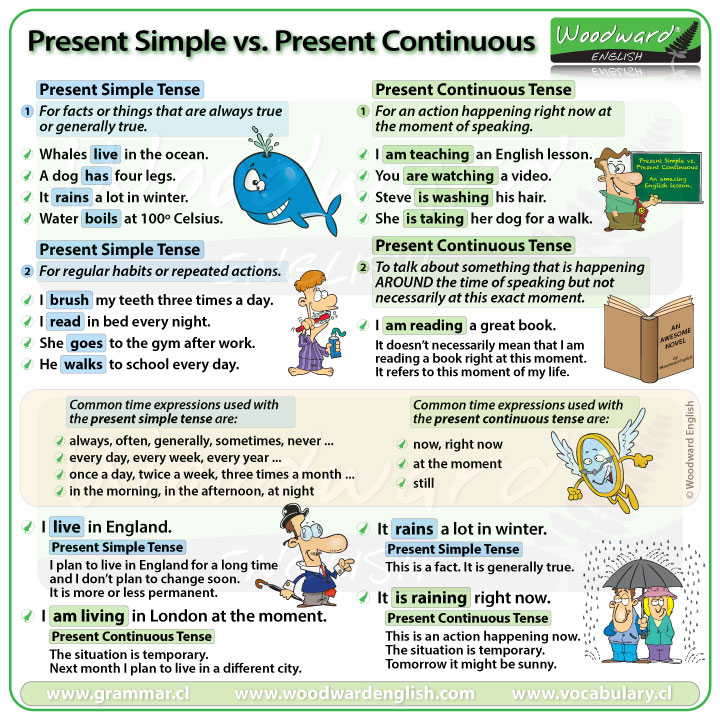
The most important skill is knowing when to use each tense. Think of it this way:
- Present Simple = Permanent. Your job, your responsibilities, what your company does.
- Present Continuous = Temporary. Your current project, what you are doing this week, what is happening right now.
This infographic provides a great visual summary of the key differences.
Let's look at some examples from your field:
- "I work as a SAT technic consultant." (Present Simple: This is your permanent role).
- "I am working on an installation in Riyadh this week." (Present Continuous: This is a temporary, ongoing project).
- "My company provides technical support." (Present Simple: This is what the company always does).
- "My company is providing extra support during the system migration." (Present Continuous: This is for a limited, temporary period).
Test your understanding!
Complete the following sentences with the correct form of the verb in parentheses: Present Simple or Present Continuous.
- I usually ___________ (work) from the main office, but this month I ___________ (travel) to different client sites.
- The server ___________ (not respond) right now. I think they ___________ (do) maintenance.
- She ___________ (manage) the IT department.
- What project ___________ you ___________ (work) on at the moment?
- A desktop PC ___________ (have) its own processing unit, monitor, and keyboard.
Show answer
- I usually work (Present Simple for a routine) from the main office, but this month I am traveling (Present Continuous for a temporary situation) to different client sites.
- The server is not responding (Present Continuous for "right now") right now. I think they are doing (Present Continuous for a current action) maintenance.
- She manages (Present Simple for a permanent role/responsibility) the IT department.
- What project are you working (Present Continuous for "at the moment") on at the moment?
- A desktop PC has (Present Simple for a fact/definition) its own processing unit, monitor, and keyboard.
Conclusion
Great job today! You've tackled two of the most fundamental tenses in English and learned how to apply them directly to your professional life.
Key Takeaways:
- Use the Present Simple to describe your job, your company, and your regular responsibilities (permanent facts and routines).
- Use the Present Continuous to describe what you are doing now or temporary projects you are involved in (actions in progress).
- Pay close attention to the small grammar rules: the -s for he/she/it in the present simple, and the verb 'to be' (am/is/are) in the present continuous.
Preview of the Next Lesson
Now that you can talk about what you do regularly and what you are doing now, the next logical step is to talk about what you have already finished. In our next lesson, we will focus on how to use the past simple tense to report on completed tasks and results.