¡Hola! Welcome to our final lesson in the "Communicating About School" module.
In our last session, you did a fantastic job learning how to pick out keywords from a teacher's update. You might have noticed that some of those updates could be about places, for instance, a field trip al parque (to the park). Today, we'll build on that by learning how to name common places in the neighborhood, such as the park (parque), school (escuela), and store (tienda).
Being able to point out and name these places is a wonderful way to build conversations with your son as you walk or drive around your community.
1. The Most Important Places: School, Park, and Store
Let's start with the three most essential places for your daily life. Notice how each word uses either el (masculine) or la (feminine), which you'll remember from our first module.
la escuela(lah ess-KWEH-lah) - the schoolel parque(el PAR-keh) - the parkla tienda(lah tee-EN-dah) - the store / the shop
This vocabulary chart is a great way to see these words, plus a few others, in a visual context.
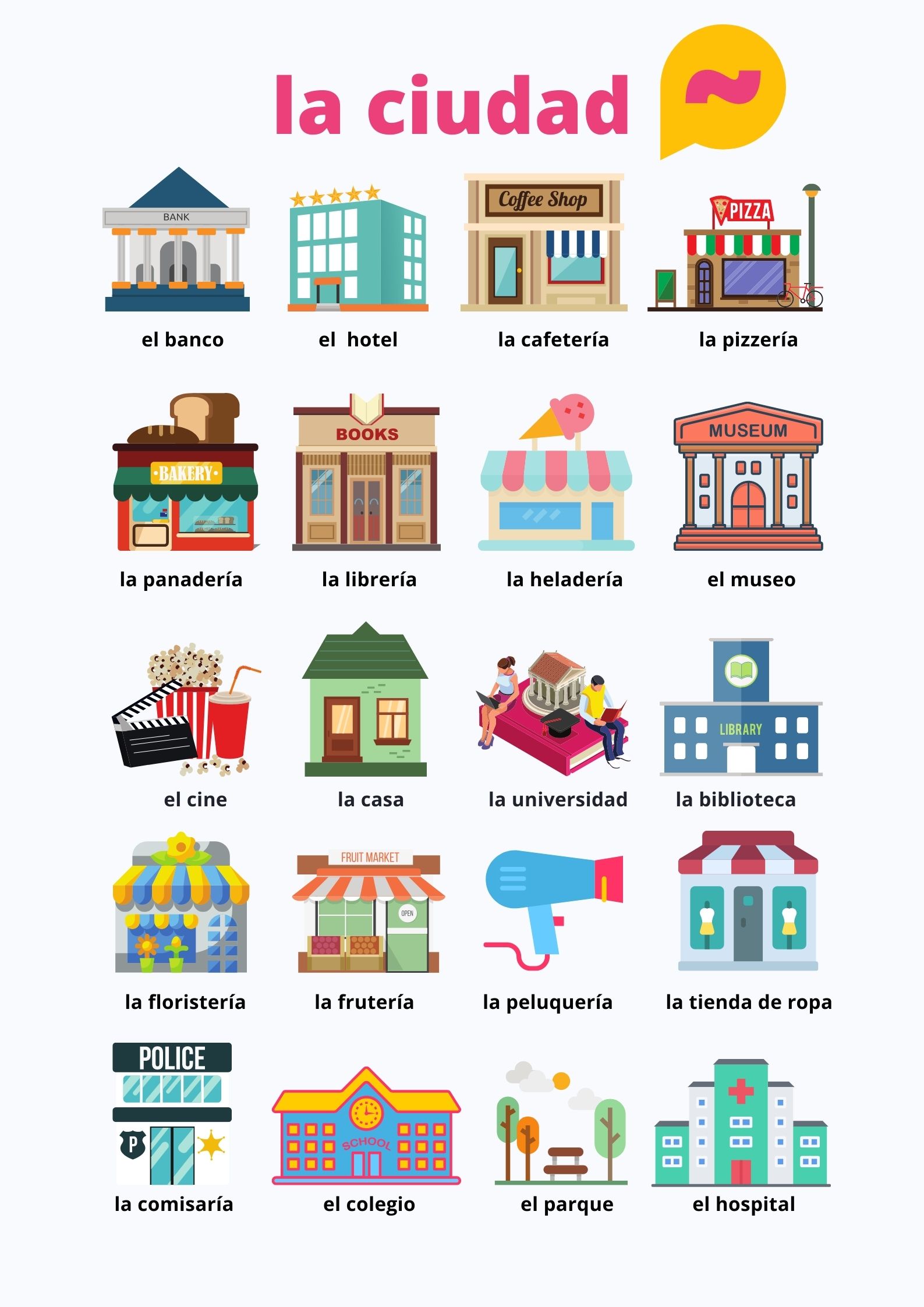
Now, let's get the pronunciation right. Listening to a native speaker is the best way to do this.
Spanish Vocabulary: Public Places!
Please watch the beginning of this short video from the 7 Minute Language School. It will help you hear the correct pronunciation for 'la escuela' and 'el parque'.
Watch from the beginning (00:02) until 01:07. Listen carefully and try to repeat the words 'la escuela' and 'el parque' out loud.
2. Expanding Your Neighborhood Vocabulary
Beyond the school and park, you'll often visit different kinds of shops or stores. The general word is la tienda, but Spanish also has specific names for different types of stores. Knowing a few of these will be very useful.
A great resource for this is the article "Buildings, places and locations in Spanish" from Berlitz. It has extensive lists, but we'll focus on the most practical ones for you.
Buildings, places and locations in Spanish: A nifty guide
This guide contains vocabulary for all sorts of locations. We will focus on the section for shops, which is very relevant for talking about your neighborhood.
Please find the section titled 'Vocabulary for shops in Spanish' and review the table under the subheading 'Tiendas (shops)'. Focus on these words, which will be very useful when talking with your son: El supermercado (supermarket) La panadería (bakery) La librería (bookstore) La juguetería (toy store)
Here is a summary of those very useful words:
el supermercado: the supermarketla panadería: the bakery (frompan- bread)la librería: the bookstore (fromlibro- book)la juguetería: the toy store (fromjuguete- toy)
Test your understanding!
Imagine you and your son are walking, and he wants a new toy. Which place would you suggest going to?
a) La panadería
b) La juguetería
c) La librería
Show answer
The correct answer is b) La juguetería (the toy store).
3. Using Place Names in Simple Phrases
Now, let's put these words into action with phrases you can use immediately.
Saying "Let's go to..."
In a previous module, you learned vamos a + verb (let's go + do something). You can use the same structure for places: vamos a + [place].
There's one small rule to remember:
- When "to the" is a masculine place (
el),a + elcombines to becomeal.Vamos **al** parque.(Let's go to the park.)Vamos **al** supermercado.(Let's go to the supermarket.)
- When "to the" is a feminine place (
la), it stays asa la.Vamos **a la** escuela.(Let's go to the school.)Vamos **a la** tienda.(Let's go to the store.)
Saying "There is / There are..."
A very useful word for pointing things out is hay (sounds like "eye"), which means "there is" or "there are".
This article from Latinele provides a clean list of places and explains how to use the word 'hay' to talk about their existence.
Please read the short sections 'Vocabulary of Places in the City' and 'Using Ser, Estar and Haber'. Pay special attention to the explanation of 'Haber', which introduces the word 'hay'.
You could use it like this:
Mira, ¡**hay** un parque!(Look, there's a park!)Allí **hay** una tienda.(Over there, there is a store.)
Test your understanding!
How would you say "Let's go to the toy store" in Spanish?
Show answer
You would say: Vamos a la juguetería. (We use a la because juguetería is a feminine noun).
Conclusion
¡Excelente! You've now learned the names of key places in your neighborhood and, more importantly, how to use them in simple, practical phrases. This is a big step towards being able to narrate your daily activities with your son.
Key Takeaways:
- Core Vocabulary: You can now name the
escuela, theparque, and thetienda. - Useful Shops: You also learned words for specific, relevant stores like
el supermercadoandla juguetería. - Practical Phrases: You can now suggest where to go using
Vamos al...andVamos a la..., and point things out withHay....
This lesson concludes our module on communicating about school. You've covered everything from polite greetings with teachers to talking about the places that make up your son's daily world.
Preview of the Next Lesson:
We are now moving to our final module, "Putting It All Together: Simple Conversations." In our next lesson, you will learn to ask ¿Qué estás haciendo? (What are you doing?). This is the perfect question to ask once you arrive at the park! You could say: Estamos en el parque. ¿Qué estás haciendo? (We are at the park. What are you doing?).
¡Nos vemos en la próxima lección! (See you in the next lesson!)