¡Hola! Welcome back.
In our last lesson, you learned how to have polite, brief conversations with your son's teachers using formal greetings and farewells. That was an important first step in building a good relationship with the school.
Today, we will go a step further. This lesson is designed to help you understand the gist of simple teacher updates about homework or events. You won't need to understand every single word. The goal is to learn to listen for key words and phrases that give you the main idea of what the teacher is communicating about your son's day. This will make you feel much more connected to his school experience.
1. Decoding Teacher Feedback: Keywords for Your Son's Day
Often, a teacher's update will be a quick comment about your son's behavior or activities. They might start with phrases like:
Hoy, su hijo...(Today, your son...)Quería comentarle sobre [Son's Name]...(I wanted to tell you about [Son's Name]...)
Your job is to listen for the descriptive words that follow. Let's build a small vocabulary for this.
Tips for Communicating with Parents
This article, written for teachers, contains excellent vocabulary for describing students. We will look at the 'Praise' and 'Problems' sections to learn the words you are most likely to hear.
Please review the tables under the headings 'Problems' and 'Praise'. You don't need to memorize every word, but try to recognize a few positive and a few 'needs-attention' words.
From that reading, here are some key words to listen for:
Positive Feedback:
creativo(creative)amable(kind)servicial/atento(helpful)inteligente(intelligent)
Needs-Attention Feedback:
distraído(distracted)callado(quiet)tímido(shy)hablador(talkative)
Let's see this in a realistic context. The same article provides a sample conversation. Notice how the teacher mixes feedback.
Tips for Communicating with Parents
Now, let's see how these words are used in a sample parent-teacher conversation from the same resource.
Read the short dialogue under 'Phrases in Use'. Pay attention to the teacher's (Manuel Silva's) description of Juan: 'Juan a menudo está distraído en clase. Pero también es muy creativo...'
The teacher says the student is often distraído (distracted) but also very creativo (creative). By catching just those two keywords, you get the full picture of the update.
2. The Homework Update: La Tarea
One of the most common topics is homework. The main keyword to listen for is la tarea (lah tah-REH-ah) or sometimes los deberes.
This next video includes many phrases a teacher might use. We'll focus on the ones about homework.
40 Classroom Spanish Sentences | Spanish Speaking Practice!
This video runs through common classroom sentences. Listening to them will help you recognize the rhythm and keywords when a teacher speaks.
Watch the segment from 03:20 to 05:00. Listen for the phrase 'tenemos tarea hoy' (we have homework today) and other words you've learned like 'libro' (book) and 'página' (page).
Here are some ways you might hear about homework:
Hay tarea en la mochila.(There is homework in the backpack.)Hoy tienen tarea de matemáticas.(Today they have math homework.)No se olvide de la tarea, por favor.(Don't forget the homework, please.)
You might also hear about school subjects. The article "Tips for Communicating with Parents" has a useful list under the "School-Specific Vocabulary" section. For a 3-year-old, you are most likely to hear about plástica (art) and música (music).
3. Understanding School Events: Fiestas and Excursiones
Sometimes the update will be about an upcoming event, like a party (fiesta), a field trip (excursión), or a celebration (celebración).
Often, schools send notes home for these events. Looking at an example can help you know what information to listen for.

When a teacher tells you about an event, listen for these keywords from the form:
Qué(What): The name of the event (e.g.,Fiesta de Primavera).Cuándo(When): The date and time (e.g.,mañana a las diez- tomorrow at 10).A dónde(Where): The location (e.g.,en el parque- at the park).
Example: "Mañana tenemos la fiesta de primavera en el patio a las once." (Tomorrow we have the spring party in the playground at eleven.)
If you just catch the highlighted words, you have the gist!
4. Your Survival Toolkit: When You Don't Understand
It is perfectly normal not to understand everything. The most important skill is knowing how to ask for help politely.
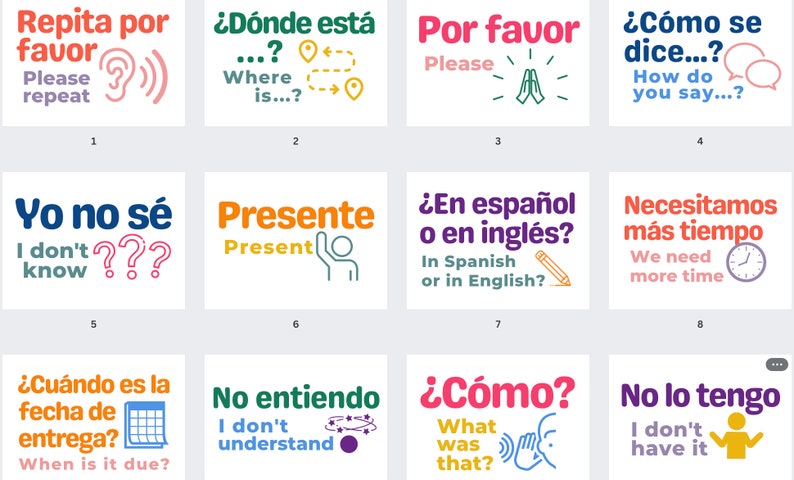
Here are your essential phrases:
No entiendo.(I don't understand.)Más despacio, por favor.(Slower, please.)¿Puede repetir, por favor?(Can you repeat, please?)No hablo mucho español.(I don't speak much Spanish.)
Don't be afraid to use these! It shows you are trying to understand and invites the teacher to simplify their language.
Test your understanding!
A teacher is speaking to you very quickly. You want her to say it again, but slower. What two phrases could you combine?
Show answer
You could say: No entiendo. ¿Puede repetir, más despacio, por favor? (I don't understand. Can you repeat, slower, please?)
Conclusion
¡Buen trabajo! You now have a strategy for understanding the main points of a teacher's update. Instead of trying to translate every word, you can listen for specific keywords that give you the information you need.
Key Takeaways:
- Listen for descriptive words to understand feedback about your son (e.g.,
creativo,distraído). - The keyword for homework is
la tarea. - For events, listen for words like
fiestaorexcursiónand details aboutqué,cuándo, anddónde. - Use your "survival phrases" like
No entiendoandMás despacio, por favorwhenever you need them.
In our next lesson, we will begin the final module of the course, "Putting It All Together." We'll learn how to ask "what are you doing?" (¿qué estás haciendo?) and describe ongoing actions. This will be a wonderful tool for interacting with your son as you play or go about your day together.
¡Hasta la próxima