¡Hola! Welcome back.
In our last lesson, we focused on how to connect with your son by asking him about his day at school with phrases like ¿qué hiciste hoy? and ¿te divertiste?. This is a fantastic way to build your Spanish conversation skills within your family.
Today, we'll shift our focus from talking with your son to talking with his teachers. The goal is to equip you with the polite phrases you'll need for greetings and showing appreciation during those brief but important interactions at school drop-off and pick-up. This will help you feel more confident and respectful when you meet the people who are a big part of your son's new world.
1. The Foundation of Politeness: Tú vs. Usted
The most important concept for today's lesson is understanding the difference between the informal "you" (tú) and the formal "you" (usted).
Túis informal. You use it with friends, family, and children. You've been using it implicitly when learning phrases for your son. For example,¿Cómo estás?Usted(often abbreviated asUd.) is formal. You use it to show respect to elders, professionals (like teachers or doctors), and people you don't know well.
When speaking to your son's teacher, you will always use usted. This small change signals respect and politeness.
To understand this crucial difference, please read the first part of the following article.
Expressions of courtesy: How to be polite in Spanish
The article 'Expressions of courtesy' from Baselang clearly explains the difference between the informal 'tú' and the formal 'usted'. This is the cornerstone of being polite in Spanish.
Please read the section titled '“You” polite in Spanish'. Focus on the main rule: use 'tú' for family and friends, and 'usted' for teachers and professionals.
A key practical point from the reading is that verbs change depending on whether you use tú or usted. For example, the question ¿Cómo estás? (How are you?) becomes ¿Cómo está usted? or more commonly, just ¿Cómo está? when speaking formally.
Let's hear this difference.
In this clip from 'The Language Tutor', you'll hear the pronunciation and context for both the informal '¿Cómo estás?' and the formal '¿Cómo está?'.
Watch from 05:42 to 06:17. Pay close attention to how the speaker explains when to use the more respectful form, '¿Cómo está?'.
2. Polite Greetings for Teachers
When you see your son's teacher, you'll want to start with a polite, time-appropriate greeting.
The most common and appropriate greetings are:
Buenos días(Good morning)Buenas tardes(Good afternoon)Buenas noches(Good evening/night)
You can combine these with the teacher's title:
Profesor(male teacher, pronounced pro-feh-SOR)Profesora(female teacher, pronounced pro-feh-SO-ra)
So, a perfect morning greeting would be: Buenos días, profesora.
If you are meeting a teacher for the first time, you can add Mucho gusto (Nice to meet you).
Example:
- You:
Buenos días, profesora. Soy el papá de [Son's Name]. Mucho gusto.
(Good morning, teacher. I am [Son's Name]'s father. Nice to meet you.)
Test your understanding!
It's 3 PM and you are picking your son up from school. You see his male teacher. How would you greet him?
Show answer
Buenas tardes, profesor.
3. Showing Gratitude: More Than Just Gracias
Saying "thank you" is a universal sign of courtesy. The basic phrases you've learned, gracias (thank you) and muchas gracias (thank you very much), are always great to use.
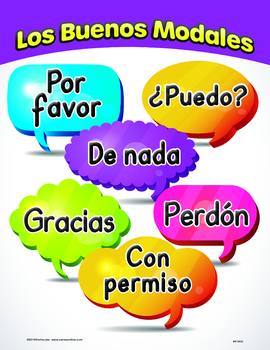
To show a deeper level of appreciation, especially if a teacher has been particularly helpful, you can use a more formal phrase.
25 Polite Sentences in Spanish: Elevate your Spanish and speak respectfully!
The Butterfly Spanish channel offers excellent phrases for real-life situations. In this clip, you'll learn a very polite and heartfelt way to express gratitude.
Watch from 10:09 to 11:00. Focus on the phrase 'Le agradezco mucho' (I am very grateful to you). The 'le' in this phrase is the formal 'you' that refers to 'usted'.
The key phrase here is Le agradezco mucho. It's a powerful way to say "I'm very grateful to you" and is perfect for thanking a teacher for their time or help.
You can also use:
Gracias por todo.(Thanks for everything.)Gracias por su ayuda.(Thank you for your help.) - Notice the use ofsu(your, formal) instead oftu(your, informal).
4. Polite Goodbyes
When you're ready to leave, you can go beyond a simple adiós. A polite closing wishes the other person well.
Let's look at some excellent options for ending a conversation with a teacher.
Expressions of courtesy: How to be polite in Spanish
Let's return to the Baselang article, which also provides polite ways to say goodbye that use the formal 'usted'.
Read the section 'Polite expressions to say Goodbye in Spanish'. Focus on the phrases 'Que le vaya bien' and 'Que tenga un buen día'.
Here are two fantastic phrases for a polite farewell:
Que le vaya bien.(Literally "May it go well for you," used like "Take care" or "All the best.")Que tenga un buen día.(Have a good day.)
5. Putting It All Together: Sample Scenarios
Let's see how these phrases work in a couple of mini-conversations.
Scenario 1: Morning Drop-off
You: Buenos días, profesora. ¿Cómo está?
(Good morning, teacher. How are you?)
Teacher: Buenos días. Muy bien, gracias. ¿Y usted?
(Good morning. Very well, thank you. And you?)
You: Bien, gracias. Que tenga un buen día.
(Well, thank you. Have a good day.)
Teacher: Igualmente. Adiós.
(You too. Goodbye.)
Scenario 2: Afternoon Pick-up
You: Buenas tardes, profesor.
(Good afternoon, teacher.)
Teacher: Buenas tardes.
You: Gracias por todo hoy. Le agradezco mucho.
(Thanks for everything today. I'm very grateful.)
Teacher: De nada. Con gusto.
(You're welcome. With pleasure.)
You: Hasta mañana. Que le vaya bien.
(See you tomorrow. Take care.)
Conclusion
¡Excelente trabajo! You are now equipped with the essential polite phrases for interacting respectfully with your son's teachers. This not only shows good manners but also helps build a positive relationship with the school community.
Key Takeaways:
- Always use the formal
ustedform when speaking to teachers. - Start with a time-appropriate greeting like
Buenos díasorBuenas tardes. - Express thanks with
Gracias,Muchas gracias, or the more formalLe agradezco mucho. - End the conversation with a polite closing like
Que tenga un buen díaorQue le vaya bien.
In our next lesson, we'll build on this foundation. We will start to focus on how you can understand the gist of simple teacher updates, which is the next step in becoming more involved in your son's school life.
¡Hasta luego